Kids as young as 18 months old were given facial tattoos in the Nile Valley region 1,400 years ago, archaeologists discovered while studying mummified bodies in Sudan. What’s more, the practice coincided with the introduction of Christianity to the region known as Nubia.
“If the tattoos were a symbol of the wearer’s Christian faith, then it might have been important for parents to create permanent ways to mark their children as Christian,” study lead author Anne Austin, an archaeologist at the University of Missouri–St. Louis, told Live Science.
Tattooing is a long-standing human practice. Some of the oldest archaeological evidence of tattoos can be found on Ötzi the “Iceman,” whose well-preserved 5,300-year-old body discovered in the Alps was decorated with 61 of them. Other early tattoos have been found on Egyptian mummies from 5,000 years ago, Siberian mummies from 2,300 years ago, and Peruvian mummies from 1,200 years ago. All of these examples were tattoos on adults, though; tattooed children are discovered much less commonly.
In the new study, the researchers identified extensive examples of tattooing at the Christian-era site of Kulubnarti in northern Sudan. Two cemeteries at the site were in use between A.D. 650 and 1000. Using microscopy with infrared lighting, which can penetrate skin to reveal tattoos barely visible to the naked eye, the researchers identified 17 people with definite tattoos and six people with possible faded tattoos.
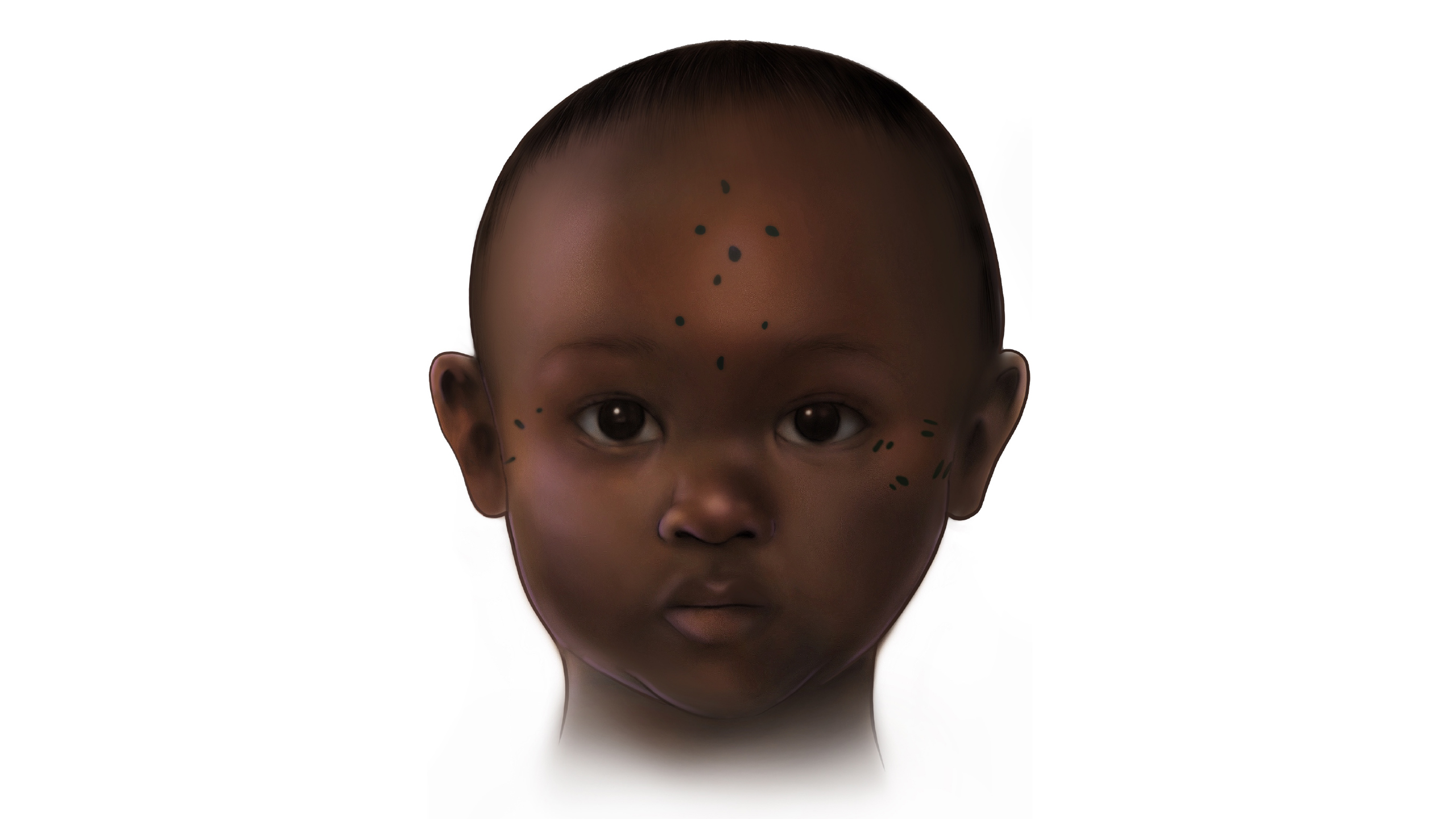
While investigating exactly where on the body the people buried at Kulubnarti sported tattoos, the researchers noticed an unusual pattern: Two people had back tattoos, but the rest had designs on their foreheads, temples, cheeks or eyebrows. Facial tattoos are already relatively uncommon in the archaeological record, but the researchers found an even rarer practice: the tattooing of children.
Most of the Kulubnarti people with tattoos were children under age 11, the researchers wrote in the study, while the youngest person with definite tattoos was 18 months old. A 3-year-old girl was even found to have had one tattoo positioned directly over another tattoo, suggesting that young children were repeatedly tattooed.
The tattoos consisted of clustered dots and dashes. The most frequent design was four dots tattooed in a diamond pattern on the person’s forehead, which could represent a Christian cross, according to Austin. “It’s entirely plausible that tattooing was part of a form of baptism if it was used as a sign of Christianity at Kulubnarti,” she said.
But the researchers are also investigating another theory for the widespread tattooing of children found in the cemetery.
“If parents tattooed their children in order to protect them or for medical reasons, then maybe the high rate of tattooing in young children shows us that people at Kulubnarti were facing unusually high amounts of health issues,” Austin said.
Forehead tattoos may represent parents’ attempts to protect their kids from headaches or high fevers, both of which are commonly experienced in bouts of malaria, a disease with a long history in the Nile Valley, according to the study.
The team also found that the Nubians likely used knives, not needles, to make the tattoos, based on the shape of the tattoo markings.
Even if the tattoos were simply decorative, Austin said, we should not be quick to judge past people for the practice.
“The form of tattooing at Kulubnarti — which could have been done fairly quickly — doesn’t seem any more extreme than piercing a toddler’s ears or circumcising newborn babies,” she said.