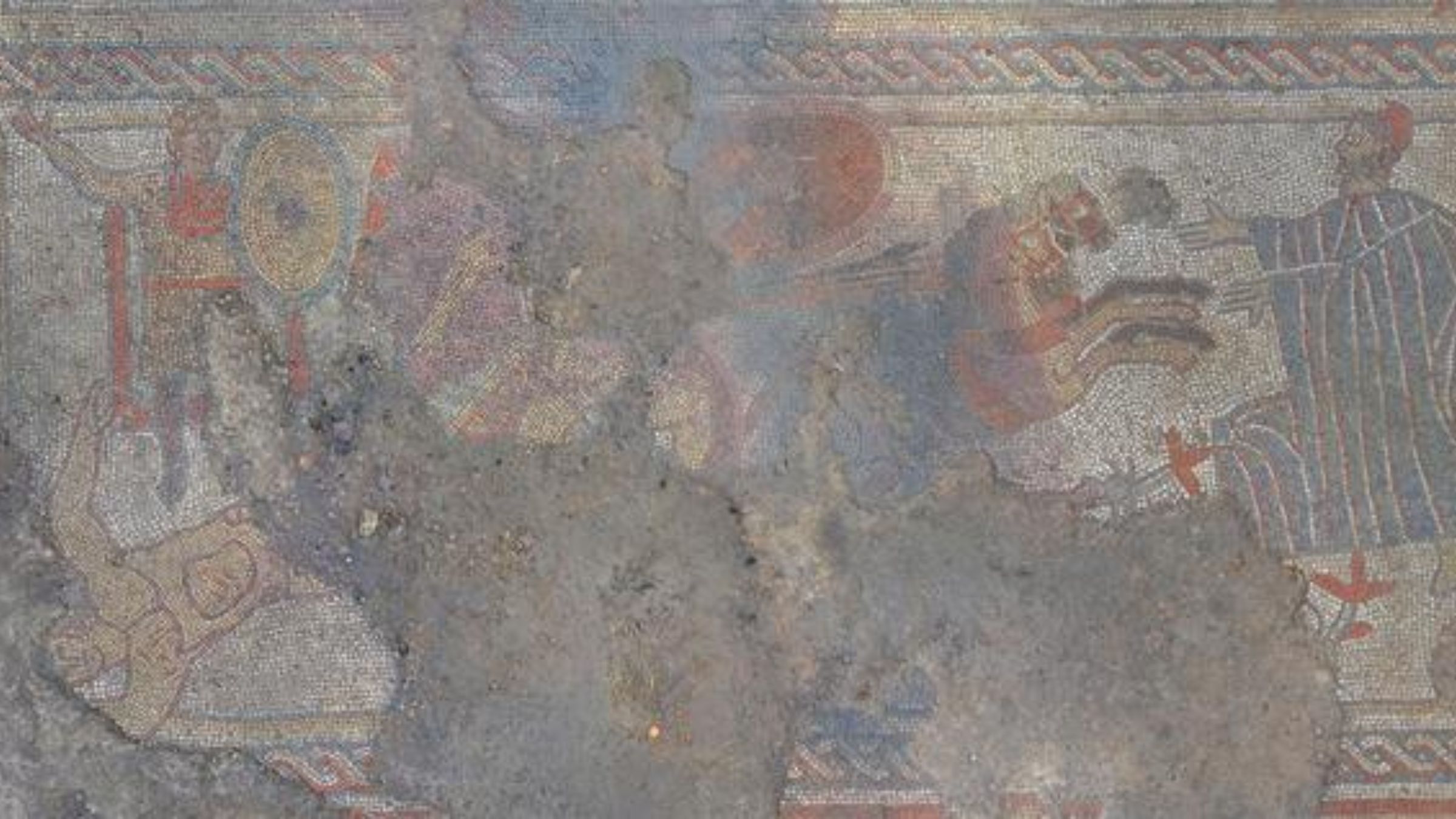
A Roman mosaic recently discovered in Britain depicts a long-lost version of the Trojan War story that differs from the most famous telling of the saga.
The artifact, known as the Ketton Mosaic, shows a key conflict during the Trojan War. But it is not based on Homer’s “Iliad,” the most enduring version of the tale, researchers reported in a new study. Instead, it was inspired by a more obscure tragedy by the Athenian playwright Aeschylus. Called “Phrygians,” it was written in the early fifth century B.C. and survives today only in fragments and analyses discussed in other ancient works.
Measuring 33 feet by 17 feet (10 by 5.3 meters), the mosaic likely covered part of the floor of a triclinium, or dining room, in a large villa. The mosaic was in use by the fourth century A.D., but preliminary work suggests the villa may have been occupied even earlier.
In Homer’s telling of the Trojan War, the Greeks spend 10 years fighting against the city of Troy, in what is now modern-day Turkey. According to the myth, Paris, a son of Troy’s King Priam, abducted the beautiful queen Helen of Sparta, and the Greeks were fighting to get her back.
The mosaic shows three scenes from the conflict between the Greek hero Achilles and the Trojan prince Hector. In the first panel, the two duel after Hector kills Patroclus, a close companion and possible lover of Achilles. In the second, Achilles drags Hector’s dead body behind his chariot. And in the third, Achilles ransoms Hector’s body to his father, Priam, for his weight in gold.
Initially, researchers thought the mosaic depicted scenes as described in Homer’s epic, the “Iliad.” But upon closer examination, study first author Jane Masseglia, a historian at the University of Leicester, found that some of the details in the mosaic were inconsistent with Homer’s version. In the new study, published Dec. 3 in the journal Britannia, Masseglia and her colleagues argue that the differences instead point to “Phrygians” as the inspiration for the imagery.
For example, in the “Iliad,” Achilles explicitly says he will not accept gold as ransom for Hector’s body. And in the mosaic, Achilles drags Hector’s body around Patroclus’ tomb, while in the “Iliad,” he drags it around the walls of Troy. Fragments of “Phrygians” and of ancient scholars’ analyses of the text, however, describe both events as they’re depicted in the Ketton Mosaic. “Phrygians” is the only known retelling of the Trojan War to describe events this way.
The art style offered further clues about the mosaic’s inspiration. “In the Ketton Mosaic, not only have we got scenes telling the Aeschylus version of the story, but the top panel is actually based on a design used on a Greek pot that dates from the time of Aeschylus, 800 years before the mosaic was laid,” Masseglia said in the statement.
Other parts of the mosaic also had designs from more ancient times, she noted.
“I found other parts of the mosaic were based on designs that we can see in much older silverware, coins and pottery, from Greece, Turkey, and Gaul,” Masseglia said.
The findings suggest close cultural relationships between Romans in Britain and the rest of the classical world, the authors wrote in the study.
“Romano-British craftspeople weren’t isolated from the rest of the ancient world, but were part of this wider network of trades passing their pattern catalogues down the generations,” Masseglia added. “At Ketton, we’ve got Roman British craftsmanship but a Mediterranean heritage of design.”