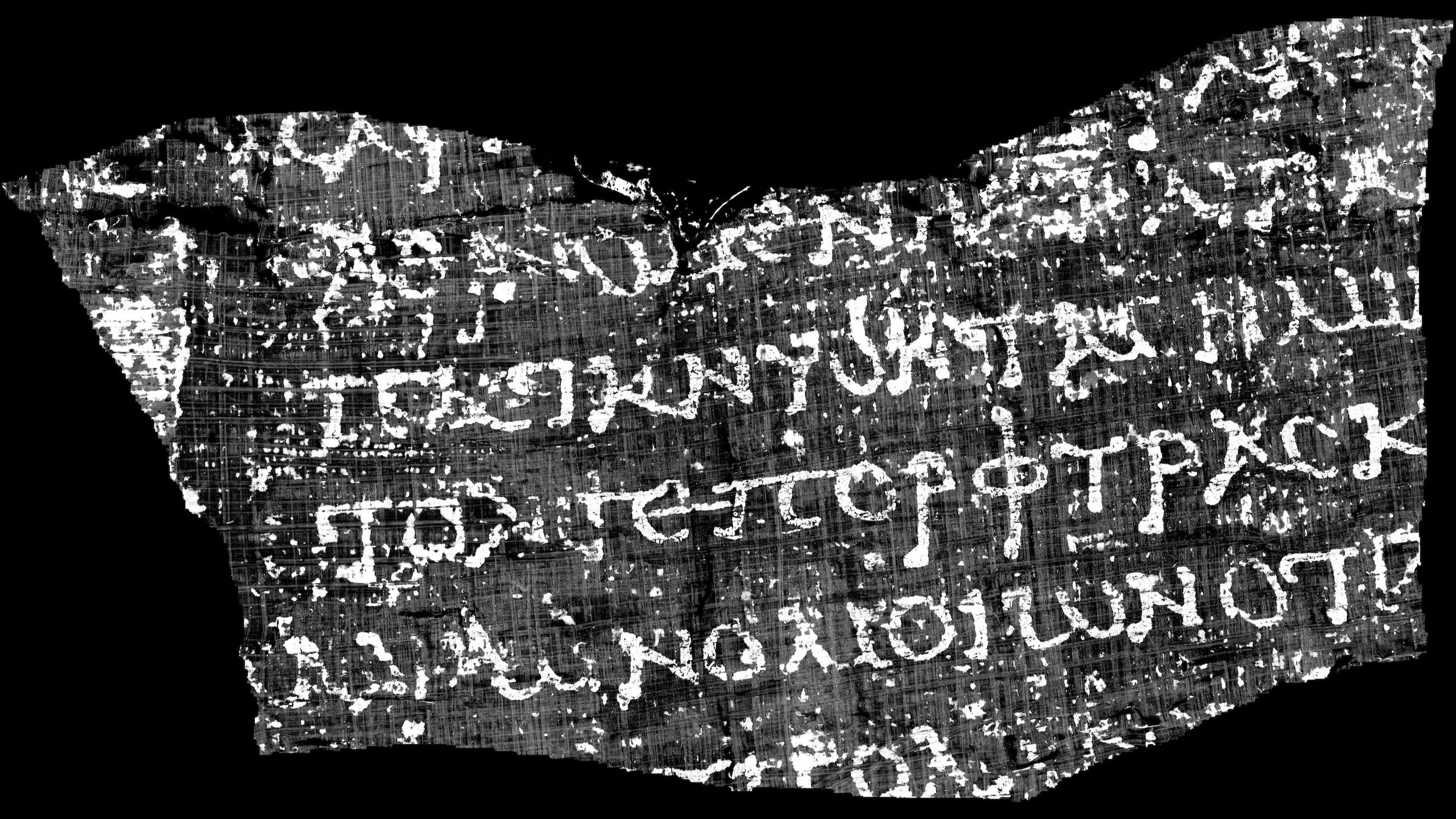
Nearly 2,000 years ago, Mount Vesuvius buried a vast collection of scrolls in ash and scorched them into solid black lumps. Now, without unrolling them, researchers have virtually read two of them — and uncovered what may be a work by a well-known Stoic philosopher.
The breakthrough comes from the Vesuvius Challenge, an international research effort to digitally read the scrolls that were preserved when Pompeii and Herculaneum were buried by ash and pumice in A.D. 79. Papyrologists, who study and preserve the ancient manuscripts, announced June 25 that they had digitally unwrapped the surviving portion of one scroll, known as PHerc. 1667, revealing roughly 5 feet (1.5 meters) of continuous Greek text across 20 columns. Researchers also recovered more than 70 columns of text from a second scroll, PHerc. 172.
“For nearly two millennia, many of these texts have been physically preserved but intellectually inaccessible,” Brent Seales, Vesuvius Challenge co-founder and a computer scientist at the University of Kentucky, said in a statement. “Today — after years of interdisciplinary work combining advanced imaging, artificial intelligence, academic research and an innovation contest — we are finally able to read them.”
Over the past few years, Seales and his team have used a synchrotron to essentially X-ray inside the scrolls and detect the ink ancient Romans used to write. The letters are then studied by papyrologists, who translate the text.
Part of PHerc. 1667 was physically opened in the 1980s, but overlapping layers obscured the writing so badly that the scroll was given a readability score of zero, Federica Nicolardi, a papyrologist at the University of Naples Federico II, said in the statement.
The handwriting and text of PHerc. 1667 suggest the scroll dates to the second or third century B.C., making it one of the oldest scrolls in the Herculaneum collection. This early date means it could not have been authored by Philodemus of Gadara, the first-century-B.C. Epicurean philosopher whose writings dominated the Herculaneum library.
Experts think the text reads more like a Stoic treatise on ethics and human behavior, and it specifically mentions Aristocreon, the nephew and pupil of the influential Stoic philosopher Chrysippus. Very little of Chrysippus’ own writing has survived, so if the attribution holds up, it would be a significant addition to the historical record of early Stoic thought.
In a separate discovery, researchers identified a new book title within scroll PHerc. 139. The end of the scroll references Philodemus’ eighth book of “On Gods.” While this treatise had previously been known to exist, the new discovery reveals the work extended across at least eight volumes. Experts plan to reexamine other texts in the Herculaneum collection for additional volumes that may belong to the same series.
More than 600 Herculaneum scrolls remain unopened. It’s thought that the villa was once owned by the father-in-law of Julius Caesar.
How much do you know about the Roman town destroyed by Mount Vesuvius? Find out by taking our Pompeii quiz!