



Cut marks on dozens of canine skeletons found at archaeological sites in Bulgaria suggest that people were eating dog meat 2,500 years ago — and not just because they had no other options.
“Dog meat was not a necessity eaten out of poverty, as these sites are rich in livestock, which was the main source of protein,” Stella Nikolova, a zooarchaeologist at the National Archaeological Institute with Museum of the Bulgarian Academy of Sciences and author of a study published in December in the International Journal of Osteoarchaeology, told Live Science. “Evidence shows that dog meat was associated with some tradition involving communal feasting.”
Although consuming dog meat — a practice sometimes called cynophagy — is considered taboo in contemporary European societies, this hasn’t always been the case. Historical accounts mention that the ancient Greeks sometimes ate dog meat, and archaeological analysis of dog skeletons from Greece has confirmed those stories.
During the Iron Age (fifth to first centuries B.C.), a cultural group known as the Thracians lived to the northeast of the Greeks, in what is now Bulgaria. The Greeks and Romans considered the Thracians to be uncivilized and warlike, and in the middle of the first century A.D., Thrace became a province of the Roman Empire. Like the Greeks, the Thracians were said to have consumed dog meat.
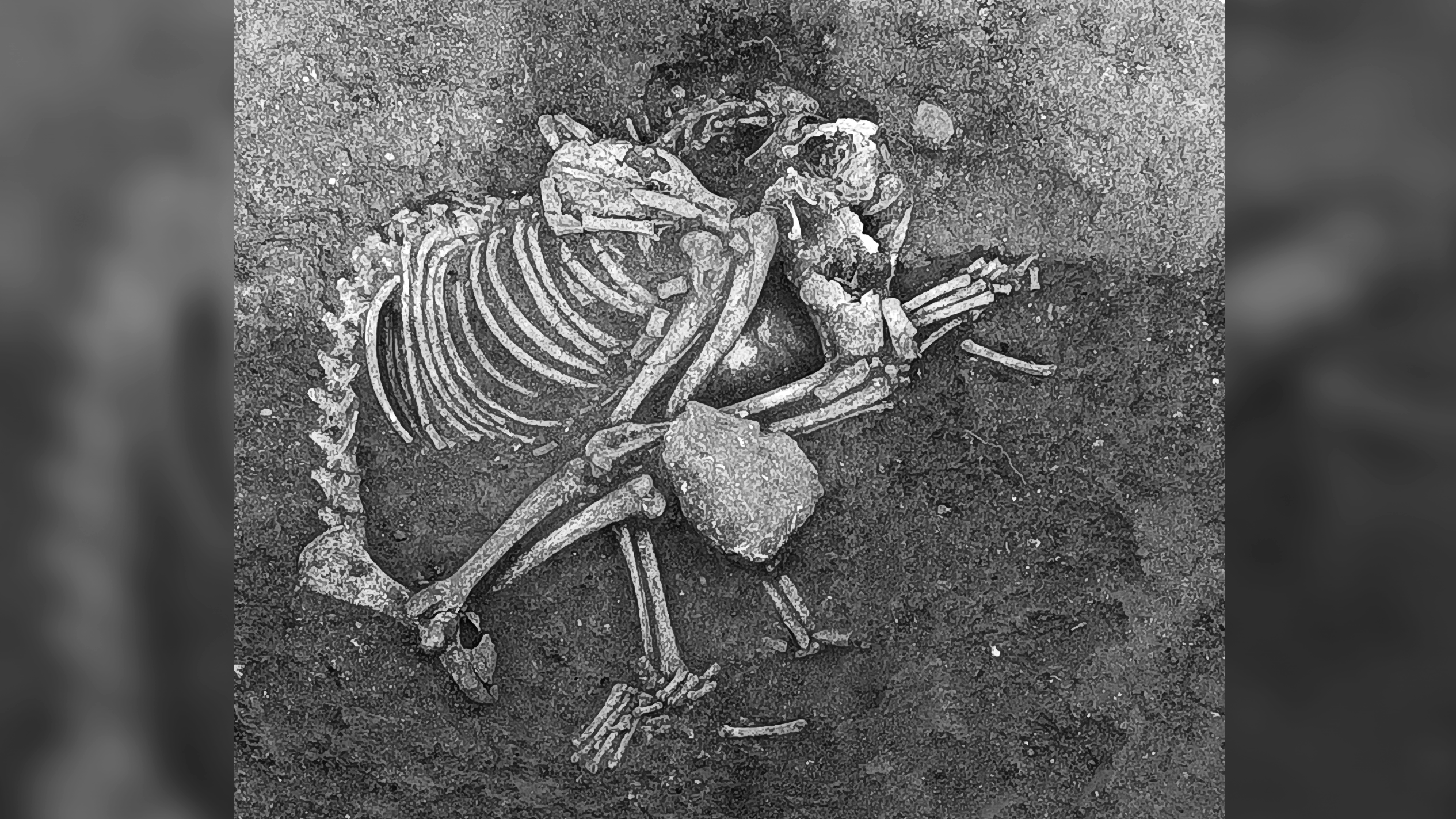
To look into the question of whether the Thracians ate dogs, Nikolova examined skeletons and previously published data from 10 Iron Age archaeological sites spread throughout Bulgaria. She discovered that most of the dogs had medium-sized snouts and medium-to-large withers heights, making them roughly the size of modern German shepherds.
But the large number of butchery marks on many of the bones revealed the dogs were not man’s best friend. “It is most probable they were kept as guard dogs, as the sites have a lot of livestock,” Nikolova said. “I don’t believe they were viewed as pets in the modern sense.”
At the site of Emporion Pistiros, an Iron Age trade center in inland Thrace, archaeologists found more than 80,000 animal bones — and dogs made up 2% of the total. When Nikolova looked closely at the dog bones from Pistiros, she found that nearly 20% of them had butchery marks made by metal tools. Two lower dog jaws also had burned teeth, possibly the result of someone removing hair and fur with fire prior to butchering and cooking the animals.
“The highest number of cuts and fragmentation is observed in the parts with the densest muscle tissue — the upper quarter of the hind limbs,” Nikolova said. “There are also cuts on ribs, although in dogs they would yield little meat.” The cuts Nikolova noticed on the dogs followed roughly the same pattern as those on sheep and cattle at the site, suggesting all of the animals were being butchered in a similar manner.
Because the Thracians had many other animals more traditionally associated with meat consumption, such as pigs, birds, fish and wild mammals, Nikolova does not think the Thracians were eating dogs as a last resort.
At Pistiros, butchered dog bones were discovered within the discarded remains of feasts and in general domestic trash heaps, Nikolova said, meaning dog flesh may have been consumed in different ways. “So, while linked to a certain tradition, it was not confined to that title and was an occasional ‘delicacy,'” she said.
Several other Bulgarian archaeological sites Nikolova investigated had evidence of cut and burned dog bones, as did sites in Greece and Romania, meaning “we cannot label dog meat consumption as unique to Ancient Thrace, but a somewhat regular practice that was carried out in the 1st millennium BC in the North-East Mediterranean,” Nikolova wrote in her study.
Nikolova plans to further investigate the role of dogs at Pistiros as part of the Corpus Animalium Thracicorum project. She noted that the butchered dogs at Pistiros are from the first part of the Iron Age, but later on the people there began burying intact dogs, so she hopes to determine whether there was a change in people’s attitude over time that made dogs a less acceptable source of food.
Nikolova, S. (2025). Dog meat in late Iron Age Bulgaria: necessity, delicacy, or part of a wider intercultural tradition? International Journal of Osteoarchaeology. https://doi.org/10.1002/oa.70062