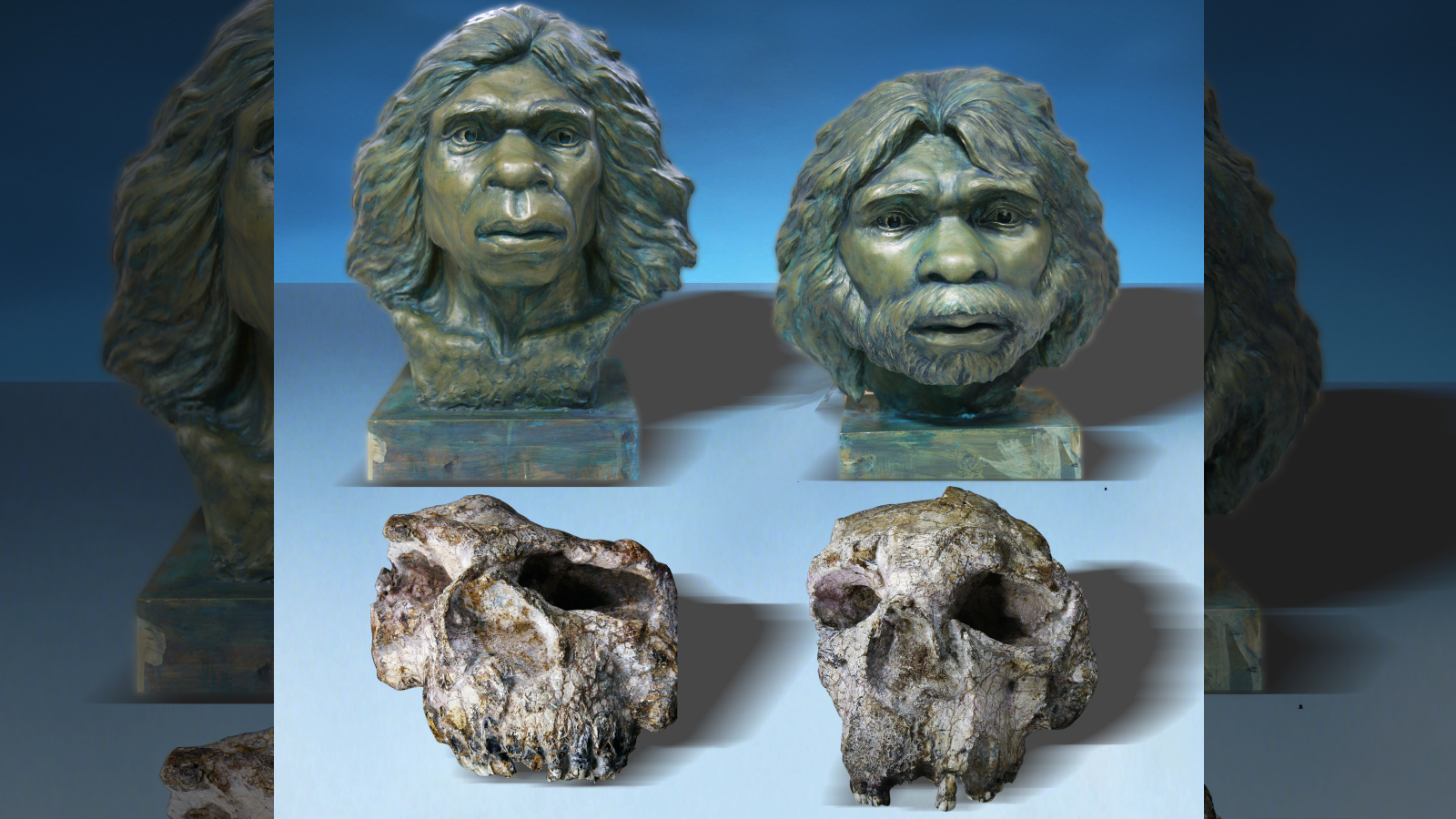
Three Homo erectus skulls previously unearthed in China are almost 1.8 million years old, around 600,000 years older than originally thought, a new study finds.
This revelation has made the Yunxian skulls from Hubei province the oldest evidence of our early human relatives, known as hominins, in East Asia, according to research published Wednesday (Feb. 18) in the journal Science Advances.
“What this means is that we need to consider pushing the origin of Homo erectus back” to around 2.6 million years ago, Bae said in an email.
H. erectus has long been considered the first human relative to leave Africa, with 1.78 million to 1.85 million-year-old fossils found at the Dmanisi site in Georgia being the earliest evidence of humans in Asia. But stone tools discovered at two sites in China dated to 2.1 million and 2.43 million years ago have complicated that picture, since they predate experts’ theory of when H. erectus originated.
The exact date of the three Yunxian skulls, which were found between 1989 and 2022, has long been debated, but they were previously considered to be around 1 million years old based on the age of animal teeth found close by, although one study dated them to around 1.1 million years ago using electron spin resonance and uranium-series dating. So when the opportunity arose to try a new dating technique at the site, Bae and his colleagues thought it was a good chance to revisit the debate.
Their team used a technique called cosmogenic nuclide burial dating to determine the age of the quartz found in the sediment layers where the skulls were found. This dating technique measures the half-life of two chemical variants — Aluminum-26 and Beryllium-10 — to determine how much time has passed since the quartz was exposed to cosmic rays.
This dating method revealed the hominin fossils were approximately 1.77 million years old, which is about 600,000 years older than the oldest age proposed for the site previously, Bae said.
Because the new date is younger than the stone tools discovered elsewhere in China, there is still a large time gap of around 600,000 years between the earliest fossil evidence and the earliest tool evidence, he added.
But since this date is close in time to the Dmanisi fossils in Georgia, the results suggest that H. erectus moved across Asia relatively quickly, Bae said. The size and shape of the Yunxian skulls, however, shows that these hominins had larger brains than those found in Dmanisi, despite being a relatively similar age. “This points to important variation in the early hominins outside of Africa,” Karen Baab, a professor of anatomy at Midwestern University in Illinois who was not involved in the new study, told Live Science in an email.
Chris Stringer, a paleoanthropologist at the National History Museum in London who was not involved in the new study, told Live Science in an email that “it would indeed be remarkable” if the Yunxian skulls were nearly 1.8 million years old, but “placing Yunxian at such a great age would put it completely out of sync with the rest of the fossil record.”
According to previous work by Stringer and his colleagues, the Yunxian fossils may belong to a group that gave rise to the Denisovans, which their model suggests emerged around 1.2 million years ago.
The new date for the Yunxian fossils, if correct, may also require experts to reconsider the origin of the ancestor to our own species, Homo sapiens, Stringer said. “I would suggest that further work on the dating of the site is certainly needed!”
Tu, H., Feng, X., Luo, L., Lai, Z., Granger, D., Bae, C., & Shen., G. (2026). The oldest in situ Homo erectus crania in eastern Asia: The Yunxian site dates to ~1.77 Ma. Science Advances, 12, eady2270. https://doi.org/10.1126/sciadv.ady2270