



Scientists have a new tool for mapping the universe’s perplexing acceleration.
A Canadian telescope designed to chart the distribution of hydrogen gas across the ancient universe has proved it can do so using only its own data for the first time, without the help of other telescopes. The results took seven years to prove, but the payoff could be huge.
According to the authors of a new study published Monday (Sept. 28) in The Astrophysical Journal, the telescope could give scientists a new, cost-effective way to study dark energy, the poorly understood force that is causing the universe to expand at an accelerating rate over time.
Latest Videos FromLive Science
“Hydrogen is the most common element in the universe and the raw material from which stars form,” study co-author Arnab Chakraborty, a postdoctoral fellow at the University of Toronto, said in a statement. “Its faint radio emission acts like a cosmic tracer, revealing how matter is distributed across space.”
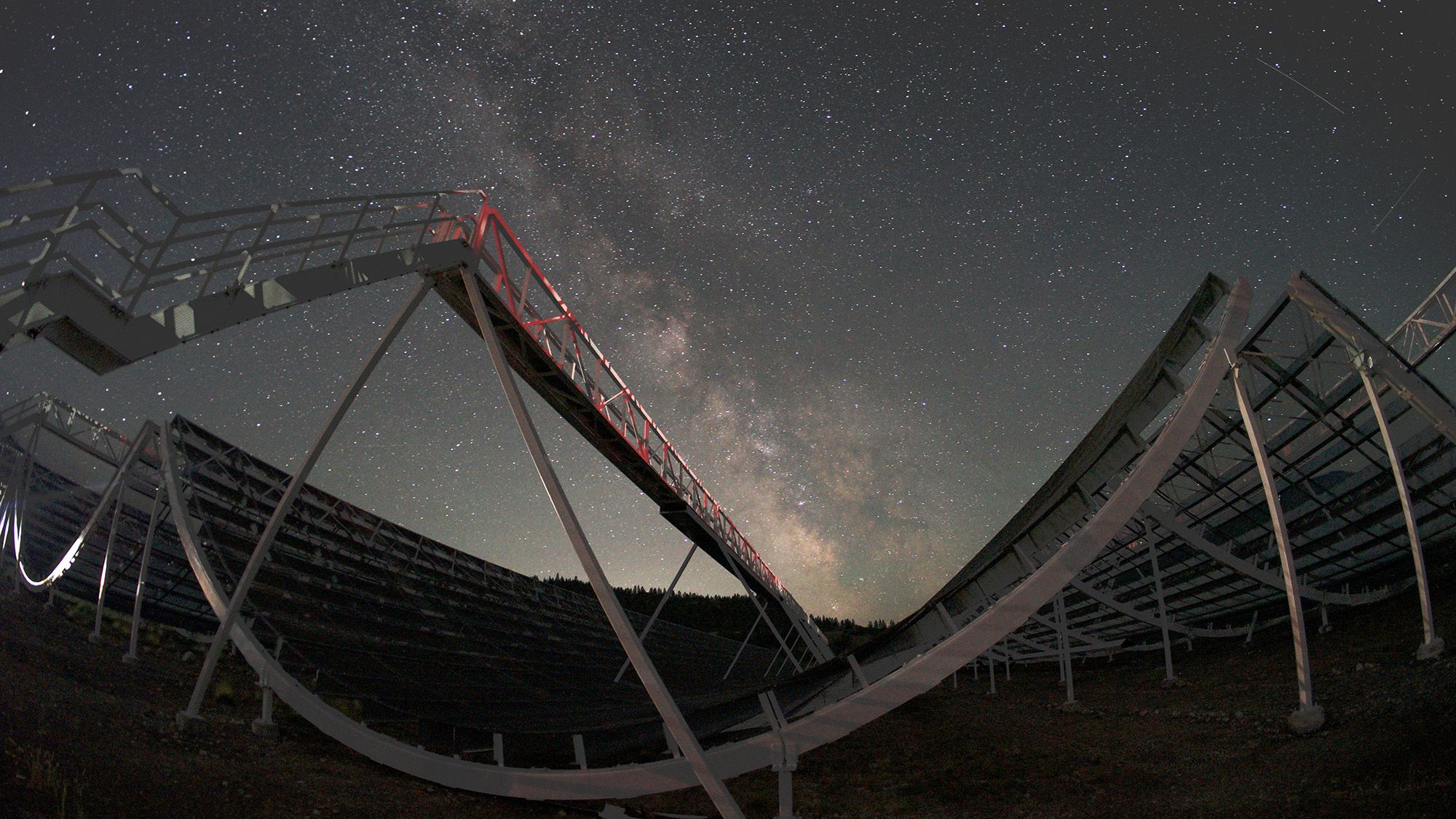
The Canadian Hydrogen Intensity Mapping Experiment (CHIME) is a set of radio telescopes, principally located near Penticton, British Columbia, that map the entire northern sky every day. Before the results from the new study, CHIME had to confirm its own observations with other telescopes — an expensive and time-consuming process.
It was important for CHIME to look at the universe’s ancient hydrogen gas with its own data, to serve as an independent point of measurement that did not rely on other telescopes, the team explained. The new paper, which was nearly a decade in the making, is based on 94 nights of observations in 2019 that were carefully double-checked before publication. The telescope can detect radio signals as far back as 3 billion years after the Big Bang, when the universe was a fraction of its current age.
“We worked very hard to convince ourselves that this wasn’t a false alarm,” Chakraborty said. “After all the tests, the signal remained. That gave us confidence we were seeing real hydrogen from the distant universe.”
Get the world’s most fascinating discoveries delivered straight to your inbox.
An accompanying paper published in The Astrophysical Journal includes more information about where hydrogen is found in the cosmos. This study suggests that about 2% of hydrogen is “neutrally atomic” — meaning the atoms contain a balance of just one proton and one electron, resulting in no overall electric charge — which is “broadly consistent” with measurements by other telescopes, Shabbir Shaikh, a postdoctoral fellow in the School of Earth and Space Exploration at Arizona State University and a co-author of both papers, said in the statement.
Mapping the distribution of this common gas could reveal new clues about the expansion of the universe at different times in cosmic history. In future research, the team plans to go through CHIME’s other seven years of observations to gather more information about its hydrogen gas studies.
Amiri, M., Bandura, K., Chakraborty, A., Cliche, J., Dobbs, M., Foreman, S., Gray, L., Halpern, M., Hill, A. S., Hinshaw, G., Höfer, C., Joseph, A., Kruger, N., Landecker, T. L., Van Lieshout, R., MacEachern, J., Masui, K. W., Mena-Parra, J., Miller, K., . . . Wulf, D. (2026). Detection of the Cosmological 21 cm Signal in Autocorrelation at z ∼ 1 with the Canadian Hydrogen Intensity Mapping Experiment. The Astrophysical Journal, 1009(2), 159. https://doi.org/10.3847/1538-4357/ae9835