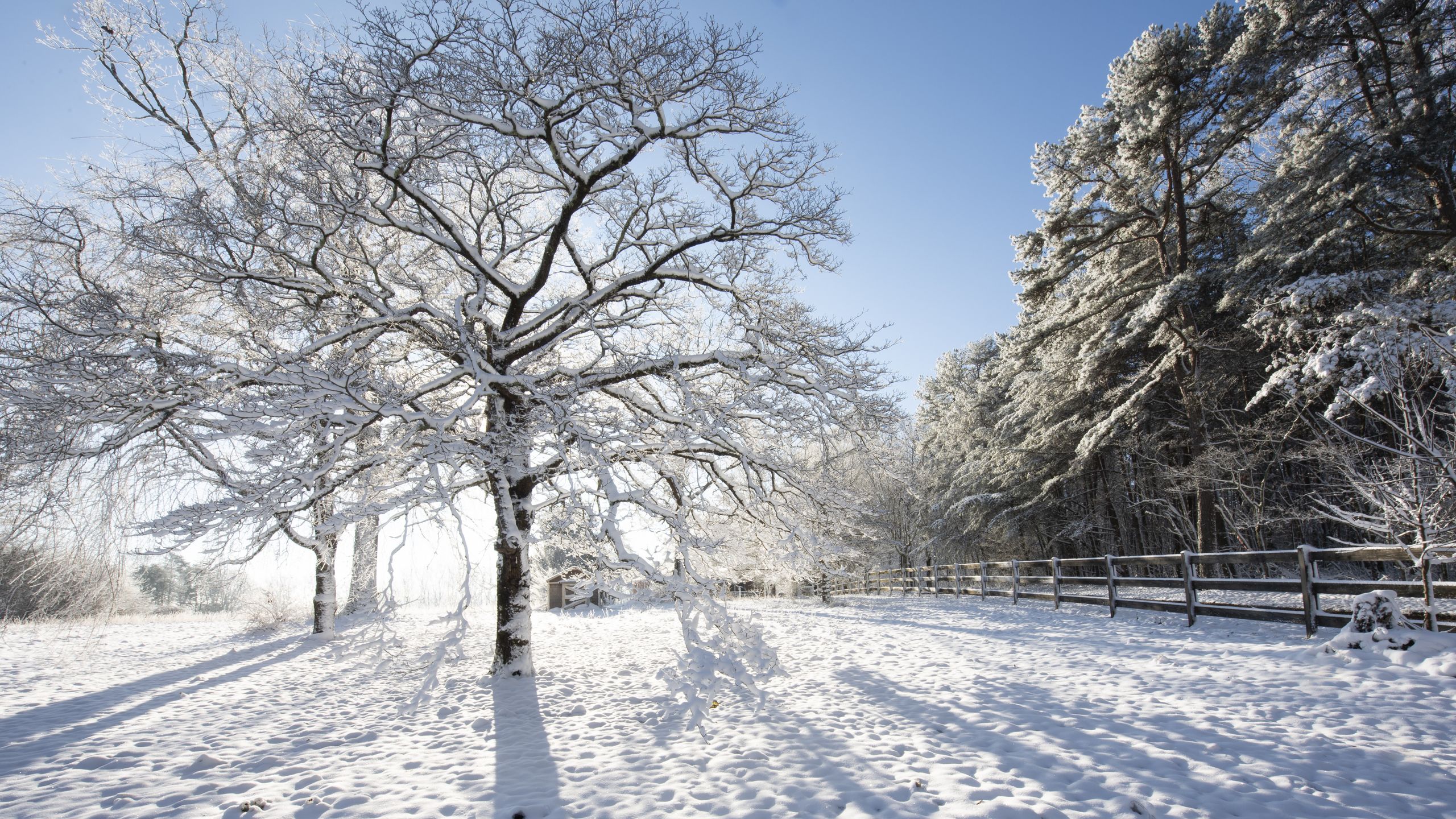
The extreme cold from an incoming winter blast could make some trees “explode,” a viral social media post claims — but don’t expect trees to start blowing up like cars in an action movie.
“EXPLODING TREES are possible in the Midwest and Northern Plains on Friday and Saturday, as temperatures are forecasted to fall 20 degrees BELOW zero!” Max Velocity (real name, Max Schuster), a weather-based content creator with a degree in meteorology, wrote in a post on the social platform X.
But can extreme cold really make trees explode?
It depends on your definition of “explode.” Trees can crack in frigid conditions due to their sap. This substance is usually liquid even in freezing temperatures, but when it gets super cold, like minus 20 F (minus 29 C), it freezes. In some places, the incoming Arctic blast will likely be cold enough to freeze trees’ sap, causing it to quickly expand, Bill McNee, a forest health specialist at the Wisconsin Department of Natural Resources, told the Milwaukee Journal Sentinel.
“That just creates a lot of physical pressure that can lead to the frost cracking appearing suddenly, branches can fall off, and people hear this really loud crack from their tree, almost like it’s a gunshot,” McNee said.
The cracking usually affects only part of the tree, but in rare cases, explosions can happen, McNee said.
“I’ve never seen the damage of it, but from what I have seen and what I read online is that it is rare for there just to be so much pressure that is suddenly released inside this tree that it almost does explode,” McNee said.
Meteorologist Cody Matz also addressed the explosion claim in an article for Minneapolis-based Fox 9, writing that “it can and does happen” but that it’s “extremely rare.” Matz noted that many people have likely lived in Minnesota and the Upper Midwest their whole lives without ever hearing of exploding trees.
The news nonprofit organization South Dakota News Watch, in partnership with the fact-checking nonprofit Gigafact, concluded that the claim that trees can explode during extreme cold was misleading but noted that temperature-driven breaking and snapping “can sound like an explosion.”
Winter blast
Regardless of whether trees can “explode,” some areas will have a chance to experience the rare cracking phenomenon. The NWS is forecasting temperatures below minus 20 F in parts of North Dakota, Minnesota and Wisconsin over the weekend, while the wind chills starting today (Jan. 22) will be even colder.
“This arctic blast will be accompanied by gusty winds, leading to dangerous wind chills,” an NWS representative wrote in a Weather Prediction Center update Thursday. “The coldest wind chills may fall below -50 [F] across the Northern Plains with sub-zero wind chills reaching as far southeast as the Mid-Atlantic, Mid-Mississippi Valley and Southern Plains. These wind chills will pose life-threatening risk of hypothermia and frostbite to exposed skin.”
The Arctic air is also set to fuel a massive and long-lasting winter storm, in conjunction with a surface front farther south and a midlevel disturbance passing through northern Mexico, according to the Weather Prediction Center update. AccuWeather reported that the winter storm is expected to bring heavy snow and ice down on more than 150 million people across 24 states from Friday through the weekend.
Meteorologists told The Associated Press that a stretching polar vortex is to blame for the Arctic blast. The polar vortex is an area of low pressure and cold air that circulates around the North and South poles all the time. Around the North Pole, the Arctic polar vortex is a circle of strong, cold winds that picks up every winter and sends cold air south with the jet stream when it’s disrupted or stretched.
A warming Arctic, fueled by climate change, is energizing the polar vortex and helping to send cold air south, according to The Associated Press. Extreme winter weather is often linked to what the polar vortex is doing, although researchers are still deciphering all of the drivers behind the vortex’s behavior.