





As astronauts prepare for long-duration missions to the moon and Mars, sustaining human life far from Earth will depend on solving a gauntlet of technological challenges. Yes, researchers need to perfect the towering rockets and futuristic habitats that will keep astronauts safe on their journey to other worlds — but they’ll also need to figure out how to do the laundry.
Now, a new lab experiment that tested a water-free approach to doing laundry in space using controlled jets of supercharged plasma suggests the technique could help meet that challenge.
Doing laundry in space may sound tedious (as it is on Earth), but astronaut health — and preventing hitchhiking Earth microbes from contaminating other worlds — literally depends on it.
On the International Space Station (ISS), astronauts typically wear the same clothes until they become too dirty and then discard them as waste that later burns up in Earth’s atmosphere during reentry. Even so, and despite rigorous cleaning protocols across the station, swabs from locations such as handrails and air vents have revealed dense populations of microbes on surfaces that appear spotless, with some of these microbes even adapting to thrive on metal surfaces.
Future long-term missions to the moon or Mars, however, will not have the luxury of regular resupply missions from Earth, making some form of sustainable “space laundry” necessary.
Comfortable clothing and furnishings that could make future months-long missions more livable, like a couch to sit on or a proper bed to sleep in instead of sleeping bags, can quickly become breeding spaces for the microbes humans constantly carry and shed as part of everyday life. Though most are harmless — even beneficial, in fact — studies suggest that some adapt to the stresses of spaceflight and behave differently in microgravity, potentially becoming more likely to cause disease or even damaging spacecraft systems by corroding metal surfaces.
Astronaut Sandra Magnus tidies the International Space Station with a vacuum cleaner in 2008. While helpful for catching stray dust, vacuuming alone won’t be enough to sanitize human habitats during future long-term missions to the moon and Mars.
(Image credit: NASA)
But sanitizing these layered “soft goods” is especially challenging in space, where limited water supplies make conventional laundry impractical.
Get the world’s most fascinating discoveries delivered straight to your inbox.
“You have a couch that six astronauts, or however many, are sitting on day in, day out. How do you keep that thing sanitized so that they don’t spread germs to each other?” Gabe Xu, a professor at the University of Alabama who led the lab experiment, told Live Science. “It’s a challenging problem, but it’s something that we’re going to need to really deal with.”
A matter of health, not stains
Many disinfectants commonly used on Earth, such as Lysol, are poorly suited to spaceflight, where airborne droplets and chemical fumes can linger in enclosed habitats and pose risks to crew health, Xu said.
In the lab experiment, Xu and microbiologist Chelsi Cassilly, a planetary protection engineer at NASA, tested whether plasma — an energized gas akin to a controlled form of lightning — could offer a solution.
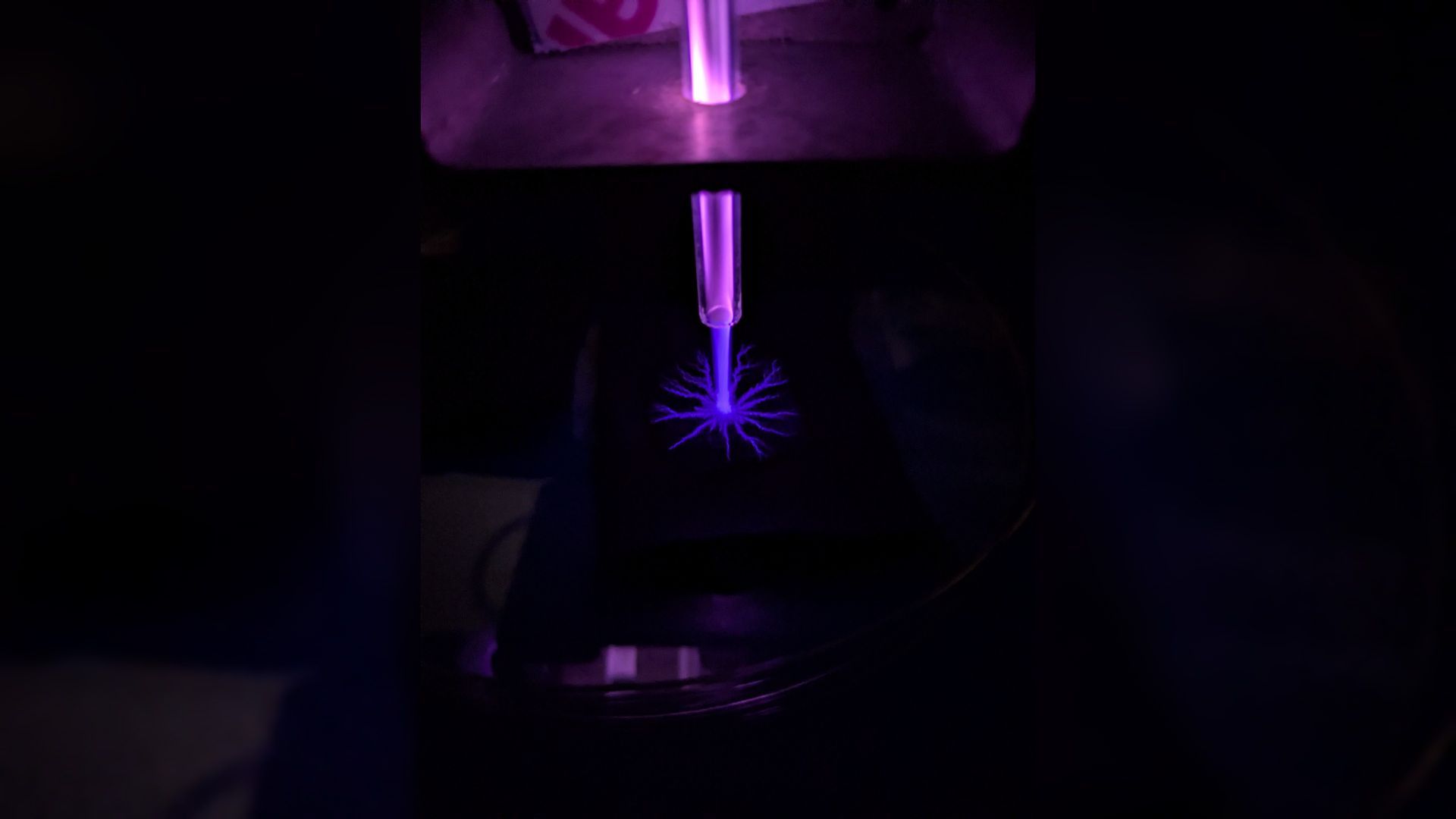
The researchers cut an ordinary cotton T-shirt into small samples and seeded them with Staphylococcus caprae, a common skin bacterium that has also been detected aboard the ISS. Then, using a cellphone-sized device, the team treated the samples with a pencil-thin, bright-purple jet of charged gas, or plasma, to test how effectively it killed the microbes.

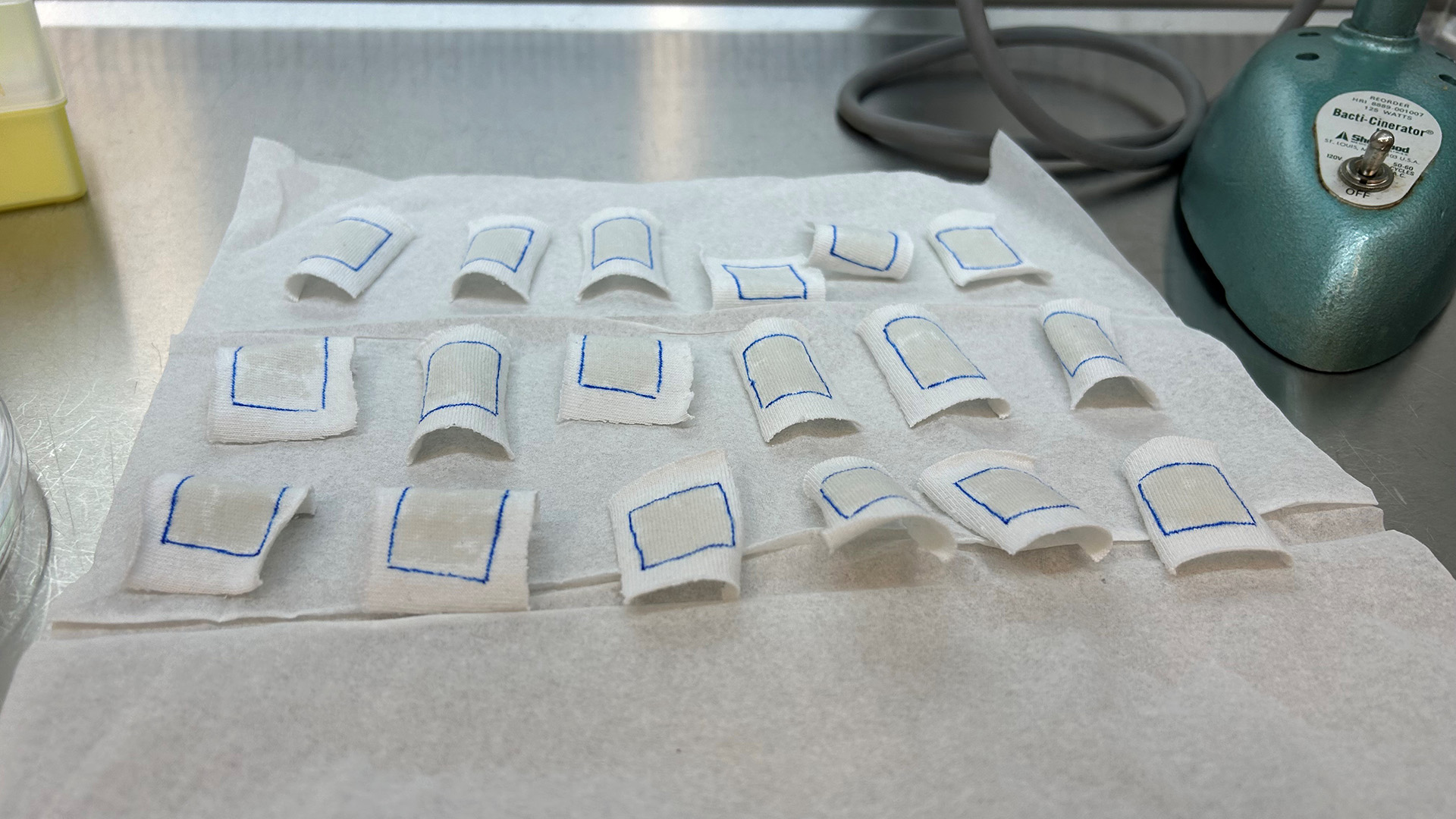
A cotton T-shirt cut into samples and inoculated with skin bacteria.
(Image credit: University of Alabama in Huntsville – Propulsion Research Center)
The results show that the technique killed the bacteria more effectively than methods currently used on the ISS, including dry vacuuming and chemical surface wipes. .
“It is not going to remove the coffee stains from anyone’s T-shirt,” Xu told Live Science, but “it will remove the stuff that will make you sick.”
When directed onto fabric, the plasma generated highly reactive oxygen and nitrogen species that penetrated the fibers and ruptured bacterial cell membranes through oxidative stress. Across tests lasting from 30 seconds to five minutes, the treatment showed no noticeable damage to the fabric fibers, Xu said.
“We think that it’s probably not any worse than just normal wear and tear,” he told Live Science.
The novelty of the technique, he added, is that it requires little more than electricity and a working gas, so there’s no need for water-intensive cleaning systems. The team is now expanding the work to test additional microbial species known to thrive in human environments and aboard spacecraft.
“We’re focusing on things that we know exist up there, or that we know that people produce just as a matter of fact throughout their day, since these are the things that would likely be in a space habitat,” Xu said.
Eventually, the researchers envision scaling the technology into a handheld device that astronauts could use as part of routine housekeeping aboard spacecraft and future habitats, Xu told Live Science. The team presented their preliminary results at The Astrobiology Science Conference in Madison.
See how much you know about human exploration into space with our spaceflight quiz!