





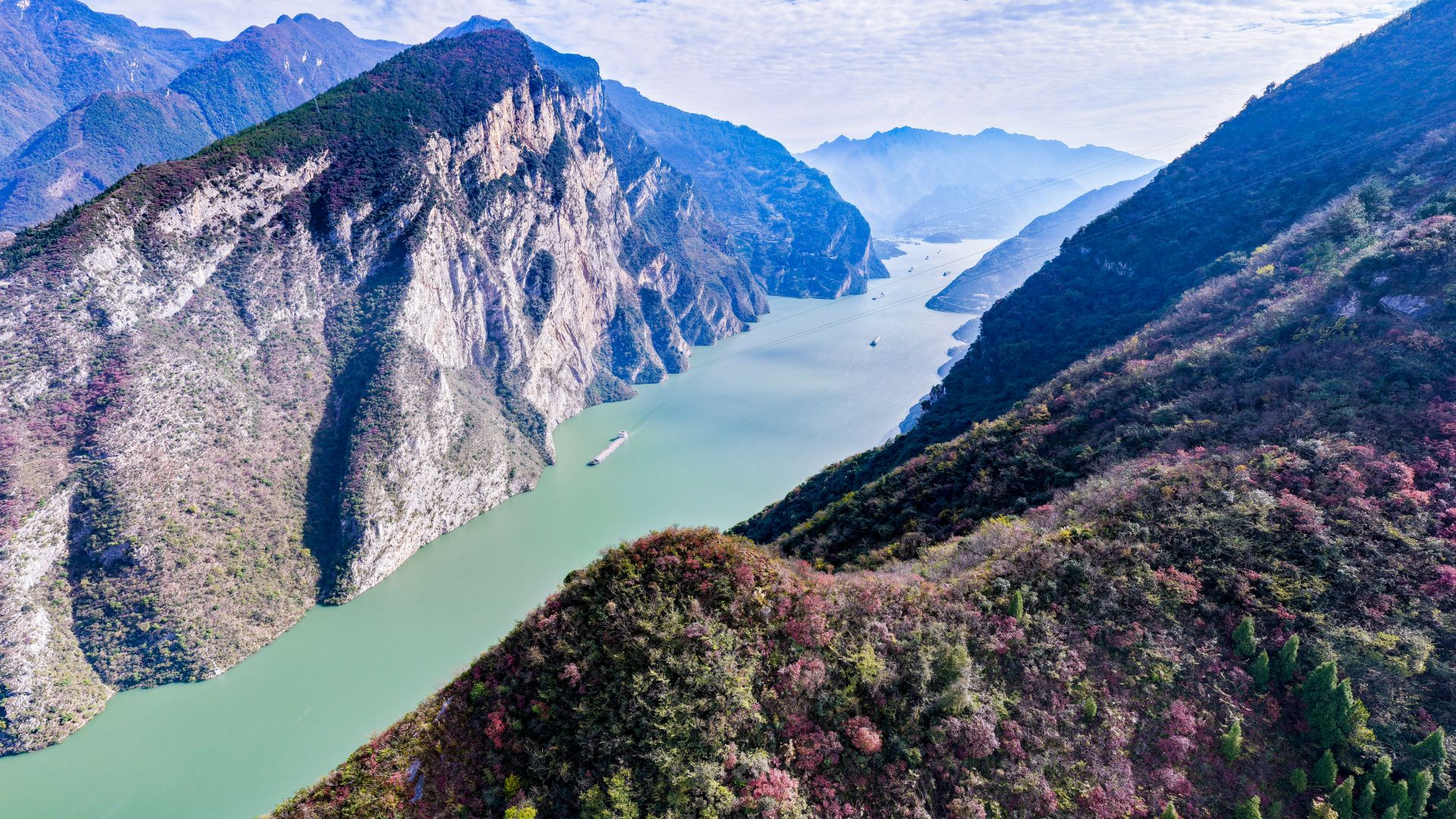
China’s Yangtze River is showing signs of recovery following the introduction of a 10-year ban on commercial fishing in 2021. The number of large fish has increased, and there has been recovery among endangered animals, including the Yangtze sturgeon (Sinosturia dabryanus) and the Yangtze finless porpoise (Neophocaena asiaeorientalis asiaeorientalis), new research finds.
“These results show that strong political decisions are required to restore biodiversity,” Sébastien Brosse, an ecologist at the University of Toulouse in France and co-author of the new study, told Live Science via email. “This is an encouraging message because biodiversity loss is often seen as irreversible.” The Yangtze is the longest and largest river in China. About 30% of the country’s population lives within its drainage basin, and the 11 provinces and municipalities that make up the Yangtze River Economic Belt generate about 47% of China’s total gross domestic product.
This decline continued despite the establishment of a network of protected areas and an investment of more than $300 billion in water-quality management and improvement. In response, China took drastic measures: The country instituted a 10-year fishing ban across the entire Yangtze basin in 2021, used river police to enforce strict penalties, and continued broad environmental management.
To assess the effects of the fishing ban, Yushun Chen, a hydrobiologist at the Chinese Academy of Sciences in Wuhan, China, and his colleagues used data from between 2018 and 2023 to evaluate the health of fish communities in the Yangtze before and after the ban went into effect.
They found that overall, the total mass of fish collected in samples more than doubled between those dates, and there was a 13% boost in the number of species in the samples.
The overall number of fish stayed about the same, but larger-bodied species that are higher up in the food web, including the economically valuable black Amur bream (Megalobrama terminalis) and the white Amur bream (Parabramis pekinensis), grew, and they contributed a larger amount of the biomass. However, the total mass of smaller species sampled decreased by 18%.
The team’s findings, published on Thursday (Feb. 12) in the journal Science, also included positive signs for migratory and endangered species. For example, populations of slender tongue sole (Cynoglossus gracilis) increased after the ban, and its freshwater migration extended farther upstream. Endangered fish species — such as the Yangtze sturgeon, Chinese sucker (Myxocyprinus asiaticus) and tube fish (Ochetobius elongatus) — also showed signs of recovery.
Another notable positive was the boost in numbers of the only freshwater mammal remaining in the Yangtze River, the Yangtze finless porpoise (Neophocaena asiaeorientalis asiaeorientalis), whose population rose by a third from 445 in 2017 to 595 in 2022. This gain may have resulted from a greater availability of bigger fish to eat; fewer deaths related to vessel strikes or fishing bycatch; and a reduction in other stressors, such as underwater noise from vessel propellers, the researchers suggested.
“In an era of unprecedented biodiversity losses and declines, especially in freshwater systems, this study offers a glimpse of hope regarding the future of biodiversity,” said Lise Comte, a conservation ecologist at California-based Conservation Science Partners who wasn’t involved in the research.
“It demonstrates that bold protection and restoration strategies can be efficient in slowing down and even reverting human impacts on ecological communities,” she told Live Science via email.
Chen and his colleagues are still monitoring Yangtze River biodiversity, and they said the recovery is continuing. But they warned that the progress could easily be reversed if commercial fishing were to restart and that lasting biodiversity recovery will depend on sustained management that addresses all human pressures on river systems.
They also suggested that similar conservation measures might be useful on rivers such as the Mekong and the Amazon.
However, the Yangtze fishing ban had huge human and financial costs, as it involved the recall of 111,000 fishing boats, the resettlement of 231,000 fishers, and an investment of more than $2.74 billion in the Yangtze River Economic Belt.
“The promising findings demonstrate the resilience of these systems but are also a case study of an approach that I hope we don’t have to emulate elsewhere,” co-author Steven Cooke, a professor of biology at Carleton University in Ottawa, Canada, told Live Science via email. “Closing all fisheries in a river basin has significant socio-economic consequences. Fishers, and those in related industries, often move on, forever changing those communities. Managing fisheries in ways that do not require such a ‘nuclear’ option is always preferred.”
A better approach would involve the ongoing assessment of fish populations; science-based fisheries management; and the study of watersheds as integrated systems that connect people, water and fish, he added.
Source: Fangyuan Xiong et al., Fishing ban halts seven decades of biodiversity decline in the Yangtze River. Science 391, 719-723 (2026). DOI: 10.1126/science.adu5160