




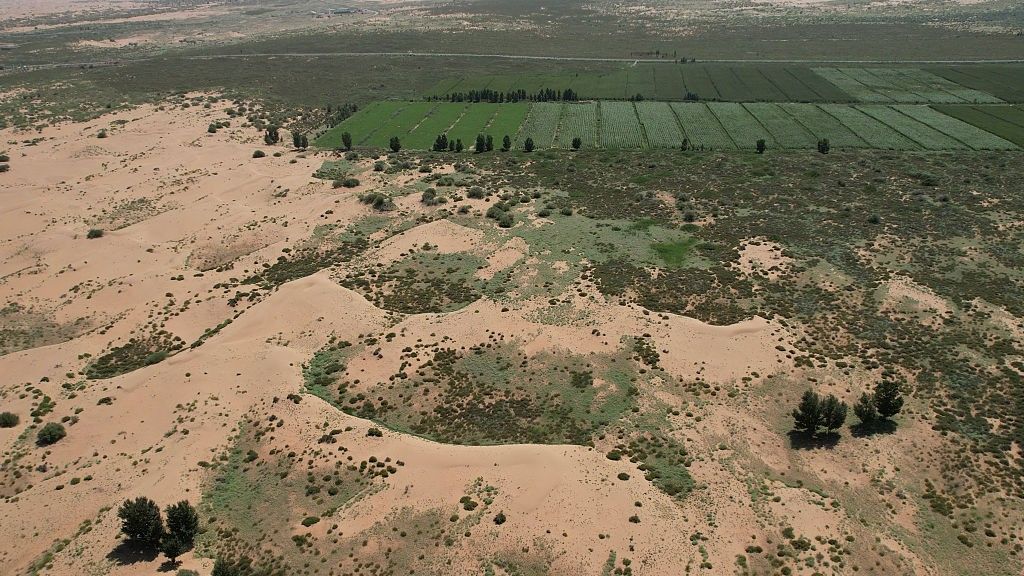
China’s “Great Green Wall” is a huge ecological engineering project to slow the expansion of the Gobi and Taklamakan deserts in the country’s north.
Since 1978, China has planted more than 66 billion trees along its borders with Mongolia, Kazakhstan and Kyrgyzstan — and Chinese authorities plan to plant 34 billion more over the next 25 years. If they succeed, the Great Green Wall will increase Earth’s forest cover by 10% since the late 1970s.
Northern China was dry before the urbanization boom of the 1950s, because the Himalayas create a rain shadow over the country’s border with Mongolia that limits precipitation in the region. This is why the Gobi and Taklamakan deserts are so enormous; combined, they cover 618,000 square miles (1.6 million square kilometers), which is slightly smaller than Alaska, according to the Royal Geographical Society.
Despite China’s efforts over the past five decades, the Gobi and Taklamakan are still expanding. The Gobi Desert, for instance, swallows around 1,400 square miles (3,600 square km) of China’s grassland every year. Desertification is ruining ecosystems and agricultural land, but it’s also making pollution in cities like Beijing worse, according to the Royal Geographical Society.
Last year, government representatives announced China had finished encircling the Taklamakan with vegetation, which has helped stabilize sand dunes and grow forest cover from about 10% of China’s area in 1949 to more than 25% today. Tree planting will continue around the Taklamakan to maintain and enlarge the forest, the representatives said.
If everything goes to plan, the Great Green Wall will be 2,800 miles (4,500 kilometers) long by 2050. The “wall” is the world’s largest seeded forest — but it’s still unclear just how effective it is at slowing desertification.
While some studies suggest the Great Green Wall has reduced the frequency of sandstorms, others argue this decrease is mostly due to climatic factors.
Critics say the survival rate of planted trees and shrubs is too low to show robust results, possibly because huge swathes of the wall encompass only one or two tree species — mostly poplar and willow, according to the Royal Geographical Society — making the wall susceptible to disease. For example, in 2000, 1 billion poplar trees were lost to a single pathogen in the Ningxia province.
Tree mortality is also high because China is planting trees in places that don’t have enough water to grow them. Without constant human intervention, many of the trees don’t survive.
“People crowded into the natural sand dunes and the Gobi to plant trees, which have caused a rapid decrease in soil moisture and the groundwater table,” Xian Xue, a leading expert on erosion-driven desertification at the Chinese Academy of Sciences, told National Geographic in 2017. “Actually, it will cause desertification [in some regions].”
Because it is a monoculture, the Great Green Wall also doesn’t promote biodiversity in the same way that a more diverse mix of indigenous plants would. Nevertheless, the program inspired Africa’s Great Green Wall, which will be a 5,000-mile-long (8,000 km) tree belt across the continent to slow land degradation and desertification.
Discover more incredible places, where we highlight the fantastic history and science behind some of the most dramatic landscapes on Earth