QUICK FACTS
Where is it? Yellowstone National Park, Wyoming [44.46284445, -110.3628428]
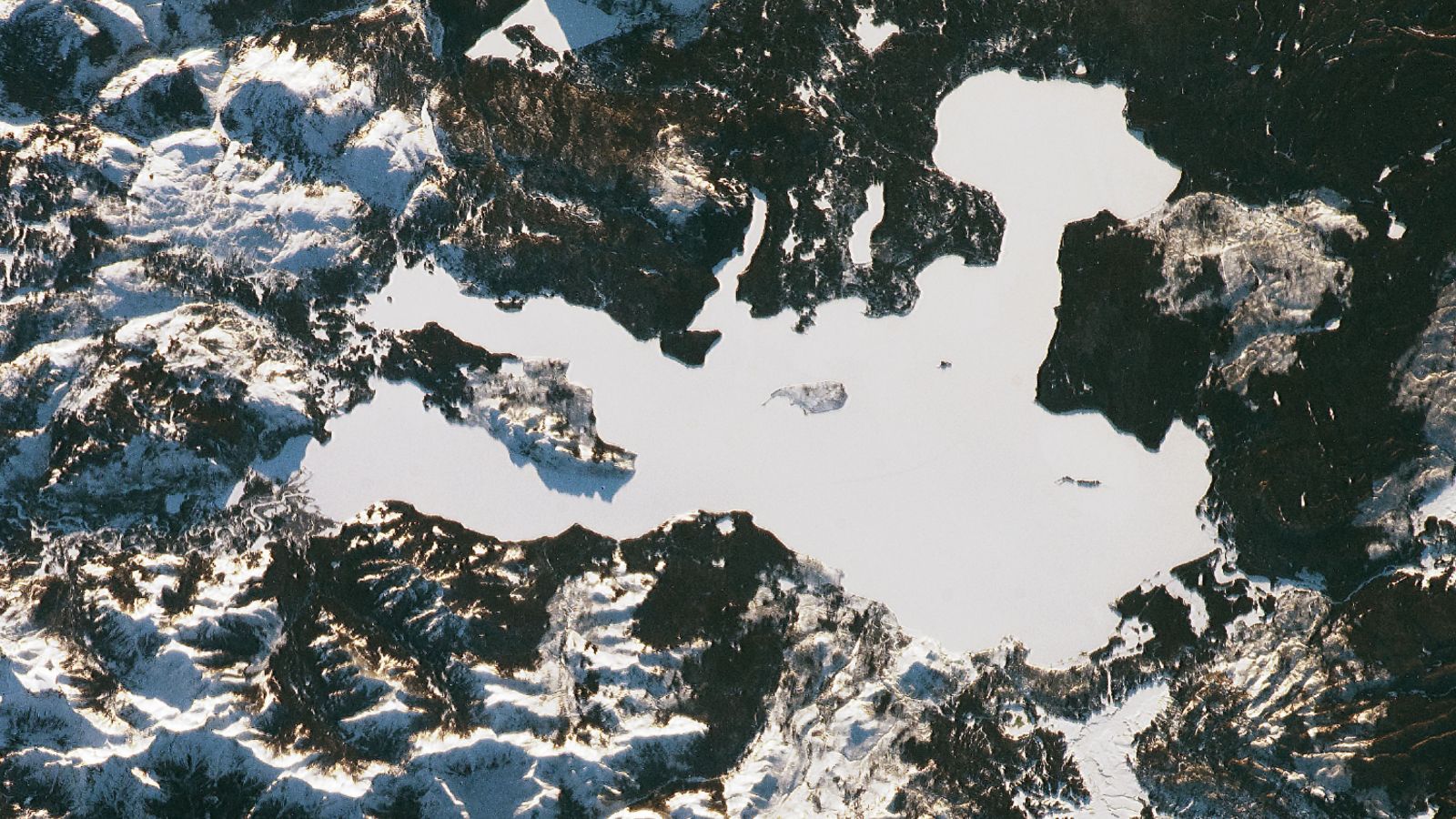
What’s in the photo? A perfectly white blanket of snow covering Yellowstone Lake
Who took the photo? An unnamed astronaut on board the International Space Station (ISS)
When was it taken? Jan. 26, 2022
This eye-catching astronaut photo shows Yellowstone’s eponymous lake covered in a thick blanket of snow, making it look like a colorless, featureless void in the surrounding landscape. But below this freezing, blank expanse lies some of the most active and hottest hydrothermal vents anywhere on Earth.
The lake freezes over every winter, around late December or early January, with an ice sheet that ranges from a few inches to around 2 feet (0.6 m) thick. But the blanket of snow on top of this ice can reach up to 3.5 feet (1.1 m) deep by March, according to NASA’s Earth Observatory. The lake is usually snow- and ice-free by late May or early June.
The thick covering of snow means Yellowstone Lake is remarkably resilient to human-caused climate change, maintaining its surface ice thickness despite rising atmospheric temperatures. This makes it a major outlier among high-altitude lakes across the globe.
This astronaut photo shows one of these deep snowdrifts, mostly undisturbed aside from a few islands, the largest of which is Stevenson Island.
While the surface of Yellowstone Lake may seem cold and lifeless during the winter months, the water below remains surprisingly mild thanks to a series of hydrothermal vents across its floor. This enables aquatic animals, including the lake’s cutthroat trout (Oncorhynchus clarkii) population — the largest of its kind anywhere in North America — to survive the long months under the ice, according to NPS.
One of the vents, right next to Stevenson Island, releases water that’s a remarkable 345 degrees Fahrenheit (174 degrees Celsius), making it hotter than Old Faithful and every other geyser or hot spring in Yellowstone National Park.
“This is much hotter than any surface hot spring at Yellowstone because the weight from the overlying lake water acts like a pressure cooker lid and allows temperatures higher than boiling to be reached,” representatives from the U.S. Geological Survey wrote in an article about the lake’s vents. “These are the hottest hydrothermal vents measured in a lake anywhere in the world.”
The vents are powered by a giant blob of magma, around 2.6 miles (3.8 km) beneath Yellowstone National Park, which contains a surprising amount of molten rock. This magma blob acts like the cap on a gigantic volcanic bottle and will one day explode, unleashing a “supervolcanic” eruption that could be felt across the continent.
Yellowstone Lake was formed shortly after a similar eruption 640,000 years ago, which carved out the 1,500-square-mile (3,900 square kilometers) caldera that the lake currently sits within. Around 130,000 years ago, a smaller eruption then carved out the doorknob-shaped handle of the lake, dubbed West Thumb (visible near the top of the astronaut photo).
For more incredible satellite photos and astronaut images, check out our Earth from space archives.