




The patient: A 35-year-old man in Iran
The symptoms: The man visited a urology clinic in a hospital and described discomfort in his bladder. He had no issues with urination and no history of surgery or disease in that region of his body. Nor was he experiencing the typical symptoms of a urinary tract infection, such as feeling a constant need to urinate or having a burning sensation during urination.
What happened next: When doctors conducted a physical examination of the man’s abdomen, they detected a large, smooth and solid mass above his pubis — the front of the pelvis where two pubic bones are connected by cartilage.
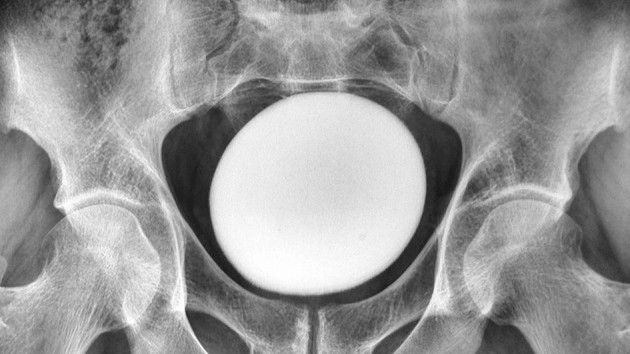
The dense mass wasn’t attached to the pelvic area or abdominal wall, and an ultrasound scan revealed that it was an egg-shaped object about 4.3 inches (11 centimeters) in diameter, according to a report of the man’s case.
The diagnosis: Physicians at the hospital identified the mass as an unusually large bladder stone. Also known as calculi, these objects grow when minerals in urine accumulate into crystals; about 85% of their makeup is calcium. They can form in the bladder when it doesn’t empty fully, which causes the minerals in urine to concentrate and crystalize.
Bladder stones typically form directly in the bladder, but sometimes, they can originate from small kidney stones that migrate from the kidneys into the bladder or into the muscular tube between them, called the ureter.
The tiniest bladder stones are invisible to the naked eye, but they can vary greatly in size. Small stones typically go undetected and are passed during normal urination. However, larger stones can obstruct the flow of urine and irritate the walls of the urinary tract, and they may cause pain, interrupted urination or internal bleeding.
The treatment: After checking to make sure the egg-like stone was not obstructing or constricting any part of the patient’s urinary tract, doctors removed the stone surgically, in a procedure called a cystolithotomy. The mass was so large that they needed to extend the incision to the back of the bladder.
The extracted stone weighed 1.8 pounds (826 grams) and measured about 5 inches (13 cm) long, 4 inches (10 cm) wide and 3 inches (8 cm) tall.
Surgeons installed a catheter to assist the man with urination as he healed, and they removed it seven days after the surgery.
What makes the case unique: Stones in the urinary tract are relatively common, but bladder stones make up only about 5% of cases, with kidney stones being much more common. Giant stones that require surgical removal, such as the one affecting the patient, “are very rare,” according to the case report.
Remarkably, this sizable stone is dwarfed by the current record-holder for bladder stones: a mass weighing 4.2 pounds (1.9 kilograms) and measuring 7 inches (17.9 cm) long. Doctors in Brazil surgically removed the stone from a male patient in 2003.
Still, the large size of the bladder stone extracted from the man Iran was highly unusual, the surgeons wrote. “Regarding the characteristics of the stone in our case, our report was the first one in Iran and in the world,” they said.
This article is for informational purposes only and is not meant to offer medical advice.