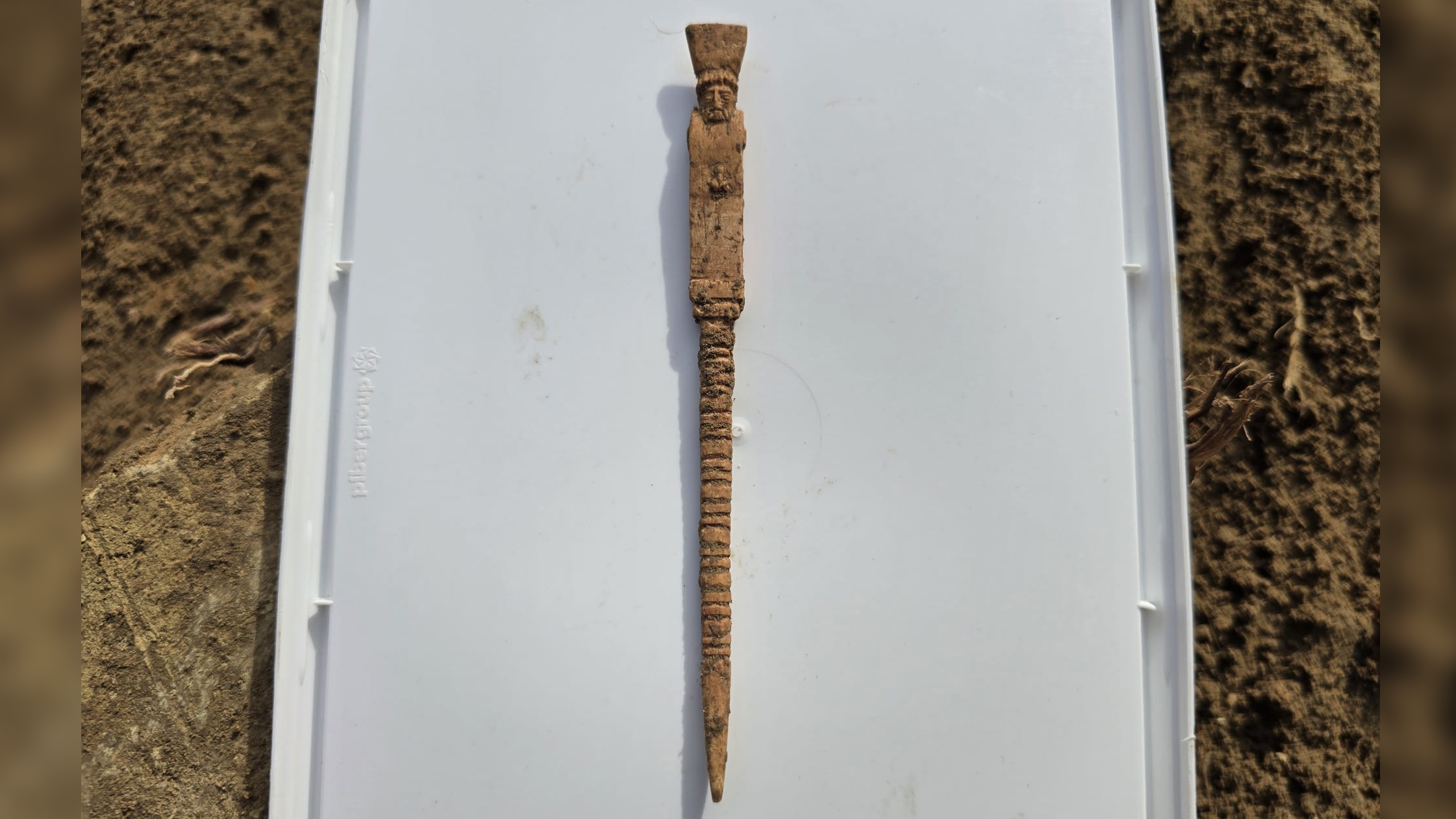
Archaeologists in southern Sicily have uncovered an ancient bone tool depicting the god Dionysus and his erect phallus. The exquisite workmanship helps date the artifact to the fifth century B.C., when the island was a Greek colony.
“This stylus truly represents a unique example in the archaeological landscape of the time,” Daniela Vullo, head of the Superintendency for Cultural and Environmental Heritage of Caltanissetta, the municipality where the artifact was found, said in a translated statement.
The stylus — a pointed instrument used for writing on or marking clay or wax — measures 5.2 inches (13.2 centimeters) long and was carved out of bone. A grumpy-looking male head decorates the top of the stylus, while the middle section features an erect penis. These characteristics suggest the stylus was carved to look like a herm of Dionysus, according to the statement.
Herms were ancient Greek sculptures, usually made from upright blocks of stone, that often featured just a carved head and male genitalia. Herms were used to ward off evil and were typically placed at crossings, boundaries and borders, as well as in front of temples. The term may come from the sculptures’ association with Hermes, the messenger god also associated with fertility.
Archaeologists found the stylus during excavations in the city of Gela. They think the stylus may have been used by a ceramicist to mark pottery before someone dedicated the stylus as a gift to a deity.
“Due to its unique characteristics, it deserves to be exhibited and made available for public enjoyment,” Vullo said.
In addition to the stylus, archaeologists have uncovered a large Hellenistic-era (fourth to first centuries B.C.) neighborhood that is still being excavated.