




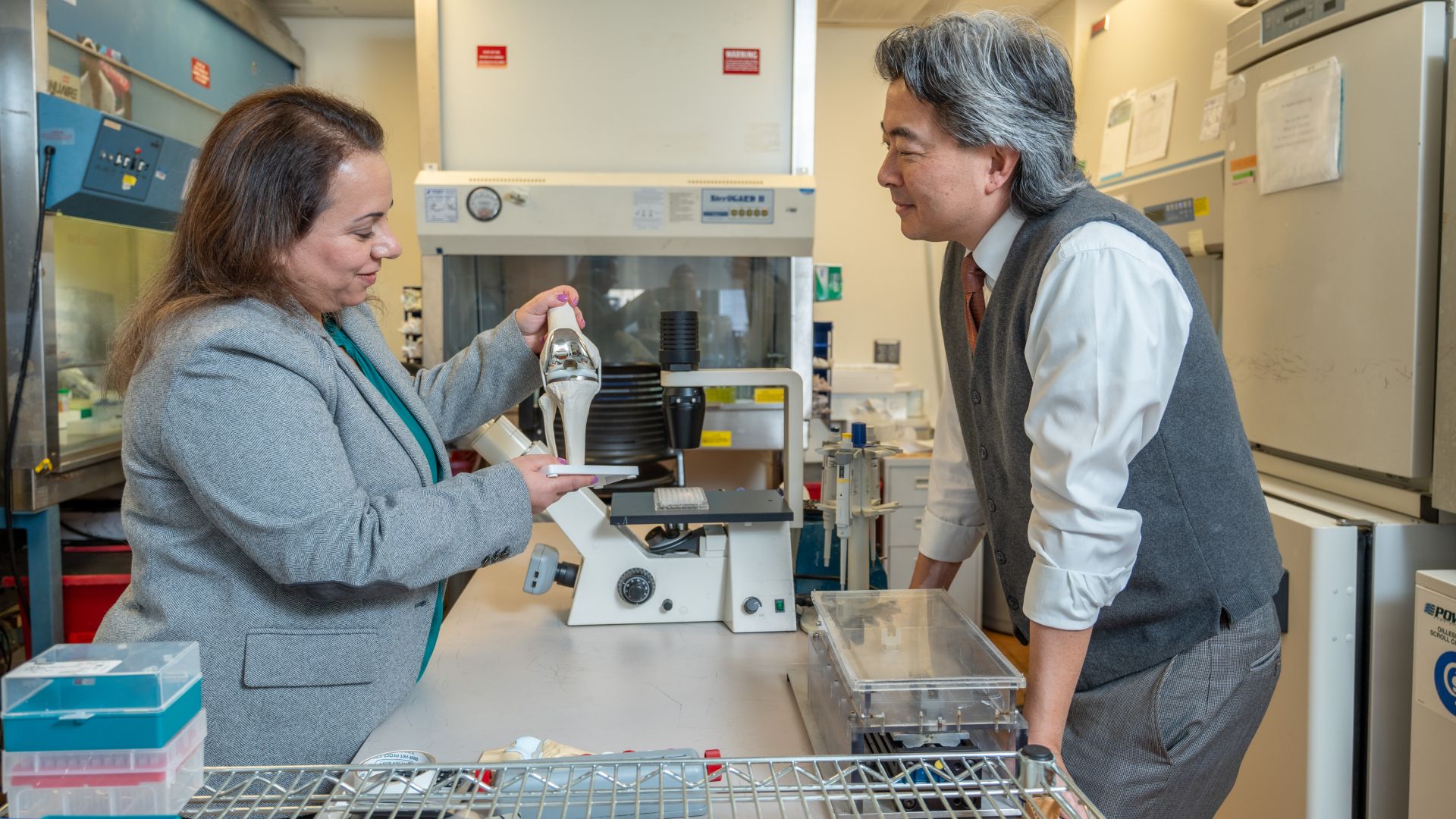
Imagine getting a knee replacement made of living materials rather than metal and plastic.
Researchers at Columbia University and the University of Missouri are working to make that vision a reality. Their 3D-printed knee implant, called NOVAKnee, is composed of a biodegradable scaffold packed with stem-cell-derived bone and cartilage. The idea is that, once inside the body, the scaffold will gradually disappear as it’s replaced by new bone and cartilage that will integrate into the patient’s skeleton.
NOVAKnee could be a better option for these patients. The implant has been tested in lab mice, in experiments where a tiny version was placed beneath the animals’ skin to see how the body reacted. It will soon be tested in larger animals in experiments that replicate how a knee replacement works in humans; the type of animal being used for those tests has not been disclosed yet.
If all goes well, the developers hope to launch their first human trials as soon as 2028. The work is being supported by a federally funded project called Novel Innovations for Tissue Regeneration in Osteoarthritis (NITRO).
Live Science spoke with two of the developers — Clark Hung, a professor and vice chair of the Department of Biomedical Engineering at Columbia University’s School of Engineering, and Nadeen Chahine, a professor of biomedical engineering in orthopedic surgery at the Columbia University Vagelos College of Physicians and Surgeons — about the new technology.
Nicoletta Lanese: What are the issues with conventional knee implants that NOVAKnee aims to address?
Clark Hung: Conventional knee replacements, metal and plastic implants, actually work really well. But they’re limited to 15 to 20 years, basically until they fail, from a materials perspective. If you’re not toward the last couple of decades of your life, there’s a good chance that you’re going to outlive your implant, which would require having another implant put in — that’s called a revision surgery.
When it [the first implant] fails, the physician has to go in and try to pull that implant out without destroying the bone that’s there. And they actually have to make a larger opening to put the new implant in.
Nadeen Chahine: When the patients are older, when they’re having that revision, you’re dealing with weaker bone, or higher bone mass loss, compared to that younger patient. So that comes with a higher risk of loosening [the implant becoming unstable within the knee joint] and higher risk of failure.
CH: So if you’re a younger patient who’s missing a lot of the anatomic surface of your cartilage, most surgeons will tell you to wait and take meds to relieve pain until you’re older, to get the actual knee replacement.
The goal here is really to get people back to function and have no pain. One of the challenges, therefore, is to come up with a living version of a knee replacement, where it could possibly be your last knee replacement and something that will have a longer duration of success than current implants.
NL: Do you think NOVAKnee could be useful to older knee transplant patients, as well?
NC: It’s not entirely fully clear, to be honest. The data has to play out to see what patient populations are going to benefit the most. I think we see that there is an opportunity to help younger adults who currently have no options — no treatments besides injections and stopgap measures to help them manage the pain and disability that they’re going through.
NL: In terms of the surgery, should this knee replacement work just like a normal one?
CH: It’s supposed to be pretty similar. … We are embracing, at least from a commercialization perspective, the orthopedic surgeon’s role in this process in that we’re coming up with a living version of something they’re familiar with.
NL: Could you theoretically accomplish something similar without an implant, by introducing stem cells directly to the knee joint, for instance?
CH: Other projects in the NITRO portfolio are looking at injectables to regenerate bone and cartilage. As of now, there’s nothing commercially available that can meet those demands. Most things on the market are there to relieve pain, whatever that mechanism is — from viscosupplementation, where you essentially inject Jell-O into the knee to try to cushion the joint, to corticosteroids. It’s masking the inherent issue [of the joint being degraded]. The NITRO program as a whole is aimed at making the problem go away one way or the other.
[When it comes to injectables] I’m not really sure how these products will work if you have major damage to the articular surface [where the bones of the joint meet], where most of the cartilage is missing. In those situations, something like we’re proposing might be more appropriate because you may or may not have the time [to regrow that tissue] if you’re essentially bone-on-bone.
We did joke at the beginning of the program that, theoretically, if these injectables work, it would put us out of business. But in my mind, I think there are a lot of people who have implants already — conventional ones — and if those were to fail and need revision, our product would still have a role.
NL: How did you go about designing the implant’s scaffold?
NC: The goal is that it’s there to elicit a response that’s controlled and well-defined — and then it will degrade over time, and that will result in components that are natural to the body that then get broken down through the normal mechanisms.
What we sought to do is to build on that by creating something that looks like a knee and functions like a knee but can’t be a permanent material like metal and plastic.
NL: And where do the stem cells come in?
NC: We are developing two versions of the technology. One of them will be seeded with the patient’s own cells. We would isolate stem cells from the patient and then use that to generate cartilage and bone cells, and that would be our “autologous” product [derived from the same individual]. Those cells then get put back on the scaffold, and then we would implant them.
On the other hand, there are some considerations where a patient might not be a good candidate for autologous therapy, or their regenerative potential is not quite what it needs to be. At that point maybe, we want to consider using allogeneic cell sources [cells from other people] and getting donor cells from a bank prepared using the same mechanisms.
We still need to understand a little more definitively who the ideal candidate is for autologous versus allogeneic, and how we decide on the clinical workflow of who should get one or the other. Right now we’re still in this R&D phase.
NL: In a human patient, how long would the scaffold take to break down and leave the new cells on their own?
NC: That’s a very hard thing for us to predict exactly. We’ve done studies both on the biodegradation, as well as studies on the matrix synthesis [the growth of bone and cartilage], and have some ideas of how those are happening. But to date, we’ve only studied them in small animal studies.
We have some idea of how much matrix is being synthesized and how much degradation is happening [once the implant is] in the body, but not necessarily in the knee. What we also don’t yet know is how the presence of mechanical loading, the use of your knee implant, affects both how much it degrades and how much matrix is being synthesized.
That’s what we’re studying at this new phase of the project [in the large animal experiments]. These are really important questions that we want to be able to answer to modify our approach if needed, to address any potential shortcomings.
CH: In our large, preclinical animal studies, NITRO is mandating that we use an arthritis model. So we’re basically going to create osteoarthritis in the animals and then do the living knee replacement. It’s going to simulate better what clinically happens in people.

NL: Since it sounds like human trials might start fairly soon, are you preparing for those already?
CH: This program we’re in is a five-year program: two years of R&D, basically benchtop; 18 months of large animal studies; and then 18 months of Phase I [safety] clinical trials. Trials would be 18 months or two years from now if everything went perfectly with our animal studies and the FDA greenlit it and said, “Hey, this is perfect data; we’re going to give you the option to go into humans.” So it’s probably really ambitious, but the whole program is ambitious.
NC: We’ve gotten a lot of interest from people all over the country and abroad who want to learn about the trial or who are asking us, “Should I postpone my knee replacement so that I could join your trial?” We obviously can’t answer any of those questions yet, but we really value the enthusiasm and the interest. We have a form that should be going up on our website so that those individuals that want to stay engaged can learn about the progress.
Honestly, while we’ve been buried in technical research and sweating those details to make sure we’re doing the best science we can to bring forward this technology, it’s very refreshing and very eye-opening to hear about the needs of regular people everywhere who are telling us how desperately they are in need of something like this. I’m getting calls and texts from my friends’ parents, from people that live in my community, everywhere — “Please tell me, what can I do?”
NL: For the people who reach out, are there particular trends? Are they mostly younger patients waiting on a future knee implant, for instance?
NC: I think there’s a lot of that. They’re too young, and waiting makes sense. And maybe they’re not as advanced, as in they’re not full bone-on-bone but they’re still in a lot of pain and discomfort. Some of them have had to give up certain activities or sports that they’ve enjoyed that now they can’t do. It’s a lot of that.
CH: I’ve seen a couple where people just don’t want foreign objects in them. Theoretically, if this all works out — and let’s say you have cells from yourself, it’s autologous, if everything absorbs away like it’s supposed to — then eventually, it becomes you, your own bone and cartilage.
So some people are like, “If I could have something that’s living, that’s going to be part of me and not something that’s going to be sticking around as an object in me, I’d prefer that.”
NL: Zooming out, do you think this new technology could be useful for other joint replacements?
NC: If it was up to us to decide what joint to try this first, we wouldn’t have picked the knee. I understand where the decision came from because that’s where there is the greatest need. However, from a mechanical perspective and from a joint function and range-of-motion standpoint, it’s probably one of the hardest. We would have started in a different joint, just to kind of build up the proof of concept in something that’s a little bit more forgiving.
Given that context, I think we have a desire and a vision to see this as a platform technology that could be developed for other large joints, or even some smaller joints, depending on the function and the need. Hopefully, in due course, that’s something that we’ll want to pursue.
NL: If you had your pick, what joint would you have started with?
NC: One of our collaborators tells us the thumb is a very important area that actually doesn’t have very good technology currently, that is usable for [joint] replacement. Despite it looking like a very small joint, it actually undergoes a lot of high forces, but the range of motion is more limited. So that could be something that we could have worked on.
CH: And everybody likes to have their ability to grip things and “pincer action” [using the pointer finger and thumb to pick things up].
NC: And we’re all going to get really bad OA [osteoarthritis] of our thumbs with all the texting we do. So it’s been a problem, but it’s only going to get worse with the aging population.
This article is for informational purposes only and is not meant to offer medical advice.