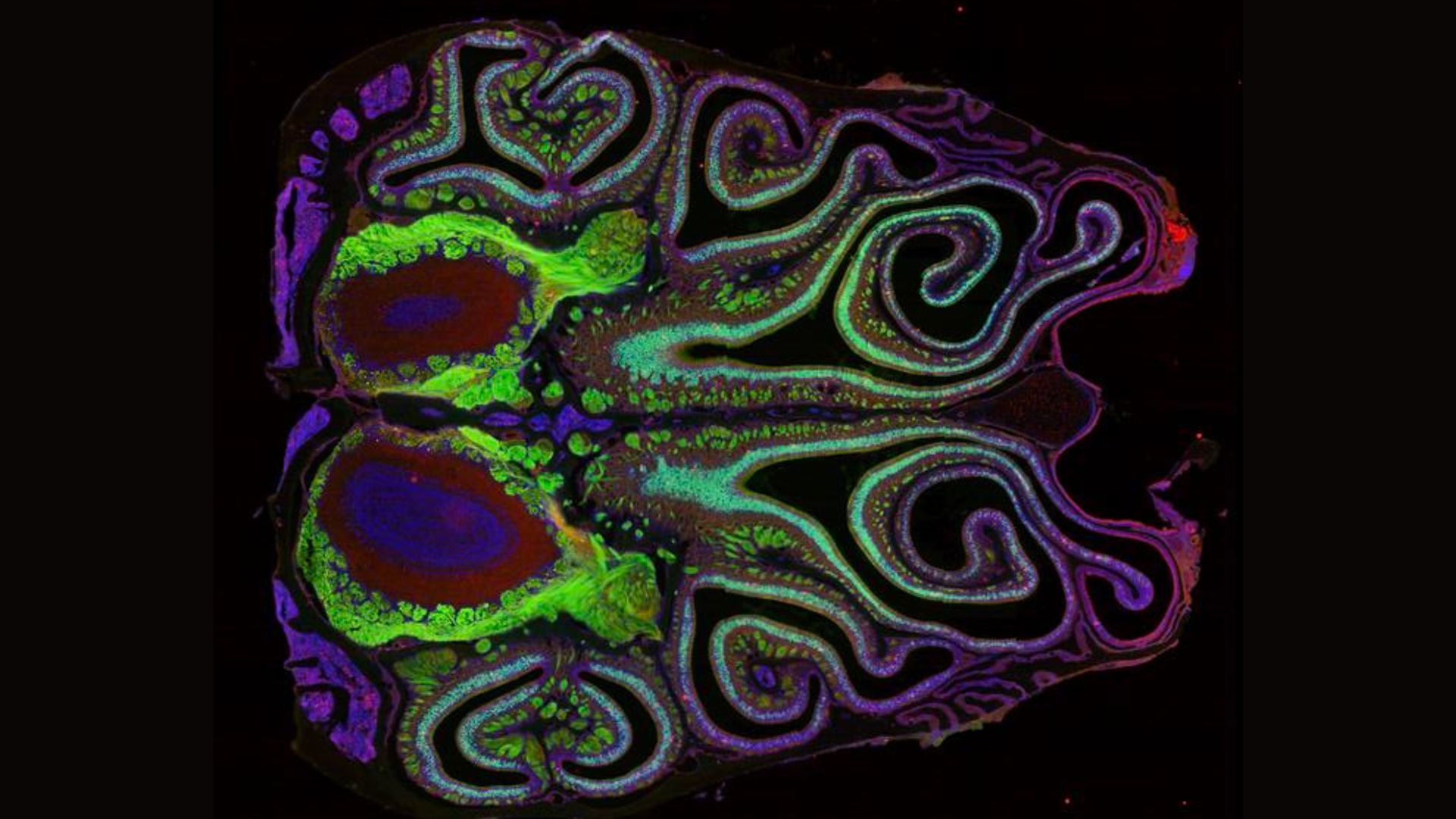
Scientists have created a comprehensive map of smell receptors in the mouse nose, revealing a few surprises about this fundamental sense.
Smell receptors, or olfactory receptors, were previously thought to be randomly distributed within the lining of the nasal cavity. But now, the first-of-its-kind map shows that they are highly organized, with different types separated into tight bands.
Smells are detected by olfactory sensory neurons in the nasal cavity. Each neuron expresses one of 1,172 different receptors encoded in mouse DNA, with each receptor detecting a different type of smell.
Other senses — such as touch, vision and hearing — are known to use sensory maps. For example, for hearing, different frequencies are encoded at different positions in the cochlea of the inner ear, and from there, that information is relayed to the brain. Smell was not thought to use such mapping, but in the past six or seven years, newer techniques have enabled scientists to examine around 5.5 million neurons in over 300 individual mice and better understand which genes are active in different nose cells.
One of these techniques is called single-cell sequencing, said senior study author Dr. Sandeep Datta, a neurobiologist at Harvard Medical School. It enabled the researchers to look at each mature olfactory sensory neuron “one at a time, to identify which receptor is being expressed,” he explained. Then, a technique called spatial transcriptomics helped the researchers locate those receptors.
Using this data, the team created a “beautiful map” of the over 1,100 smell receptors in the mouse nose. The map showed “a thousand separate stripes of odor receptor expression that overlap with each other but are very organized,” Datta said.
Neurons that express the same receptor in the nose target the same spot within the olfactory bulb, the brain’s primary processing center for smell, the team found. “The map in the nose is precisely aligned with the map in the brain,” Datta said.
The degree of complexity within the lining of the nose is remarkable, he added. “Mice, for example, have around 20 million olfactory neurons that express more than a thousand types of smell receptors, compared with only three main types of visual receptors for color vision,” he said.
Interestingly, the positions of the roughly 1,100 types of receptors were essentially the same across every lab mouse the researchers examined. The work also identified a molecule called retinoic acid (RA) that likely guides each neuron to express the correct receptor based on the location. Adding or removing RA resulted in the receptor map shifting up or down, suggesting the molecule may help control the position and influence of the neurons.
The researchers are now looking into why the stripes are arranged in that specific order. “[Another] question we’re wondering about is, to what extent are human noses organized like this?” Datta said.
“The human olfactory system is, in many respects, similar to the mouse olfactory system [though we] have fewer odor receptors,” he noted. “But we don’t know much about whether these basic principles we’re learning about in the mouse apply to humans.” Understanding this could help develop treatments for loss of smell and its consequences, including an increased risk of depression.
See how much you know about the most complex organ in the human body with our brain quiz!