A “baby” exoplanet, discovered emerging from its cosmic cocoon around a nearby star, is the youngest alien world ever seen, a new study reveals. The planetary infant is less than 1 million years old and could help researchers study how other planets, including our own, took shape.
The juvenile world, dubbed Elias 2-24 b, orbits a newly formed star around 450 light-years from Earth. It is somewhere between two and four times as massive as Jupiter and almost twice as far from its home star as Neptune is from the sun.
Astronomers spotted initial signs of the hefty exoplanet in 2017, when they noticed a small gap in the star’s protoplanetary disk — the swirling ring of gas, dust and other stellar debris left over from the star’s creation. This gap strongly implied that an exoplanet had formed there after enough of the disk’s spinning material had gravitationally clumped together, the process by which most planets form. However, the alien world was not directly visible at the time.
In the new study, published Sept. 16 in The Astrophysical Journal Letters, researchers combined observations from three telescopes — the W. M. Keck Observatory in Hawaii, the Atacama Large Millimeter/submillimeter Array in Chile and the European Southern Observatory’s Very Large Telescope, also in Chile — to take a closer look at the gap in the protoplanetary disk. Not only was the team able to directly image Elias 2-24 b and confirm its existence, but the researchers also dated it, revealing that the alien world is likely less than 1 million years old.
“What makes Elias 2-24 b so remarkable is its age,” study first author Andrea Bernardi, a doctoral student with the Institute of Astrophysical Studies (IEA) at Diego Portales University in Chile, said in a statement. “This is the youngest planet detected so far, and because it is still actively accreting material from its surroundings, we’re able to observe a stage of planet formation that is rarely seen directly.”
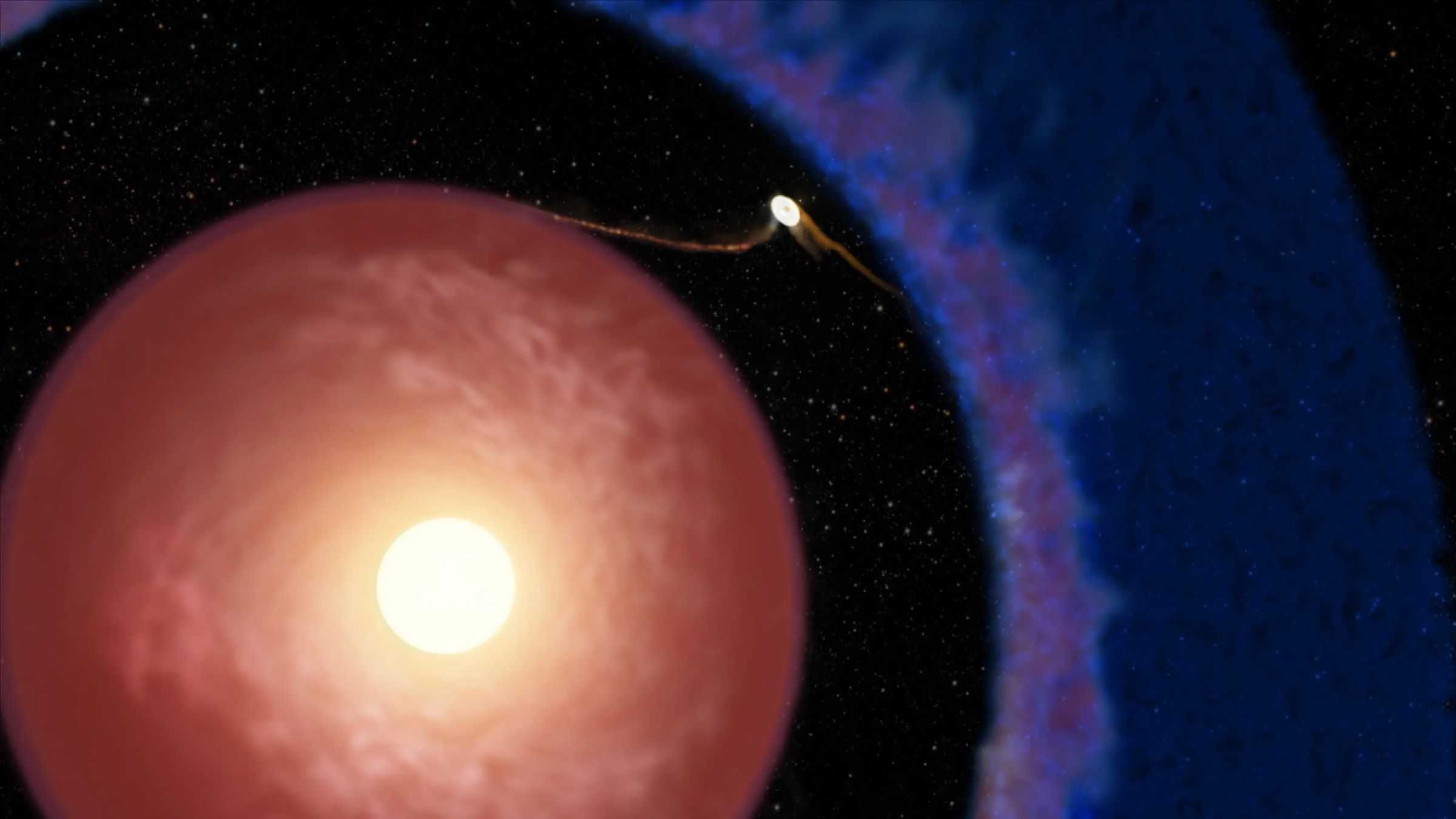
Astronomers first noticed the gap caused by Elias 2-24 b in 2017, but could not directly see the exoplanet until now.
(Image credit: Bernardi et al. 2026)
The newly confirmed exoplanet is roughly 5,000 times younger than Earth or around 0.008% the age of the oldest known exoplanet, PSR B1620-26 b or “Methuselah,” which formed around 1.1 billion years after the Big Bang. Compared to the average human lifespan, this makes Elias 2-2 b roughly equivalent to a two- or three-day-old baby.
Record setter
This is not the first time that astronomers have spotted baby exoplanets. But until recently, there has been an age limit on when they become visible to us.
Get the world’s most fascinating discoveries delivered straight to your inbox.
For a long time, the youngest-known exoplanets, which included several worlds orbiting the star PDS 70, were around 5 million years old. This is because telescopes were not powerful enough to spot exoplanets until they had cleared a large enough gap in their star’s protoplanetary disks. But advances in telescope design and data analysis have helped researchers push past this age limit: For example, in 2024, astronomers discovered TIDYE-1b, which is believed to be around 3 million years old; and in 2025, scientists detected AB Aurigae b, which could be as young as 2 million years old.

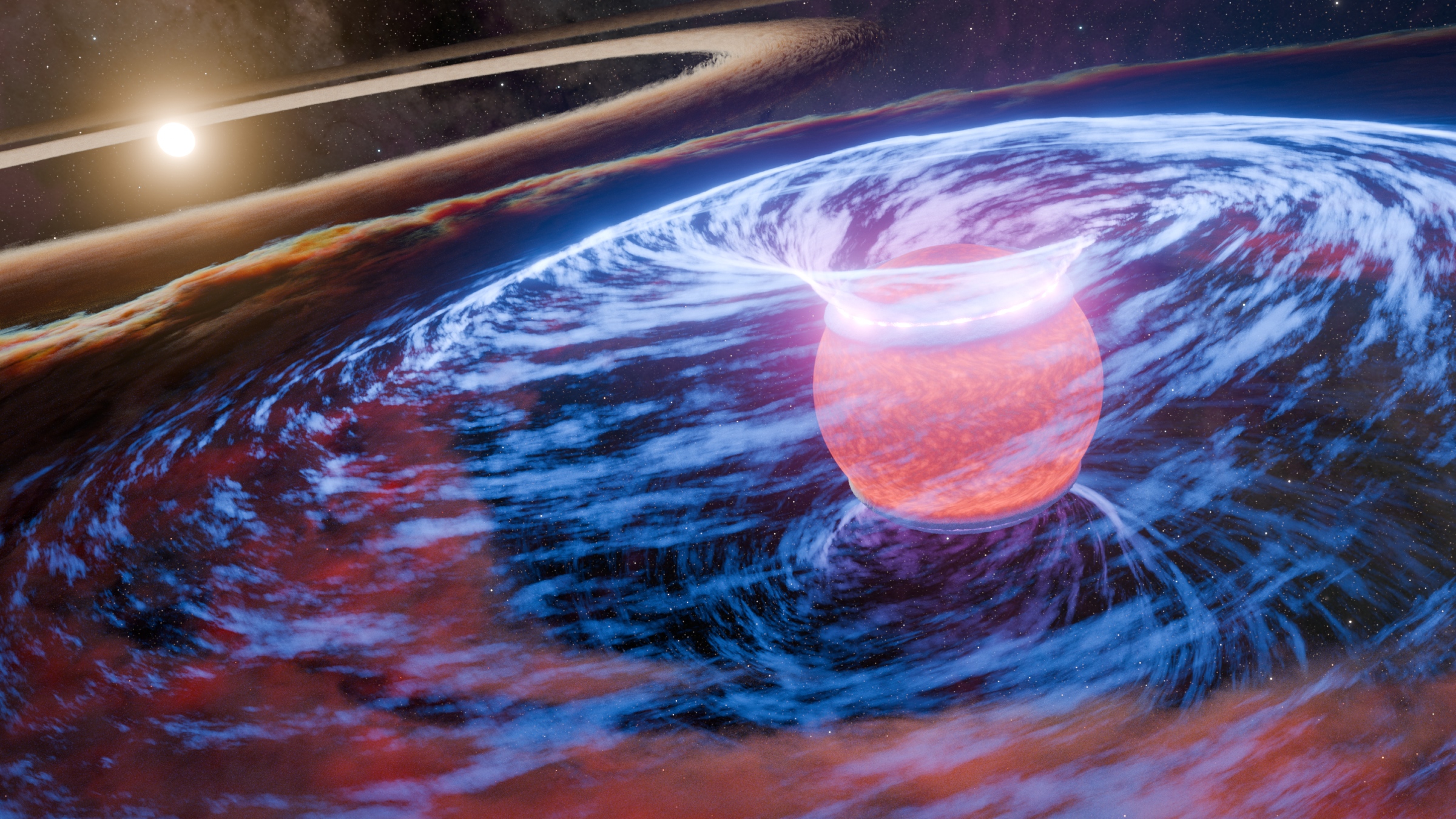
Planets form by accreting material from a star’s protoplanetary disk, as shown in this illustration of the fellow “baby” exoplanet WISPIT 2b, which is around 5 million years old.
(Image credit: NASA/JPL-Caltech/R. Hurt (IPAC))
Elias 2-24 b is at least twice as young as any known exoplanet, which is a significant step forward. This provides scientists with a rare opportunity to fill in the current knowledge gaps surrounding the initial stages of planet formation.
“Our planet-formation models already struggled to explain the previous record holders for the youngest known planet,” Lucas Cieza, an IEA astronomer who led the 2017 study that first spotted the gap left by Elias 2-24 b, said in a second NASA statement. “Elias 2-24 b shows us that even our best planet-formation models are still missing some important processes.”
Mind the gaps
A majority of the more than 6,000 exoplanets discovered so far have been spotted via the transit method, where a distant world passes between its home star and Earth, causing a temporary dip in the star’s brightness. However, this doesn’t work if the alien worlds lurk within a protoplanetary disk, because the swirling debris cloud permanently dims the star’s light when viewed side-on. This has created a bias toward finding older exoplanets.

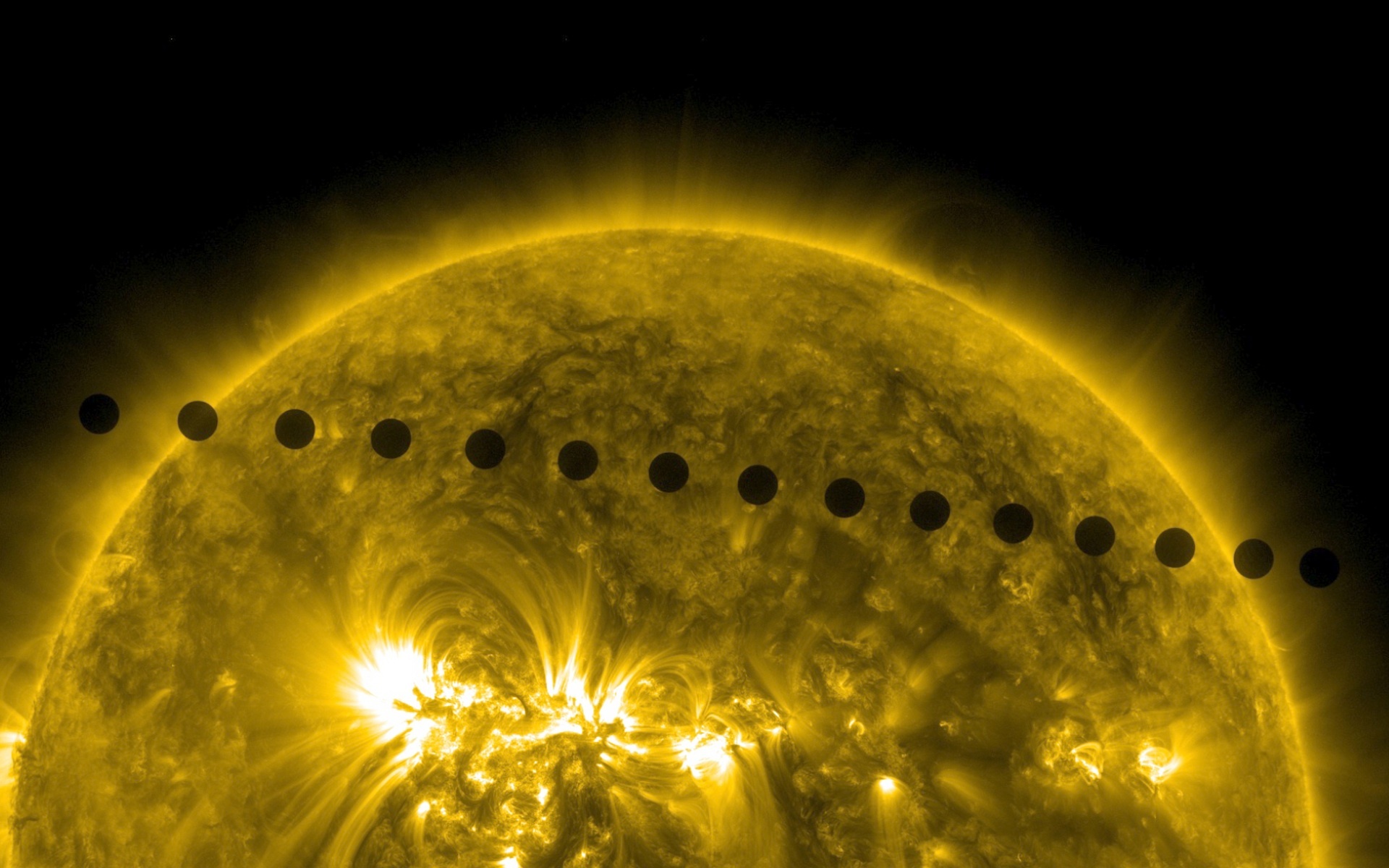
The most common method for finding exoplanets is by searching for transit events, where the alien world passes in front of its home star (similar to this transit of Venus in front of the sun). But this doesn’t work with protoplanetary disks.
(Image credit: NASA/SDO/AIA)
The only way to spot a juvenile exoplanet is if a star’s protoplanetary disk is perpendicular to Earth, so that we are looking at it from the top down or bottom up and can clearly see any gaps within it. But this is much harder because the light from the star often outshines the disks, meaning we are “mostly blind to these baby planets right now,” Cieza said.
However, this could change thanks to NASA‘s soon-to-be-operational Nancy Grace Roman Space Telescope, which launched into space Aug. 30 and is currently calibrating its instruments before beginning its potentially decades-long mission to observe the cosmos. The space telescope is equipped with a state-of-the-art starshade, or coronagraph, which blocks out the light from distant stars, making it easier to study their surroundings. Experts predict that Roman could spot up to 100,000 new exoplanets during its mission and will have less of a bias toward older planets, meaning we should find many more planetary infants.
“This is just the beginning of a new era of discovery,” Cieza said. “Roman will take planet hunting to the next level.”
Bernardi, A., Zurlo, A., Cieza, L. A., Ruane, G., Christiaens, V., Dasgupta, A., Guidi, G., Mawet, D., Mesa, D., Pérez, S., & Williams, J. P. (2026). Searching for Embedded Protoplanets with the Keck/NIRC2 Vortex Coronagraph: Confirmation of a Core-accretion Planet in the Narrow Gap of the Elias 2-24 Disk. The Astrophysical Journal Letters, 1009(1), L3. https://doi.org/10.3847/2041-8213/ae9bb6