



QUICK FACTS
Where is it? Nazaré, Portugal [39.60478265, -9.071984267]
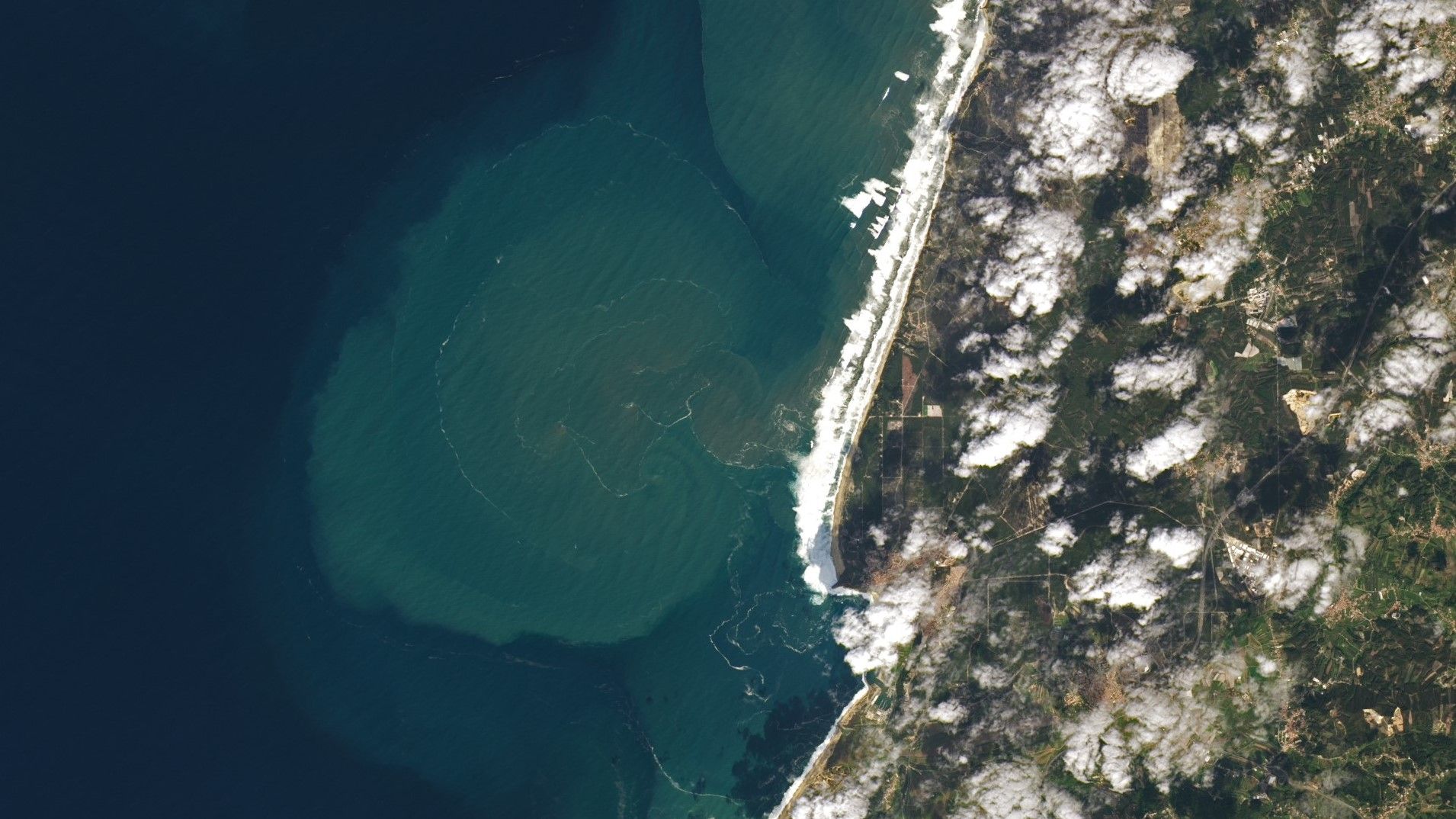
What’s in the photo? Massive 7-story waves crashing along the coast, creating giant underwater sediment plumes
Which satellite took the photo? Landsat 8
When was it taken? Oct. 29, 2020
This striking satellite snap highlights the immense power of 7-story waves crashing along the Portuguese coast and ejecting massive sediment plumes under the sea. The same day this photo was taken, a local 18-year-old surfer set a new world record by riding one of the colossal crests.
The Landsat 8 satellite captured this epic scene near the town of Nazaré in western Portugal, a region famous for having some of the tallest waves on Earth. Nazaré is home to around 15,000 people and regularly hosts “big-wave” surfing competitions, which attract surfers from around the world. The swells there are so big that surfers often have to be towed into the breaking waves with a jet ski.
The monster waves in the image likely reached heights of around 80 feet (24 meters), which is roughly equivalent to a 7-story building. This is exceptionally tall — even for Nazaré, where waves usually peak up to 50 feet (15m) at this time of year — and would usually be considered too dangerous to surf.
As these waves broke along the shore, their powerful undercurrents ripped up sand and other sediments from the seafloor and spat them out in the opposite direction to the waves, creating murky underwater clouds that could be seen from space.
The plumes in this photo extend up to 6 miles (10 kilometers) from the coastline, according to NASA’s Earth Observatory.
Later the same day, local surfer António Laureano rode an even loftier wave, estimated to be approximately 101.4 feet (30.9 m) tall — the largest wave ever surfed by a human.
This record is not officially recognized by the World Surf League (WSL) because the organization’s representatives did not calculate the wave’s height. Instead, the height was determined by oceanographers at the University of Lisbon, who analyzed a video of the wave sent to them by Laureano, surfing news site Surfer Today reported at the time.
The current WSL record for the tallest wave ever surfed belongs to German surfer Sebastian Steudtner, who rode a 93.7-foot (28.6 m) wave, also at Nazaré, on Feb. 24, 2024, according to Surfer.com.
In total, seven of the official top 10 largest waves ever surfed have occurred at Nazaré, according to Red Bull.
“Big-wave” hotspot
The secret behind Nazaré’s giant waves is the Nazaré Canyon just southwest of the town. It is the largest submarine canyon in Europe, stretching 130 miles (210 kilometers) long and roughly 3 miles (4.8 km) deep into the Atlantic Ocean.
Water inside the canyon travels faster than shallower water, forming large waves at depth that are “bent” in the direction of Nazaré. As they approach the coast, these large waves collide with other waves coming from the northwest, which further amplifies their speed and allows them to quickly rise when they approach the shore.
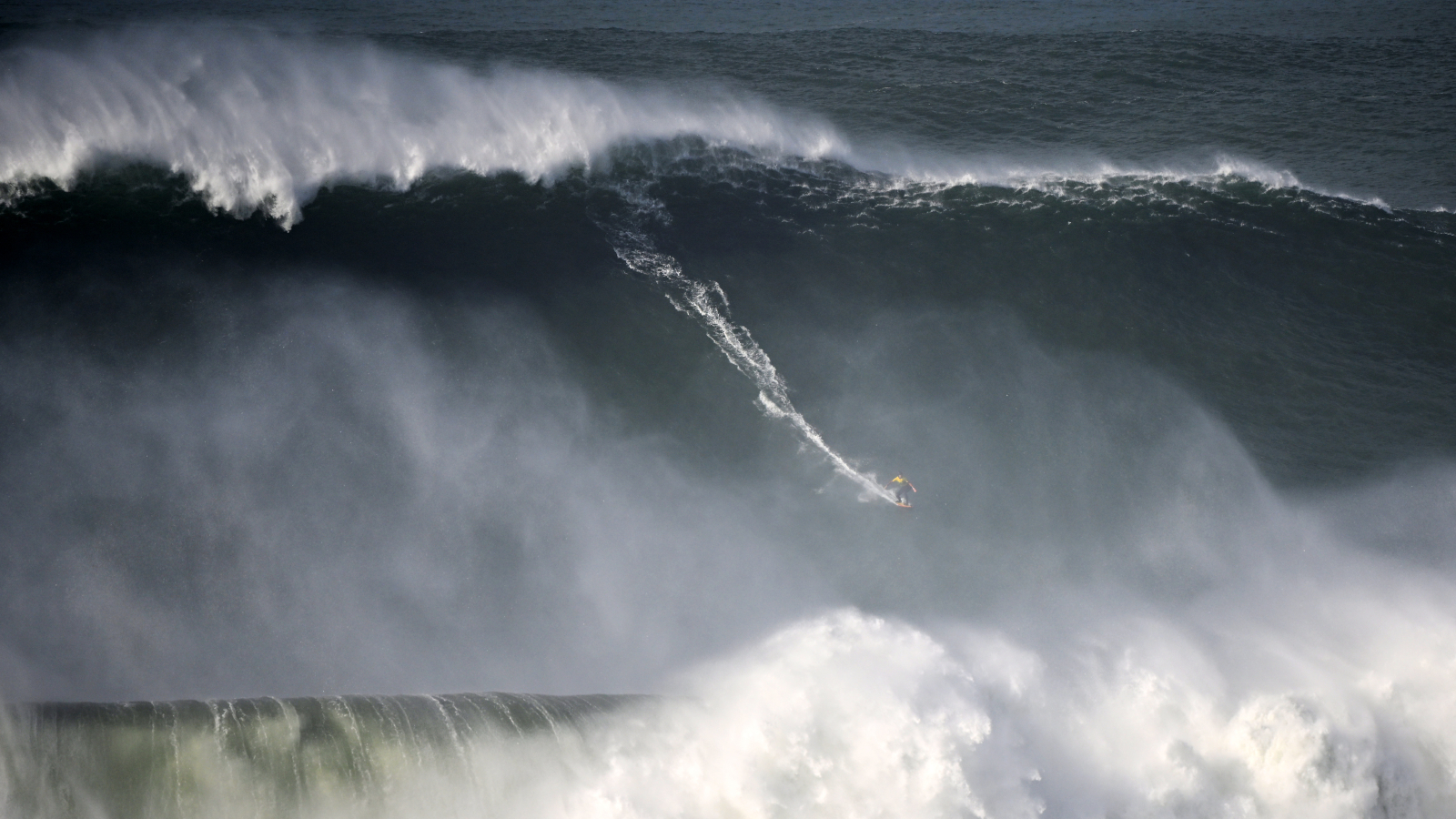

Occasionally, the waves can be further amplified by strong offshore winds. This was the case with the supercharged swells in the satellite photo, which were partially fueled by the remnants of Hurricane Epsilon, according to the Earth Observatory.
Nazaré’s big wave phenomenon is highly seasonal, with the largest waves typically occuring between November and February. In the summer months, the waves almost completely disappear, allowing tourists to flock back to the beaches and swim in the sea. However, even then, disaster can still strike.
In August 2012, for example, a five-year-old girl and her 66-year-old grandfather, both British nationals, were killed after being dragged out to sea by a massive “rogue wave” as they were walking on a nearby beach, according to the BBC.
For more incredible satellite photos and astronaut images, check out our Earth from space archives.