A gold coin minted more than 1,000 years ago as an imitation of a more famous coin may be a relic of the “Great Heathen Army” that invaded England in 865 — an invasion that led to the Viking kingdom there known as the Danelaw.
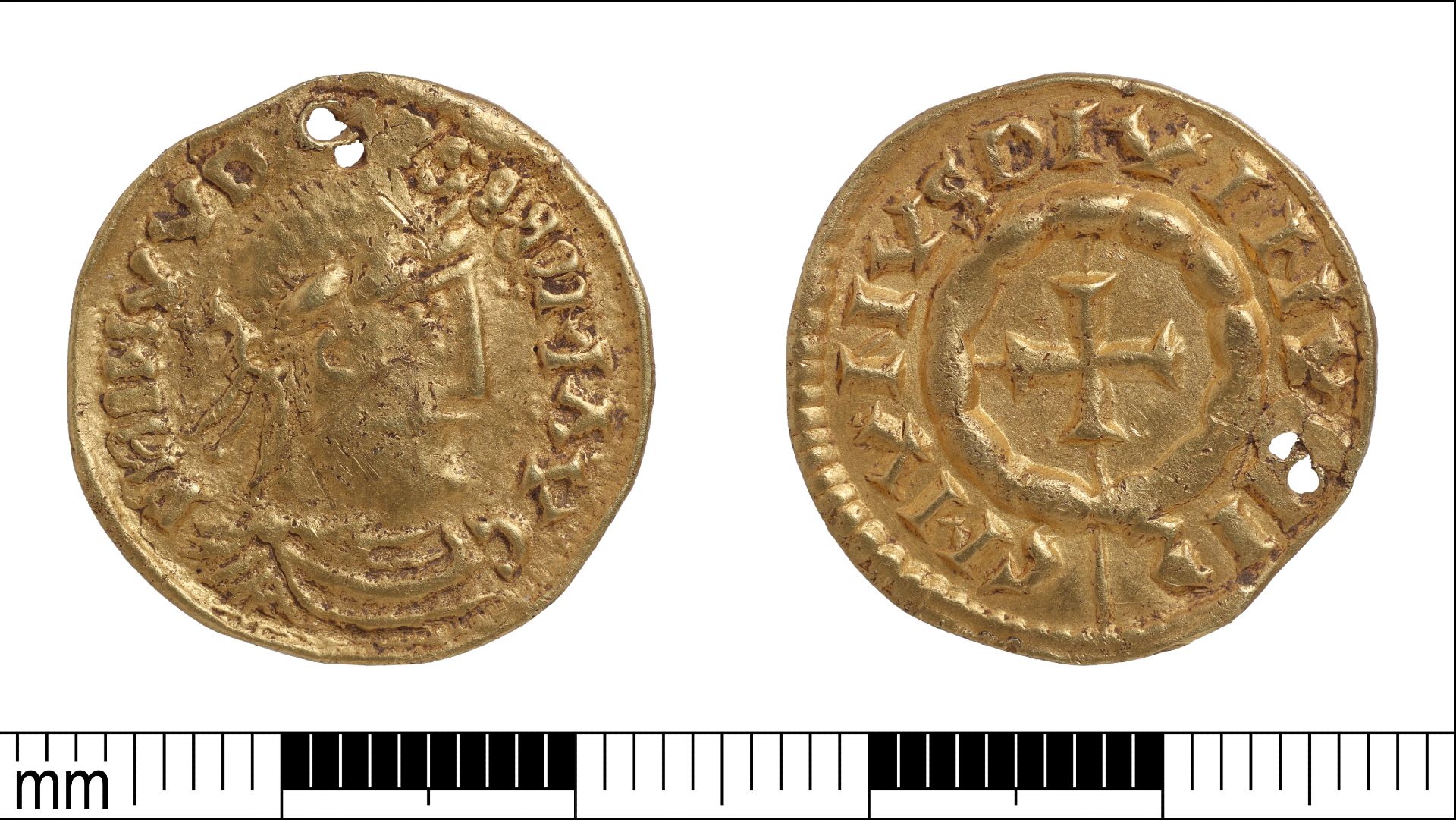
According to the Portable Antiquities Scheme, which is run by the British Museum and Amgueddfa Cymru – Museum Wales, a metal detectorist discovered the coin in 2024 in a field near Elsing, a village in Norfolk on England’s east coast, which was among the areas first invaded by the Viking army.
Importantly, the coin was a solid-gold imitation of earlier “solidus” coins minted by the Carolingian emperor Louis the Pious — the son of Charlemagne — about 50 years earlier.
The original solidi were awarded to high-ranking Carolingian nobles, but the later copies — probably made in Frisia, an area now covered by the northern Netherlands and the western edge of Germany — were used as “portable wealth” throughout Scandinavia, he said.
It is likely this one was worn as an amulet by one of the Viking invaders. “The Norfolk find is a particularly fine specimen compared with most,” Coupland said.
Gold pendant
The object is now going through an official inquiry to determine if it is “treasure” that must be given or sold to a museum, and Norfolk’s Norwich Castle Museum has expressed interest.
According to its entry on the Portable Antiquities Scheme’s website, the gold coin is pierced through twice above the head of the emperor Louis it portrays, which suggests the “head” side was meant to be facing forward when it was worn as a medallion.
The other side of the coin features a Christian cross, which probably wasn’t favored by the Viking invader who wore it. (The Vikings and other Norse, beginning in the central Danish kingdom, didn’t start converting to Christianity until the late 10th century.)
The Viking force, which the Christian English dubbed the “Great Heathen Army,” began their invasion in 865 under the Danish chieftains Ivar the Boneless (it is unclear what his name means), Halfdan and Ubba. All three chieftains claimed to be sons of the legendary Viking hero and king Ragnar Lothbrok, who appeared in Norse sagas.
Experts debate whether the army comprised as few as 1,000 Viking warriors or more than 5,000, but as the fighting continued, they were reinforced from Scandinavia in 871, and in 878, Viking leaders negotiated the Danelaw with the English king Alfred the Great.
The deal kept the invaders out of Alfred’s lands and established a Viking kingdom — with unique laws — over much of eastern and northern England for more than 50 years. In the following decades, Alfred’s successors once again amalgamated the Viking territories into the English kingdom, which fell to the Norman Conquest in 1066.