







“Hamnet” is absurd. The breathlessly acclaimed festival sensation from Oscar-winning director Chloé Zhao arrives in town this week on a tsunami of hype. Earlier in November, distributor Focus Features ran an ad on social media with a pull-quote from an outlet called The Rolling Tape, hailing “Hamnet” as “Not just the best picture of the year, the best film ever made.” (Amusingly, I could find this quote nowhere in the website’s actual review of the movie.) “Hamnet” won the People’s Choice Award at this year’s Toronto International Film Festival, which is considered by those who keep track of such things to be the most reliable Oscar bellwether these days. Given that the prize has previously gone to “Green Book,” “Nomadland,” “Belfast,” “The Fabelmans” and “Jojo Rabbit,” the joke amongst my friends is that the award is even better at predicting which fall prestige picture is going to annoy me the most.
And boy, was I annoyed by “Hamnet.” It’s the worst movie I’ve seen since “The Life of Chuck,” which perhaps not coincidentally won the TIFF People’s Choice Award in 2024. On the way to Crystal Ballroom Movie Trivia the other night, a fellow critic and I spent our entire train ride talking about how much we hated “Hamnet.” We were almost late.
Based on a 2020 novel by Maggie O’Farrell, “Hamnet” is a magical realist spin on the story behind the writing of one of William Shakespeare’s greatest plays. As English majors probably already know, the playwright had a son named Hamnet who died in 1596 at the age of 11. The cause of death is unknown, but most scholars assume it was the plague, given the era and all. Astute readers may have already noticed that Hamnet sounds a lot like Hamlet. A helpful title card before the movie informs us that the names were interchangeable in those days, I guess like John and Jack, Beth and Betty or perhaps Anne and Agnes, since Shakespeare’s wife Anne Hathaway is referred to as Agnes throughout this picture.
What “Hamnet” presupposes is that what if “Hamlet” was not a reworking of the Norse legend of Amleth — recently brought to the big screen in director Robert Eggers’ rollicking “The Northman” — but rather a father processing his grief over the loss of his son by writing about… a son avenging his father’s murder at the hands of his mother and traitorous uncle? Okay, so the plot of “Hamlet” doesn’t really sync up all that well with the whole dead kid thing. But I’ll concede it’s a better fit than the Shakespeare plays that were actually written closer to the real-life child’s passing, “Much Ado About Nothing” and “As You Like It.” Besides, have you noticed yet how much “Hamlet” sounds like “Hamnet”?
Still, as a fan of “Face/Off,” I acknowledge that we must grant films their premises, however silly. “Hamnet” is obviously not trying to be a historical drama but something airier and more abstract, as evidenced by the opening shot of Jessie Buckley’s Agnes curled up in the fetal position beneath towering, ancient trees, her blood red dress radiating against the deep green of the forest. We’re told more than once that she’s more than a woman, some sort of woodland nymph queen. Every falcon and hawk’s best friend, apparently, Agnes is a self-parodic icon of wild and untamed femininity, so at one with nature that when a midwife dares to make her give birth indoors, the dwelling is flooded with a river that rises up to meet her spawn. Buckley is a fine actress who tries her best to sell all this Earth mother mumbo-jumbo, but it still seems weird that they didn’t cast Anne Hathaway in a movie about Anne Hathaway
Her husband, whose name we do not hear spoken aloud until about 90 minutes into the picture for some reason, is a bumbling, inarticulate lummox. Presenting a William Shakespeare who’s always at a loss for words is certainly a choice. He’s played by Paul Mescal, who was so moving as the hapless single father in over his head in director Charlotte Wells’ shattering 2022 debut “Aftersun,” and has been almost exclusively miscast ever since. It’s impossible to buy this affable galoot as a gladiator or The Bard. He’s haunted throughout the picture by ominous shots of looming, empty abysses and crevasses that serve as heavy-handed foreshadowing for the tragedy to come. It reminded me of being 16 and stoned out of my mind, figuring out that the bald guy Oliver Stone had following around Jim Morrison in “The Doors” was supposed to represent death. Except that movie had better music. And Val Kilmer.
The child’s demise is staged with semi-pornographic vigor by Zhao in a way that makes the death scene from “E.T.” seem subtle and restrained. (Steven Spielberg is one of the producers of “Hamnet,” and no doubt offered some tips on putting the audience through the wringer.) Buckley puts on such a clinic of guttural screams and heaving, mucus-soaked sobs she’s guaranteed as many golden statuettes as will fit on her mantlepiece when awards season is over next spring. The film’s position is that young Hamnet heroically got into bed with his feverish twin sister and tricked the sickness into taking him instead of her. I’m pretty sure that’s not how the plague works, but it’s a nice story.

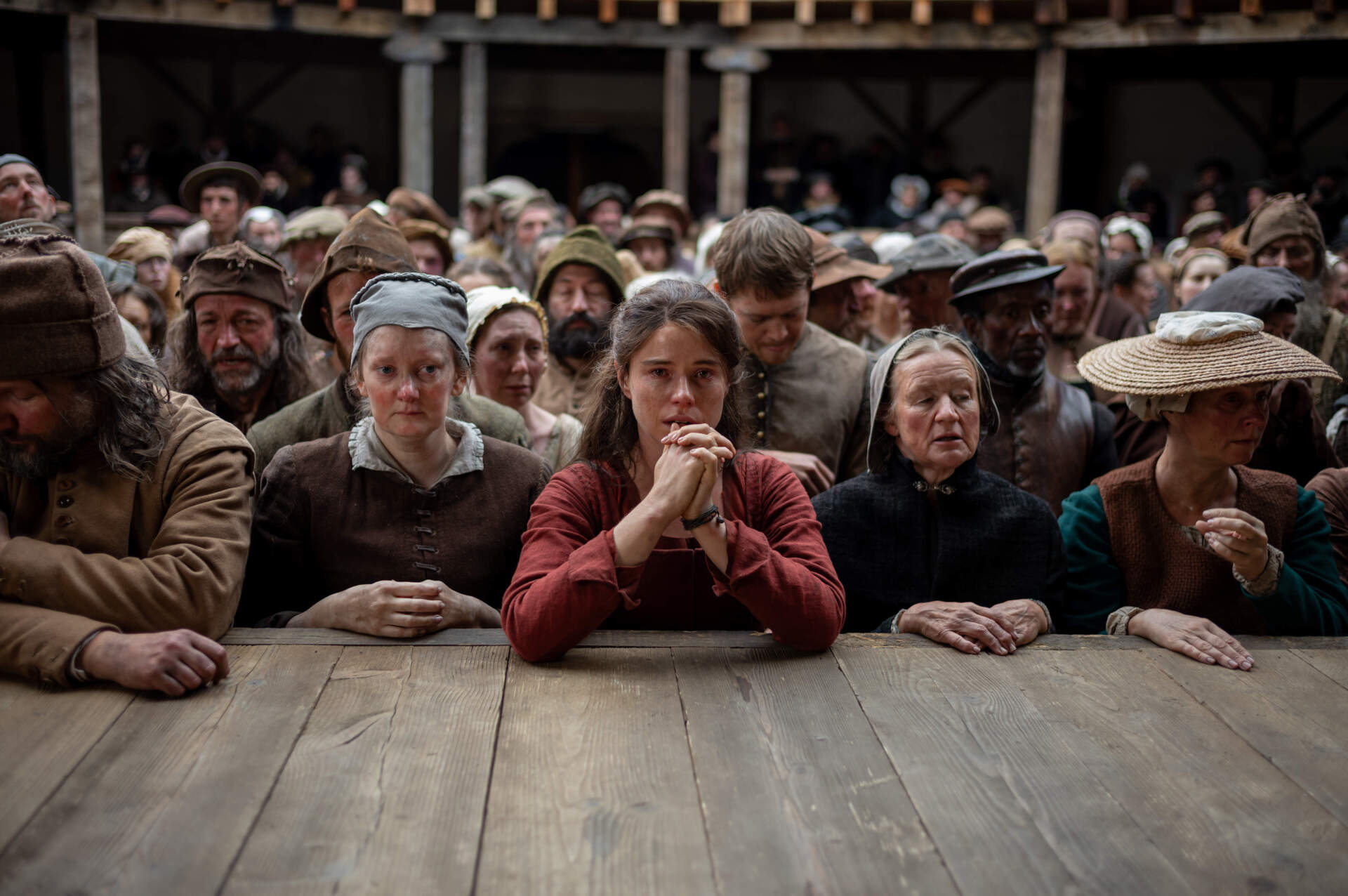
Agnes spends the rest of the movie being cruel and horrid to her grieving, heartbroken husband because he had the nerve to be off in London, working to feed his family by writing some of the greatest plays in the history of the English language instead of being at home where he could have watched his child die. The film builds to an even more shameless climax at the Globe Theatre, when a furious and bewildered Agnes somehow finds peace with her son’s passing while watching what appears to be the first stage play she’s ever seen. (Anyone who knows anything about Elizabethan theater will be bewildered by how often she’s shushed by the groundlings. I don’t want to be Neil DeGrasse Tyson here, but do a little homework!)
Bad movies like this love to bypass the hard work and painstaking craft that goes into making art, instead serving us implausible “a-ha” moments and easily graspable motivations. Just like last month’s terrible Springsteen biopic tried to boil an album as complex as “Nebraska” down to Bruce’s daddy issues, “Hamnet” has no respect for the toil and mystery of artistic creation, reducing a towering, complicated masterpiece to some sad dad’s therapeutic exercise. What I wouldn’t give for a movie about a writer to show them rewriting and revising! “Hamnet” asks us to believe that this marble-mouthed boob, who can’t get two words out otherwise, would have a bad night and rattle the complete “To be, or not to be” soliloquy off the top of his head while contemplating throwing himself into another one of those omnipresent, overly symbolic chasms. It’s just silly.
I feel like we got to the bottom of Zhao’s bag of filmmaking tricks pretty quickly. Her 2020 “Nomadland” was as fraudulent a Best Picture winner as I’ve ever seen, a self-consciously lyrical bit of poverty tourism meant to reassure bougie audiences that homeless people are happier that way and see trees more deeply than we do. “Hamnet” has a lot of low-angled, magic hour nature photography borrowed from Terrence Malick, with a self-plagiarizing musical score by Max Richter that subs in his 2004 composition “On the Nature of Daylight” for the movie’s big climax. (By my count, this is the ninth or 10th time that particular piece of music has been used in a film or television project. It felt played out in “Shutter Island” 15 years ago. I’m begging filmmakers to please put it on a shelf alongside Avro Pärt’s “Spiegel im Spiegel” and Carl Orff’s “Carmina Burana” and find a new classical music cue.)
It’s tough to say what the point of something like this is. You’re not going to learn anything about Shakespeare or “Hamlet,” and these weepy abstractions are hardly fleshed-out characters we can empathize with. The whole endeavor appears designed simply as a brute force exercise in wrenching tears. “Hamnet” exists only to garner awards and make audiences cry. The rest is silence.
“Hamnet” opens in theaters on Wednesday, Nov. 26.


