Many objects in space rotate. Earth completes a spin in roughly 24 hours, while Venus takes a whopping 243 Earth days. The moon’s rotational period is about 27 days. The sun, it turns out, also rotates. So how long does the sun take to complete a rotation?
The answer depends on your vantage point in space and the part of the sun you are measuring.
In 1612, Galileo Galilei looked at the sun through a telescope, drew what he saw, and observed that sunspots — dark areas near the sun’s surface — moved across the solar surface over time. “Galileo tracked a bunch of [sunspots] and came to the conclusion that the sun was rotating,” J. Todd Hoeksema, a solar physicist at Stanford University, told Live Science. By determining how fast the sunspots moved across the sun, Galileo found that the sun rotated once every 28 days. But this number doesn’t tell the whole story of how fast the sun rotates.
Centuries later, in the mid-1800s, English astronomer Richard Carrington also measured the sun’s rotation rate using essentially the same methods as Galileo but with a better telescope, Hoeksema said. Carrington determined how fast the sunspots were rotating in a particular region — approximately 30 degrees latitude (on the sun) — where sunspots were most often observed. According to Carrington’s measurements, sunspots moved at a rate that would take them about 27.3 days to travel all the way around the sun.
Most sunspots come and go within a week or two, so they do not last a full rotation, Hoeksema said. Even so, astronomers like Galileo and Carrington could map sunspot movement over days to determine how fast the sun was rotating and, from there, how long it would take the sun to make a full rotation, Hoeksema explained.
However, Earth’s rotation throws a wrench into these calculations. Because Earth is traveling around the sun and in the same direction the sun is rotating, a measurement of solar rotation taken from Earth captures the sun’s rotation rate relative to the movement of the Earth. This type of measurement is called a synodic rotation rate and is longer by nearly two days than a measurement that’s relative to movement of the stars (called a sidereal rotation rate), said Nicholeen Viall, a research astrophysicist at NASA’s Goddard Space Flight Center in Greenbelt, Maryland. Carrington’s rate of 27.3 days includes that extra two days, Viall said.
So, the sun actually makes more than one full rotation in Carrington’s rotation period of 27.3 days, Viall said. Despite this, Carrington’s rotation rate was “ultimately adopted as the standard by everyone,” Hoeksema said.
However, scientists now know that relative to the movement of the stars, which is so slow as to be negligible in this context, Viall said, the sun would take about 25.4 days to rotate on its axis at the solar latitude where Carrington was observing sunspots.
“From a pure physics perspective, the sidereal rate is the correct rotation rate,” Viall said. For that reason, this article will use sidereal rotation rates going forward.
Latitude and depth
Researchers like Carrington had to rely on the sun’s visible features, like sunspots, to determine the sun’s rotation rate. The problem is that not all regions of the sun have sunspots, Hoeksema said. There are “essentially no sunspots” at the poles and “relatively few” at the equator, he noted, so researchers who rely on sunspots to measure the sun’s rotation rate are limited by where on the sun they can take the measurement.
Taking measurements at different locations on the sun is necessary to get the full picture, because the sun’s rotation rate depends on latitude (on the sun) and depth, according to Hoeksema.
“It’s interesting that there is no one rotation rate that describes the sun,” he said. “Each part seems to have its own rate.” This phenomenon, called differential rotation, is possible on the sun because it is made of gas. Earth, on the other hand, does not rotate differentially because it is solid; all of its parts must move together.
Starting in the 1970s, scientists began observing solar rotation using methods other than visual observations. One of these is helioseismology, “which is using sound waves that are moving inside the sun to determine its characteristics,” Hoeksema said.
Scientists can also measure the sun’s rotation by observing Doppler shifts, whereby light waves get shorter or longer depending on whether they are moving toward or away from you, in the light emitted by the rotating sun.
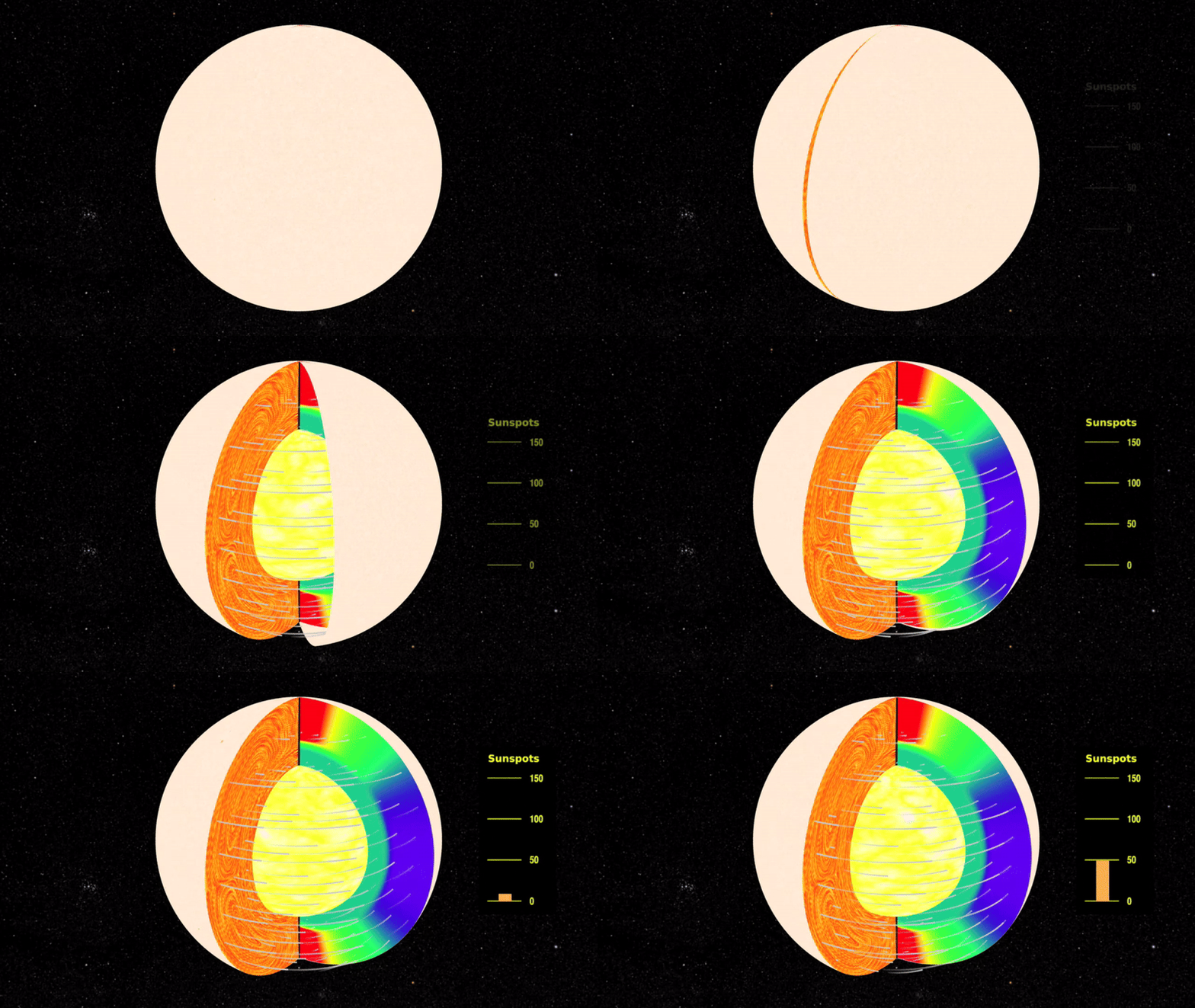
By combining these data sources, scientists have learned that the sun rotates the fastest at its equator, where it makes one rotation in 24.5 days, and the slowest at its poles, where a rotation takes 34 days or more. This latitude-based variation occurs from the sun’s surface to the bottom of the convection zone, a layer of the sun that extends from about a third of the way to the core.
In that same region, the sun’s rotation rate also varies by depth, Hoeksema said. Even deeper in the sun, the radiative zone — which lies between the convection zone and the sun’s core — rotates like a solid, at a rate of about 26.6 days, regardless of the latitude.
Scientists are not entirely sure how fast the sun’s core rotates, Hoeksema said, because researchers do not have good measurements there.
That’s “something for people to figure out in the future,” Hoeksema said.