People who hunt for honey in Mozambique use distinct dialects when communicating with birds to find bees, and the coordination benefits both species, new research shows.
The interaction is one of the few known examples of human-wildlife cooperation, researchers reported in a study published in the journal People and Nature.
The human hunter summons the bird with a call, and the bird responds with a signal of its own and guides the hunter to the honey.
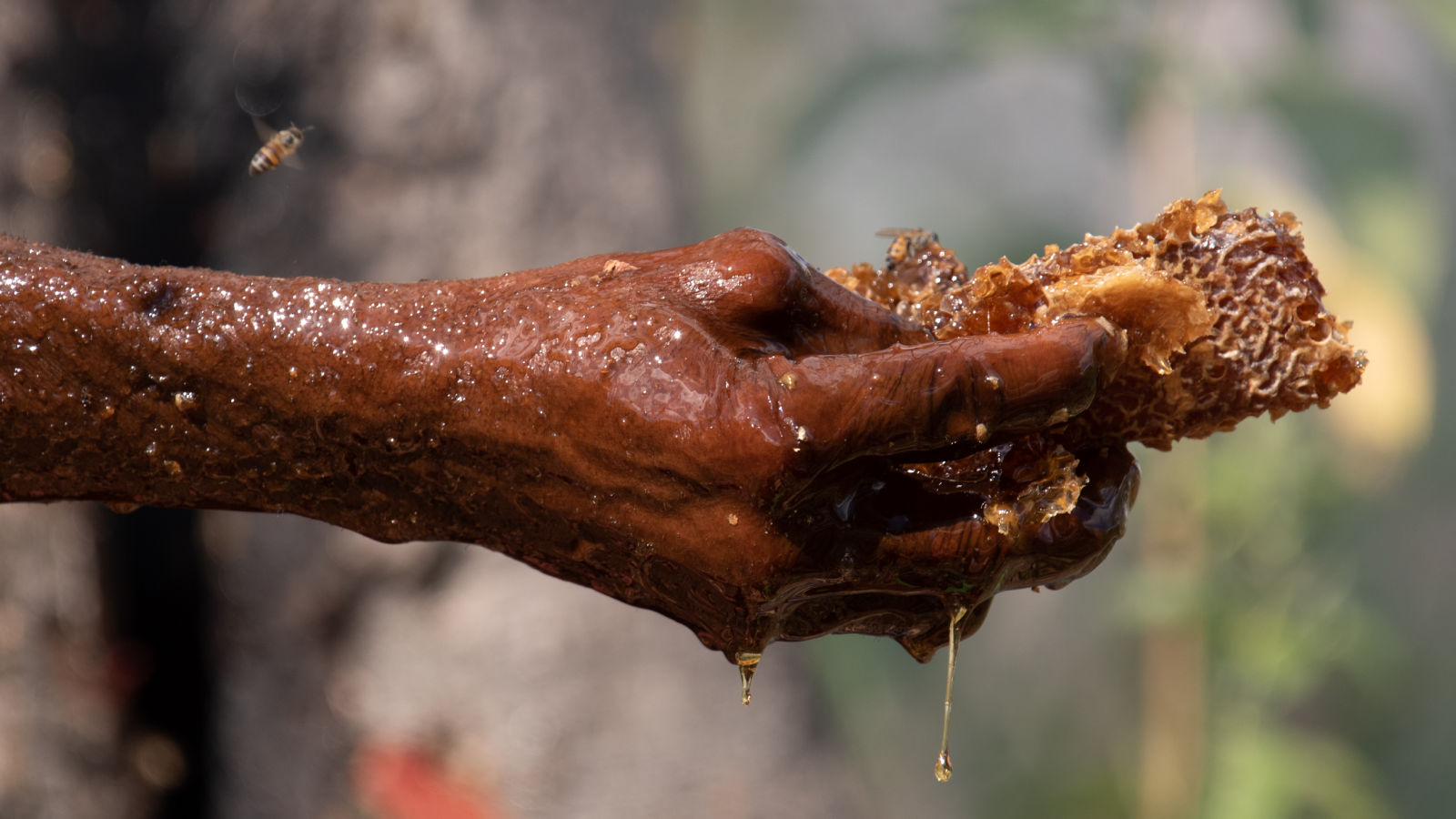
The relationship works for both species. Humans discover the honey nest, subdue the bees with fire, and break their nest open to access the honey. Meanwhile, the birds eat the leftover wax and larvae — and do not get stung to death by the bees.
“There is active coordination to mutually benefit humans and a wild animal,” lead author Jessica van der Wal, a behavioral ecologist at the University of Cape Town in South Africa, told Live Science.
Honey hunters in different parts of Africa have distinct ways of communicating with honeyguides, and van der Wal and colleagues wanted to find out whether their signals also varied within the same area.
The international team recorded calls from 131 honey hunters across 13 villages in northern Mozambique’s Niassa Special Reserve, where the Yao people depend on wild honey and honeyguides for their livelihoods.
They found that the hunters’ trills, grunts, whoops and whistles varied with distance between the villages, irrespective of the habitat. Interestingly, honey hunters who moved into a village adopted the local dialect.
It’s “like a different pronunciation,” van der Wal. “There is one language that they use with the birds, but there are different dialects.”
The study highlights how cultural we are as a species, van der Wal said. “There are a lot of animals that have culture, but humans are really driven by culture, even in the way that we communicate with wild, untrained animals,” she added.


Diego Gil, a behavioral ecologist at the National Museum of Natural Sciences in Spain who was not involved in the research, told Live Science he was surprised that the calls did not vary among habitats.
“From a human perspective, it is interesting that human immigrants to a new community learn the way that humans of that community interact with the local birds,” he said.
The birds may also be reinforcing the local dialects, said Philipp Heeb, a senior researcher at the French National Centre for Scientific Research who was not involved in the study.
“Once honeyguides learn to respond preferentially to local signals, reciprocally this preference should reinforce local consistency in human signals,” he said.
The two species have likely been cooperating for hundreds, if not thousands, of years, and by discriminating against unfamiliar honey-hunter calls, the birds could reinforce regional dialects and limit how much they can drift, he said. “The ‘selection’ pressure exerted by honeyguides might help explain the stability of the mosaic of dialects in human populations.”
Honeyguides do not learn the behavior from their parents, van der Wal said. They are brood parasites, which means that they lay their eggs in other birds’ nests.
“We think that honeyguides learn from other honeyguides interacting with humans,” she said, and her group is investigating whether humans and birds are influencing each other’s culture.
Van der wal plans to expand upon this research. She currently leads the Pan-African Honeyguide Research Network, which is documenting honeyguide behavior in different countries.
“We’re currently combining all the data and expanding into new places,” she said. “There’s so much variation in the human culture, not only in the signals or the calls being used, but in their practices and interactions with honeyguides.”
Van Der Wal, J. E. M., D’Amelio, P. B., Dauda, C., Cram, D. L., Wood, B. M., & Spottiswoode, C. N. (2026). Cooperative human signals to honeyguides form local dialects. People and Nature. https://doi.org/10.1002/pan3.70234