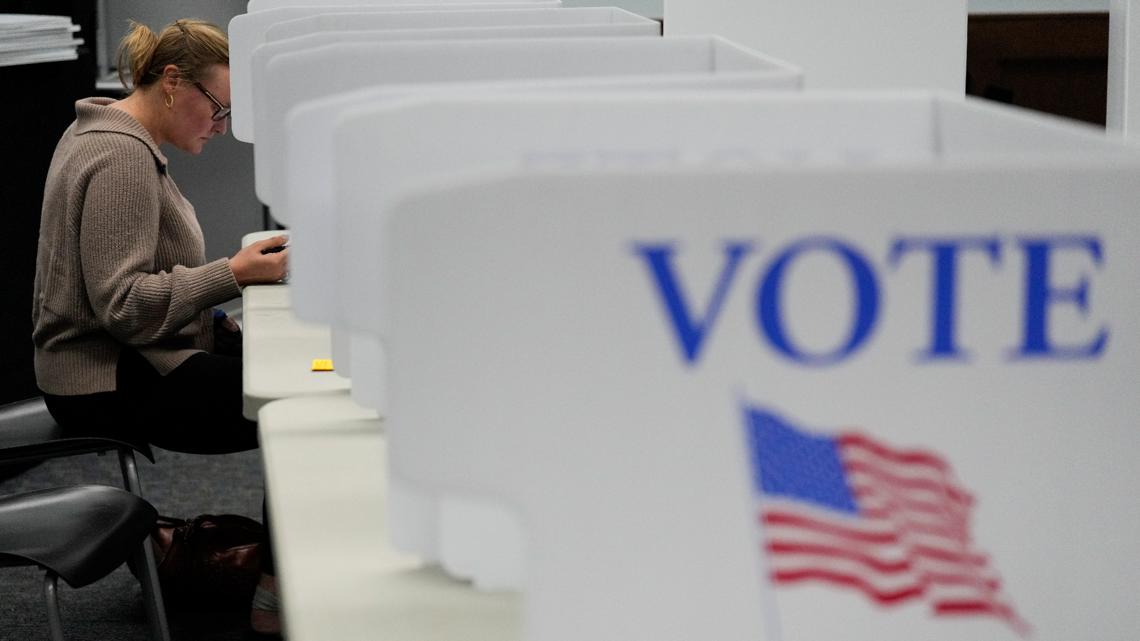
Election Day falls on the Tuesday after the first Monday in November, a tradition that dates back to 1845.
WASHINGTON — Americans in several states will cast their ballots on Tuesday, Nov. 4, in the first major Election Day since President Donald Trump returned to office.
Election Day falls on the Tuesday after the first Monday in November, right in the middle of the typical workweek. For many Americans, voting may mean early mornings, longer lunch breaks or even rushed drives to the polls after work.
This year’s elections aren’t as widespread as presidential or midterm elections. However, there are big gubernatorial contests in New Jersey and Virginia, as well as several mayoral races in key cities like New York City.
When it comes to elections, the U.S. is an outlier among democracies for holding them on weekdays. An analysis by the Pew Research Center found that the U.S. is only one of nine nations that are a part of the Organization for Economic Cooperation and Development that doesn’t have weekend voting.
Two of those nine, Israel and South Korea, designate national holidays on election days to help bolster voter turnout.
Is Election Day a federal holiday?
Google search data indicates Americans often wonder if Election Day is a holiday.
There are currently 12 federal holidays recognized in the U.S., with the newest addition being Juneteenth. Election Day is not one of them.
To make the change, Congress would have to approve the new holiday, followed by the president’s signature.
Despite the last few election cycles resulting in the highest-turnout elections in decades, voter reform advocates argue that making Election Day a federal holiday could boost turnout even further.
The idea of making Election Day a national holiday has strong bipartisan support, with 72% of U.S. adults surveyed by the Pew Research Center favoring it. Making Election Day a federal holiday has seen increased support in recent years, rising from 65% in 2018 to 72% in 2024.
Which states recognize Election Day as a state holiday?
While our voting date in November isn’t a federal holiday, a handful of states recognize it as a holiday.
Illinois, West Virginia, Maryland, Hawaii and New York are among the states that have classified general Election Day, held on the Tuesday after the first Monday in November in even-numbered years, as a state holiday, where employers are required to give time off for voting.
In states like Montana and Indiana, Election Day is considered a state holiday, and some state offices are closed, but employers are not required to provide time or pay to give Election Day off.
Colorado and California are two states that don’t consider Election Day as a state holiday but do require employers to pay their employees if they need to take time off to head to the polls.
Why isn’t Election Day a holiday?
Busy or conflicting schedules on Election Day are part of the reason that some voters don’t head to the polls.
During the 2020 election, 13.1% of U.S. adults who were registered to vote cited scheduling conflicts as the main reason they didn’t vote, according to Statista Research Department.
Advocates for making Election Day a federal holiday argue it boosts voter turnout by allowing a larger swath of Americans to get paid time off.
Those against the efforts argue it could cause longer lines at the polls, bring about issues with childcare and even hurt workers who do not have holiday pay. Rather than a paid holiday, they say the focus should be on expanding early voting. In 2020, the COVID-19 pandemic helped widen early voting efforts, resulting in nearly 70% of ballots being cast before Election Day.
In recent years, some companies have shown a surge of interest in making voting time off a guarantee.
Approximately 2.000 companies have pledged with Time To Vote to provide time off for employees to vote or to distribute voter information. Patagonia has given its workers the day off since 2016. Employers such as Walmart and Starbucks have guaranteed employees time off to vote in previous presidential elections.
Why is Election Day on a Tuesday?
Ever since 1845, Election Day has occurred on the Tuesday after the first Monday in November.
Congress’ decision to codify the tradition on a weekday all came down to the way of life in the mid-1800s.
At the time, the U.S. was largely an agrarian society, so it made sense to vote in November, when farmers were done with their harvest and right before harsh winters.
Tuesdays were ideal as it allowed voters, who at the time lived far away from most polling places, a two-day window to travel for Election Day. Wednesdays were market days for farmers, while weekends were off the table due to Sunday service, according to History.com.
So, Tuesdays in November became the most convenient days for voters in America at the time. Ironically, the tradition is now more of a hindrance than a convenience for modern-day corporate America.
The distinction for the Tuesday after the first Monday was created to avoid Election Day from falling on Nov. 1, All Saints’ Day for many Catholics and Christians.