For years, students at a high school just steps from the Colosseum in Rome have spun tales of mysterious rooms hidden underneath the gymnasium floor. Now, it turns out those rumors have more than a grain of truth to them.
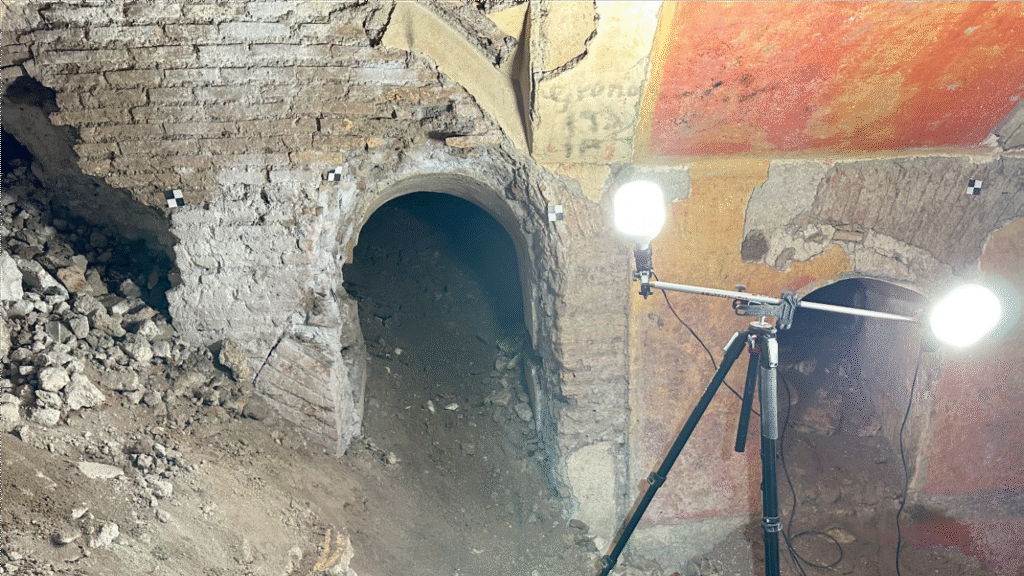
Students on several clandestine explorations happened upon an ancient structure beneath their school. Upon notifying their teacher, who notified the authorities, archaeologists arrived to take a more detailed look. Following an excavation earlier this year, archaeologists have announced that the dark corridors and dimly lit chambers actually belonged to a luxurious second-century villa.
The Liceo Scientifico Cavour (Cavour Scientific High School) is located in a building near the Colosseum that originally housed a Catholic missionary congregation. When the missionaries’ headquarters were constructed in the late 19th century, early archaeological exploration of the foundation revealed part of a “domus” — a large ancient Roman house. This neighborhood is incredibly important in Roman history, as figures such as Cicero, Pompey and Octavian (later known as Augustus) lived there, but is not well-understood archaeologically because of all the modern buildings on top of the ancient layers.
Claudia Marino, a history and Latin teacher at the high school, reported the students’ discoveries in the subterranean tunnels to the Special Superintendency of Rome, but crews did not begin excavating the site until January 2026. The discovery was presented to the public on May 28 by Marino and Filippo Coarelli, an archaeologist at the University of Perugia in Italy.
The rooms preserved under the high school’s gym are part of a mid-second-century house that, based on an inscription found in the late-19th century excavation, was likely owned by a member of the Umbrius family. Little is known about this family, but the Umbrii may have originally come from Samnium, a region of south-central Italy not far from Pompeii, which famously erupted in A.D. 79. For now, the house is being called the Domus Liceo Cavour (the House of the Cavour High School).
Preserved stucco decoration on the vaults of an ancient Roman house.
(Image credit: Cantieri Narranti/Special Superintendency of Rome)
Archaeological excavation revealed figurative and floral frescos on the walls and stucco decorations along the ceiling vaults of the villa. In one room, archaeologists discovered a mosaic with large, irregularly shaped tiles — a style fashionable among elite Romans in this time period. They also found much more recent graffiti made by students, tourists and other subterranean explorers in the 20th century.
Only a portion of the Domus Liceo Cavour has been explored so far, as it extends far beneath the school, but additional excavation may be carried out in the future. The school and the archaeological superintendency plan to work together to eventually open up the site to visitors, potentially with students as guides.
Get the world’s most fascinating discoveries delivered straight to your inbox.
From Augustus to Nero, see how much you know about ancient Rome’s famous leaders with our Roman emperor quiz!