



quick facts
What it is: Saguaro, a lower-redshift spiral galaxy
Where it is: About 10 billion light-years away in the constellation Ursa Major
When it was shared: July 29, 2026.
Ever since NASA’s James Webb Space Telescope (JWST) began science operations in 2022, something has been bothering astronomers. Scattered across JWST’s deepest images of the early cosmos are tiny, crimson-colored smudges that glow brightly in infrared light but appear surprisingly compact, making them difficult to classify. These mysterious objects appear in huge numbers around 600 million years after the Big Bang before seemingly vanishing less than a billion years later.
These odd-looking “little red dots” (LRDs) left astronomers wondering whether they were witnessing an entirely new type of galaxy or something even stranger. But now, fresh observations from JWST, combined with data from the Hubble Space Telescope and NASA’s Chandra X-ray Observatory, suggest that LRDs may not have disappeared at all. Instead, they may have simply changed their appearance as the universe grew older.
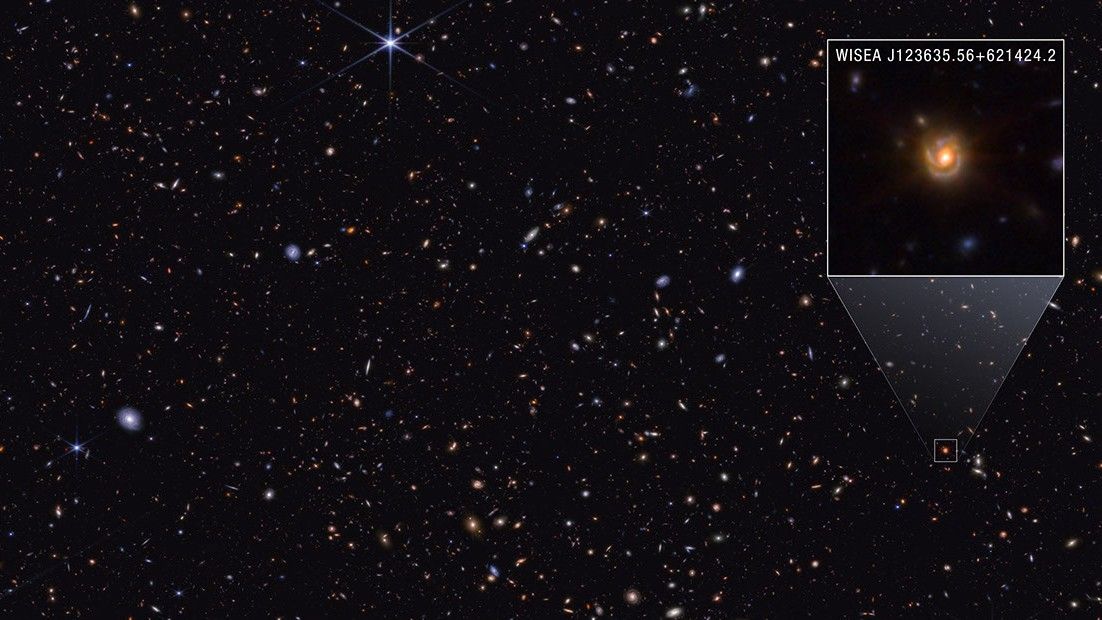
Researchers trained JWST on a relatively close galaxy near the Big Dipper known as WISEA J123635.56+621424.2, nicknamed the Saguaro because its sweeping spiral arms resemble the iconic cactus of the Sonoran Desert, which bears red fruit.
Latest Videos FromLive Science
The Saguaro galaxy existed around 3.3 billion years after the Big Bang, long after LRDs were thought to have faded from view. However, at its heart sits a compact, reddish core that ticks nearly every box for an LRD, including unusually weak X-ray emissions. The researchers chose the Saguaro because, unlike the incredibly distant LRDs, it’s close enough for the space telescope to spot the galaxy’s spiral arms and brilliant central core.
The aim wasn’t to study the Saguaro as it is now but to try to calculate what it would look like if it were much farther away. Using computer models, the researchers shifted the galaxy to the enormous distances seen in the early universe. As they did, its elegant spiral arms gradually melted into the darkness until only a tiny glowing red point remained. It looked almost identical to the LRDs littering JWST’s farthest deep-field images.
The findings suggest that many LRDs may in fact be ordinary galaxies, but at such vast distances that only their bright, active centers remain visible, while the surrounding galaxies fade beyond even JWST’s incredible vision.
Instead of representing a completely new class of cosmic object, then, LRDs may actually be a short-lived phase in the growth of supermassive black holes during the universe’s youth.
Get the world’s most fascinating discoveries delivered straight to your inbox.
The hunt is now on for more nearby galaxies like the Saguaro to see whether they follow the same pattern. This will enable scientists to build a catalog of LRDs to understand better how galaxies and their central black holes evolved together across cosmic history.
TOPICS