



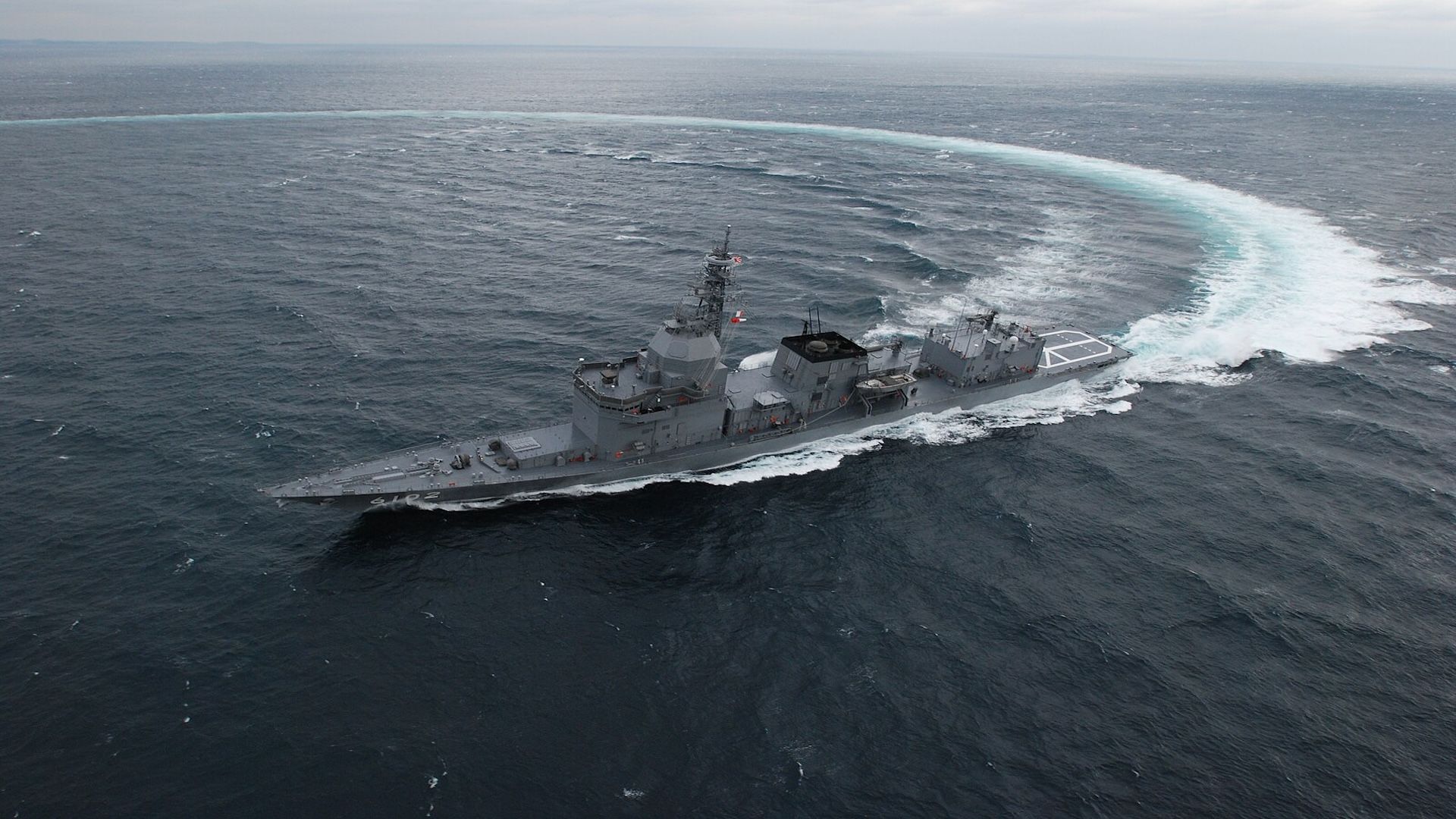
Japan has deployed a system that fires laser beams with 100 kilowatts of energy — powerful enough to disable small drones. It was installed on board a 6,200-ton (6.3 million kg) warship.
The weapon combines 10 lasers (each 10 kW in power) into a single 100 kW beam, giving it enough focused power to burn through metal surfaces. It is a fiber laser, meaning the beam is generated by light being amplified and focused as it travels through a solid-state optical fiber doped with rare earth elements. Engineers designed this system specifically to shoot down drones, mortar rounds and other lightweight airborne threats.
On Dec. 2, Japan’s Acquisition, Technology and Logistics Agency (ATLA) confirmed in a statement that the laser system was installed on the JS Asuka test ship after arriving at one of Japan Marine United’s shipyards. It was seen packed into two 40-foot (12-meter) domed modules.
A step forward for laser weaponry
ATLA’s next goal is to carry out successful sea trials, where the laser will face tougher conditions like wind and moisture. It will have to keep its aim steady on a pitching deck while handling atmospheric scattering and reflections.
But there are more roadblocks for laser weapons like Japan’s to overcome before they can reach the battlefield. Directed‑energy systems — those that damage targets with highly-focused energy instead of a solid projectile — often need lots of time to recharge between shots and demand substantial cooling and electrical power. Even in ideal conditions, fiber lasers typically only reach about 25% to 35% efficiency, and their energy requirements are especially challenging to accommodate on a ship.
According to The Asia Live, ATLA officials said that operational deployment is still years away, but this set of trials will help them evaluate whether an even more powerful laser could be used to intercept missiles in the future.
Japan now joins the U.S., France, Germany, and the U.K. on the list of nations confirmed to be developing a directed‑energy weapon. China is also suspected to be among them, after a photo emerged on social media of what appeared to be a laser on a Chinese amphibious transport dock in 2024.
Nevertheless, the only publicly scheduled deployment of a sea-based laser system is on vessels equipped with “Aegis” — an advanced naval defense platform ordered by Japan’s Ministry of Defense, according to Naval News. These are expected to enter service after 2032.
Almost two years ago, the U.K. government announced that its system, dubbed “DragonFire,” had passed its first field test by shooting down several drones over the Hebrides off the coast of Scotland. Furthermore, in late 2024, Chinese scientists claimed to have created a new type of microwave weapon that could concentrate high-powered electromagnetic waves onto a target.