




Follow us
Add us as a preferred source on Google
Subscribe to our newsletter
On Monday (Oct. 19), Japan’s space agency launched a first-of-its-kind sample-return mission to Mars. The historic endeavor marks another major step toward humanity’s shared goal of understanding — and perhaps eventually colonizing — one of our closest planetary neighbors, experts say.
The Japan Aerospace Exploration Agency’s (JAXA) Martian Moons Exploration (MMX) probe is an international effort, constructed with help from NASA, the European Space Agency (ESA) and others. Over the next few years, it will closely study the Red Planet’s twin moons, Phobos and Deimos. The spacecraft will snap close-up photos of the pair before attempting to land on the larger satellite, Phobos, to scoop up rocky material that will hopefully be carried back to Earth in around five years.
If the mission is successful, the returned samples will finally settle a decades-old mystery about the origins of both moons. The findings could also help paint a picture of Mars’ ancient history and provide clues about what the early solar system was like.
The MMX probe will study Phobos (bottom center) and Deimos (upper right) up close. [This is a composite image made by stitching together individual photos of Mars (left) and its moons.]
(Image credit: NASA/JPL/University of Arizona)
“This mission marks a transformative leap in our capacity to investigate the Martian system,” Sonia Fornasier, an astronomer at the Paris Observatory who has studied Phobos and Deimos extensively and is a project scientist for MMX’s infrared spectrometer instrument (MIRS), told Live Science. It “ranks very high” among the missions we have sent to the Red Planet so far, she added.
What will MMX do?
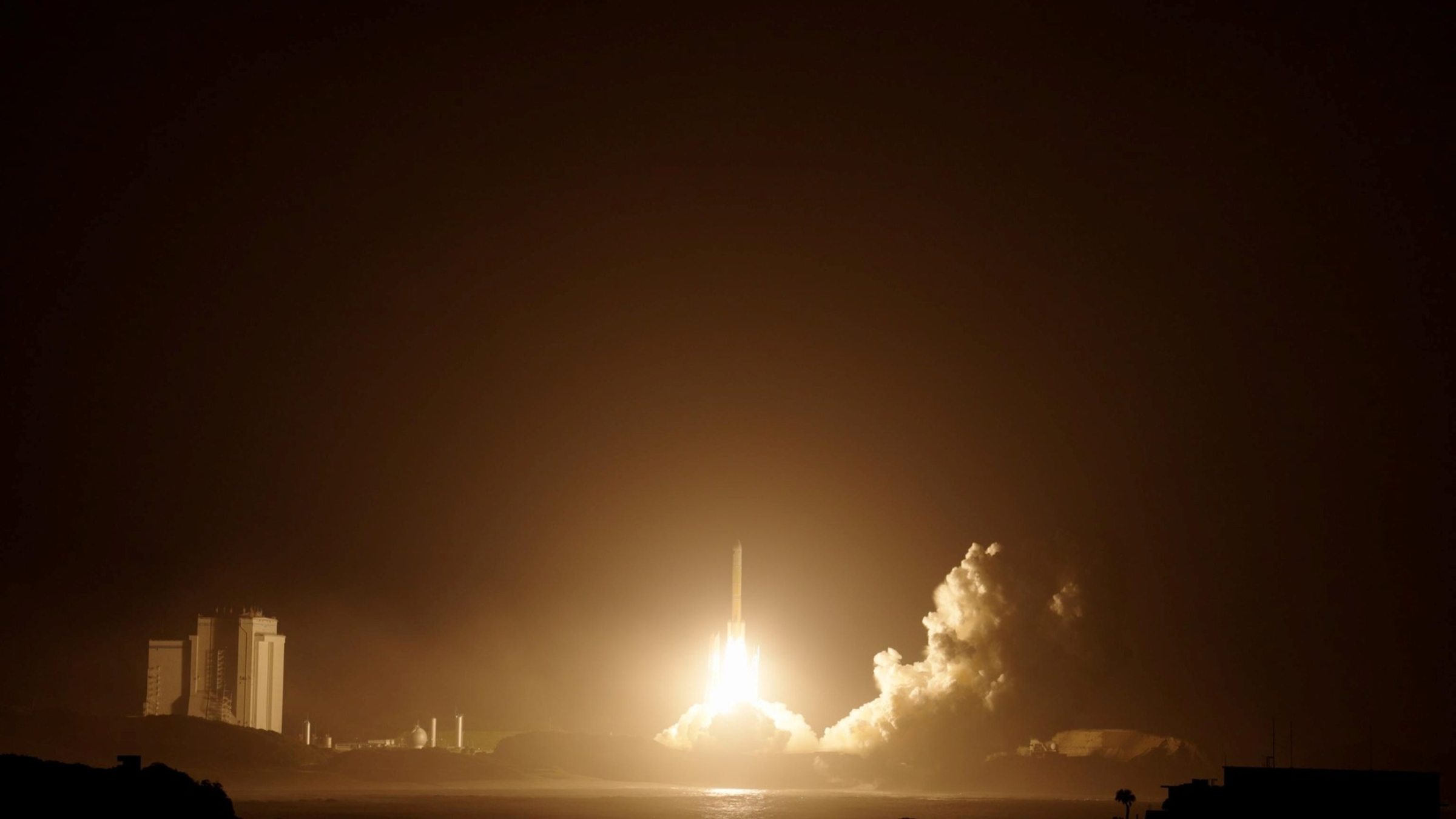
JAXA launched the MMX probe on board an H3 rocket, which lifted off from Tanegashima Space Center in Kagoshima prefecture at 3:41 p.m. EDT Monday (4:41 a.m. Tuesday local time), Live Science’s sister site Space.com reported. (The mission was initially scheduled to launch in 2024, but it was delayed due to initial concerns about the H3 rocket.)
The camper-van-sized spacecraft successfully separated from the rocket’s fairing just over an hour later, and on Wednesday (Oct. 21), JAXA announced that the mission had passed the “initial critical operations phase,” meaning the probe is now locked into its roughly 140 million-mile-long (225 million kilometers) journey to Mars, which will take around 10 months.
“MMX took its first step today,” Naoki Murakami, general manager of Mitsubishi Electric’s space division, which led the design of the MMX probe, said in a postlaunch news conference early Tuesday morning (Oct. 20), according to The Japan Times. “This marks the beginning of a long, five-year journey.”


Large crowds gathered at the Tanegashima Space Center to watch the launch of the H3 rocket carrying MMX in the early hours of Monday (Oct. 19).
(Image credit: JIJI Press / AFP via Getty Images)
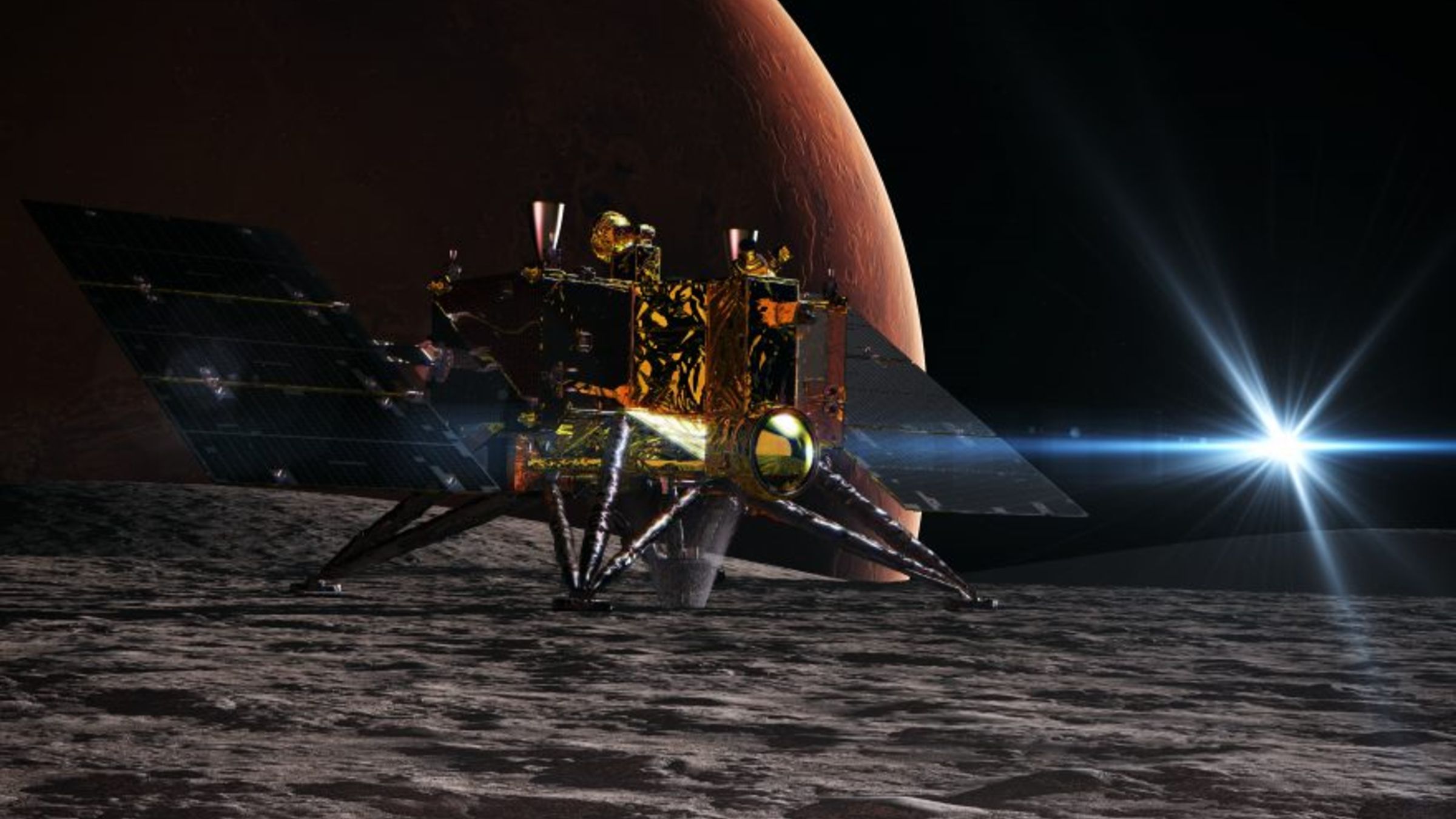
Once the probe arrives at the Red Planet in August 2027, it will insert itself into a “quasi-satellite orbit” around Phobos. In other words, MMX will circle Mars alongside the moon but will not be gravitationally bound to it, similar to around half a dozen “quasi-moons” that currently accompany Earth around the sun.
This mission marks a transformative leap in our capacity to investigate the Martian system
Sonia Fornasier, Paris Observatory
After collecting data from a distance for a few months, MMX will swoop down and attempt to land on the surface of Phobos — not once, but twice.
During the first landing, MMX will hover just above the moon and deploy a mini rover, dubbed Idefix, onto the moon’s surface. The wandering robot, built by the French and German space agencies, will have to contend with extremely weak gravity as it trundles across the surface of Phobos: The rover weighs around 55 pounds (25 kilograms) on Earth but will weigh only around half an ounce (15 grams) on Phobos, according to ESA.
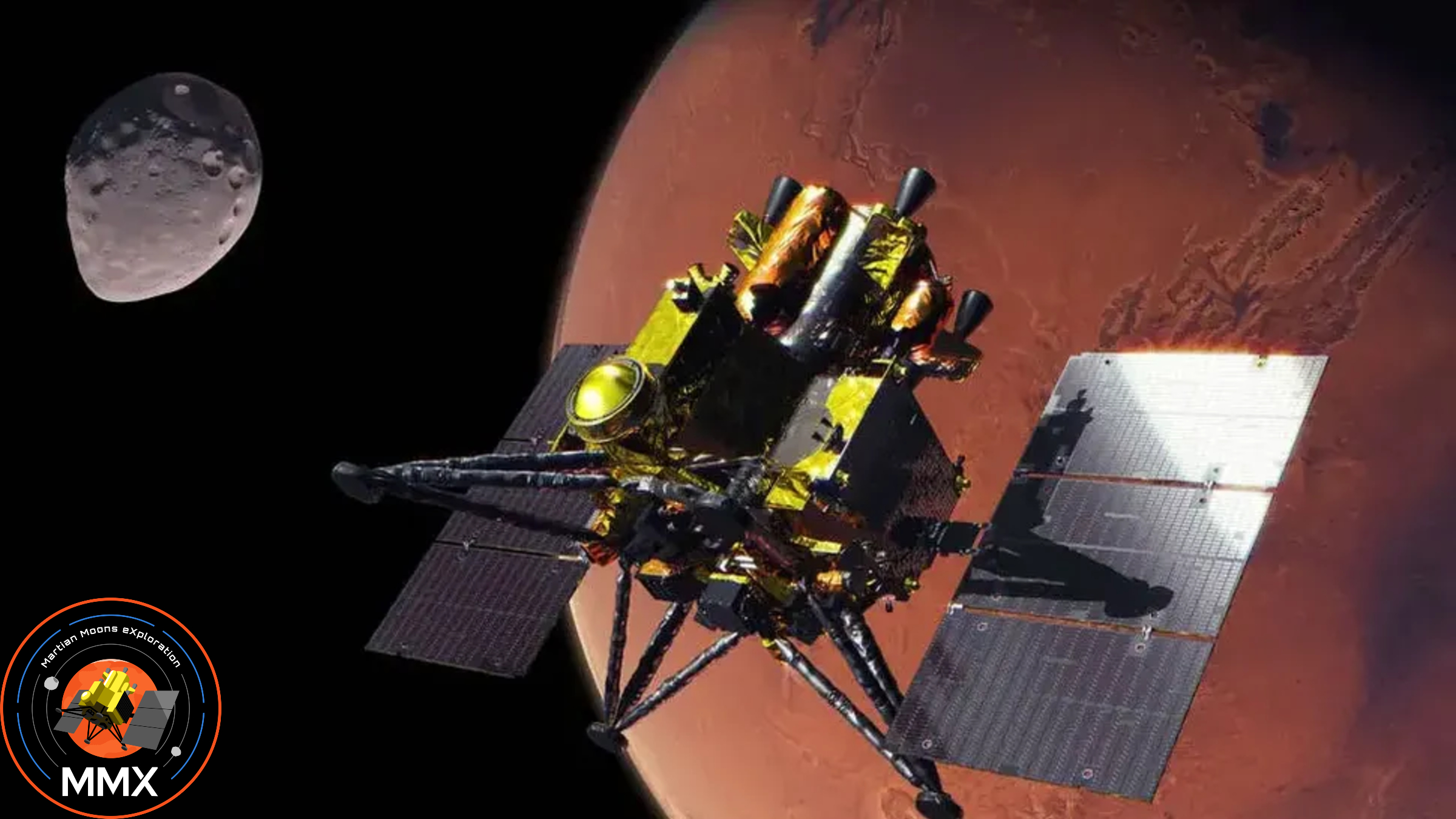
The MMX probe will arrive at Mars in August 2027, following a 10-month journey from Earth.
(Image credit: JAXA/MMX)
Once Idefix has completed its initial assessment of the moon’s surface, the entire MMX probe will set down on Phobos, on top of the spacecraft’s four-legged lander module. Mission scientists hope this goes a lot more smoothly than the attempted landings of Japan’s “Moon Sniper” and Resilience lunar landers, which crash-landed on Earth’s moon in 2024 and 2025, respectively.
Two of the MMX lander’s legs contain built-in sampling devices — one that will drill into Phobos and another that will hoover up surface material. The second device, dubbed the Pneumatic Sampler (or P-Sampler), was built by the Blue Origin-owned private company Honeybee Robotics on behalf of NASA and will collect its material in a “matter of seconds,” Kris Zacny, vice president of the Exploration Technology Group at Honeybee Robotics, said at an Oct. 15 NASA news conference. “You blink, and it’s all done.”
In total, JAXA aims to collect around a third of an ounce (10 grams) of material from Phobos. That would be around twice as much material as the space agency managed to snag on its most recent sample-return mission, Hayabusa2, which collected samples from the “spinning-top” asteroid Ryugu in 2019, finding materials rich in surprising organic compounds.
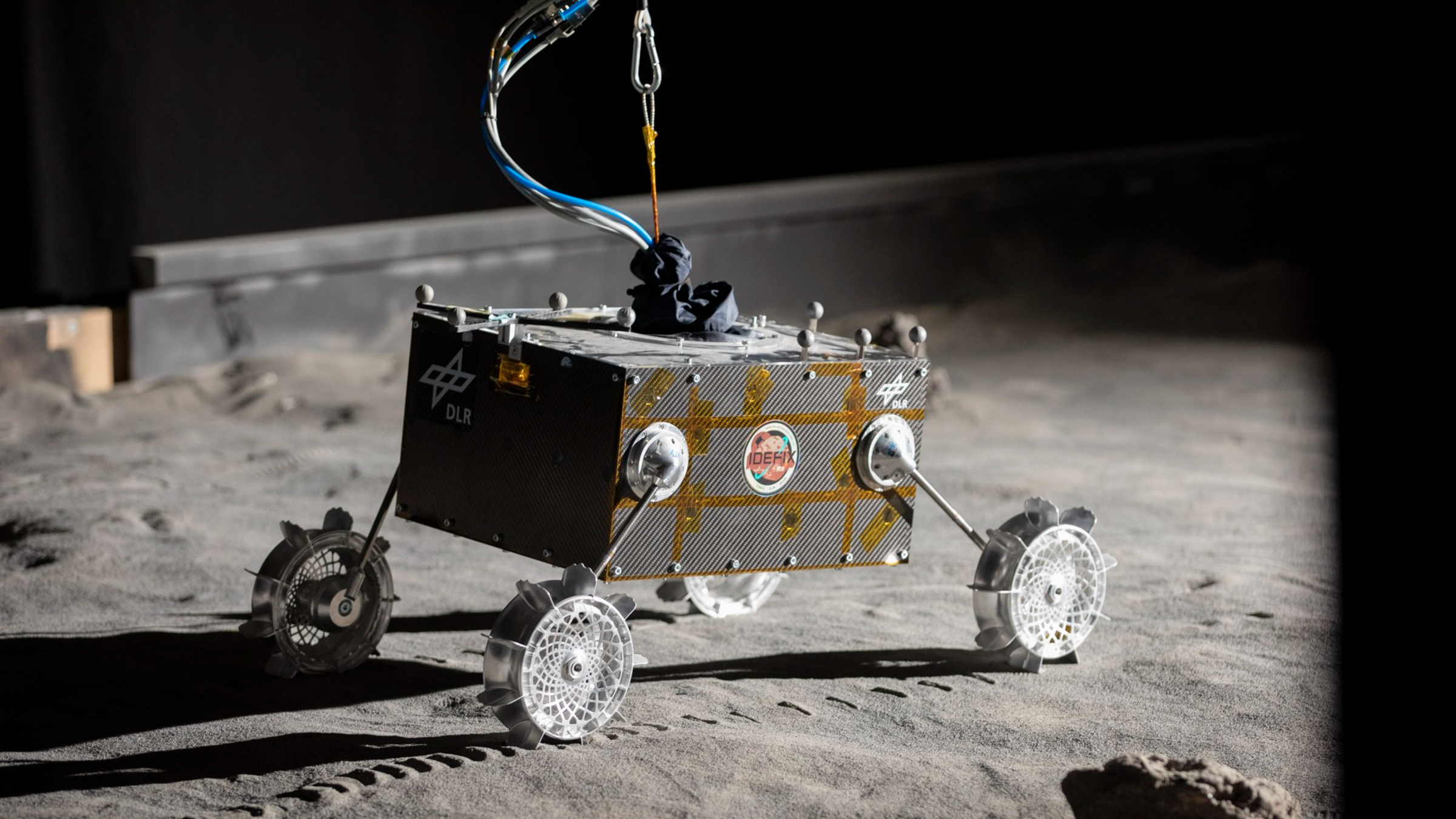
The probe will deploy the IDEFIX rover on Phobos before it lands to collect its samples. The wandering robot will provide initial data that will help select a suitable landing site for MMX.
(Image credit: DLR)
Once the samples have been acquired, at some point between late 2028 and early 2029, the probe will conduct a series of close flybys of Mars’ smaller moon, Deimos, before beginning the long trip back to Earth in late 2030 — the first return flight ever attempted by a spacecraft sent to Mars.
When the probe returns to Earth in 2031, it will release its samples in a 20-inch-wide (60 centimeters) container that will fall back to our planet’s surface, most likely somewhere in Australia, according to ESA.
What could we learn about Phobos and Deimos?
Mars’ twin satellites, which were first spotted by American astronomer Asaph Hall in 1877, are nothing like Earth’s constant companion. For starters, they are much smaller; Phobos is around 14 miles (22 km) across, while Deimos is just 7.5 miles (12 km) wide. The duo also have lopsided shapes and are between 12 and 64 times closer to Mars than the moon is to Earth. (Phobos, meaning “fear,” and Deimos, meaning “terror,” are named after the sons of the Greek war god Ares, the counterpart to the Roman war god Mars.)
Phobos is dominated by the 6-mile-wide (10 km) Stickney crater, which was left by an ancient asteroid impact. The larger moon is also slowly falling toward Mars and may eventually be ripped apart before it reaches the Red Planet’s surface.
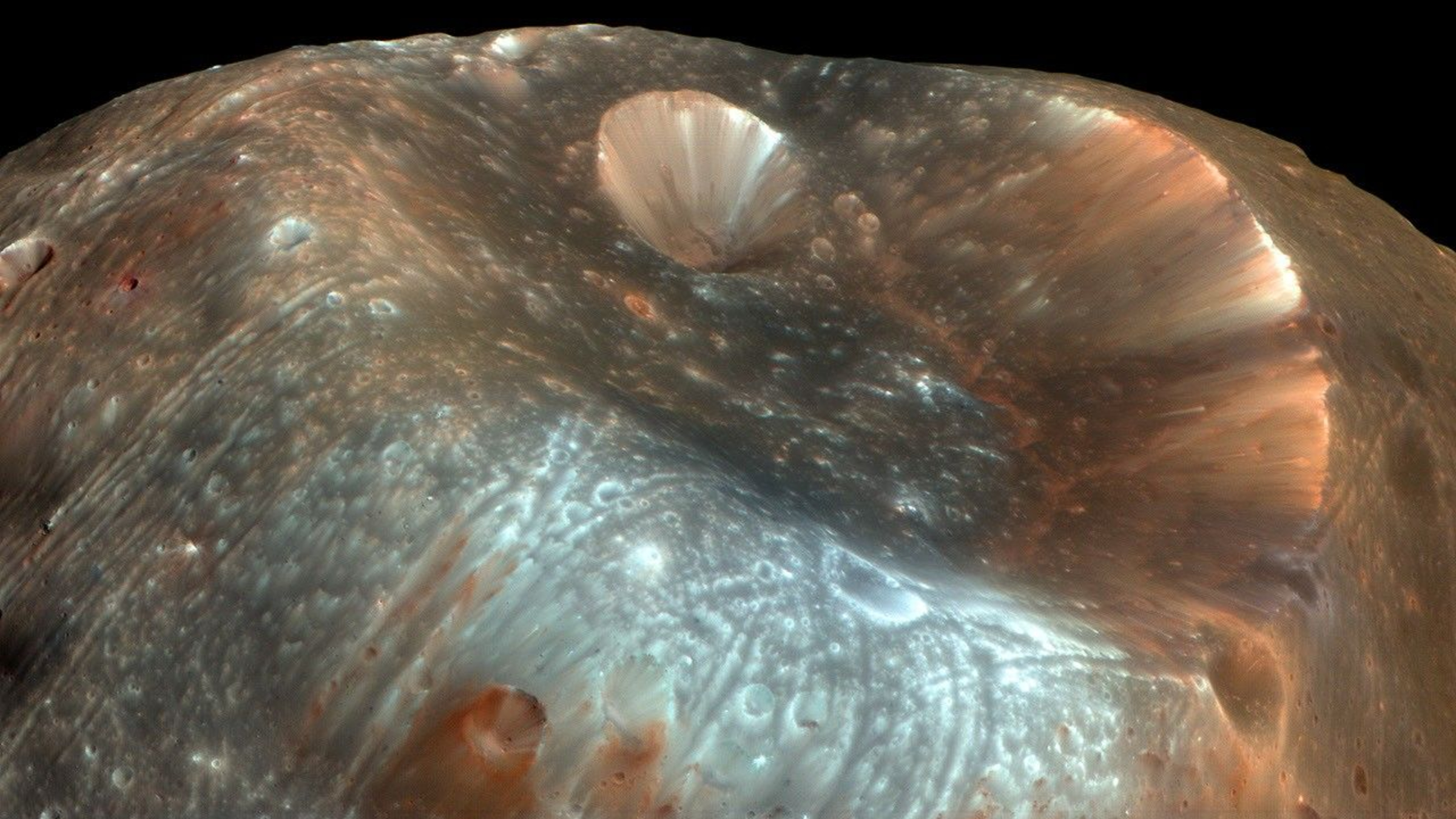
The most notable feature on Phobos is Stickney crater, which is more than 5 miles wide. This photo of the crater was snapped by the HiRISE camera on board NASA’s Mars Reconnaissance Orbiter, and was released earlier this month.
(Image credit: HiRISE, MRO, LPL (U. Arizona), NASA)
Other Martian spacecraft, such as the Emirates Mars Mission orbiter, have flown close to the moons, and NASA’s Mars rovers have frequently looked up to see the satellites eclipsing the sun in Mars’ sky (sometimes both at the same time). Yet many mysteries remain about the pair.
“Mars is right in our cosmic backyard, and yet we haven’t explored the planet’s moons,” Nancy Chabot, a space exploration expert at the Johns Hopkins Applied Physics Laboratory in Maryland and the deputy principal investigator of NASA’s MEGANE instrument on board MMX, told Live Science in an email. “MMX will do this!”
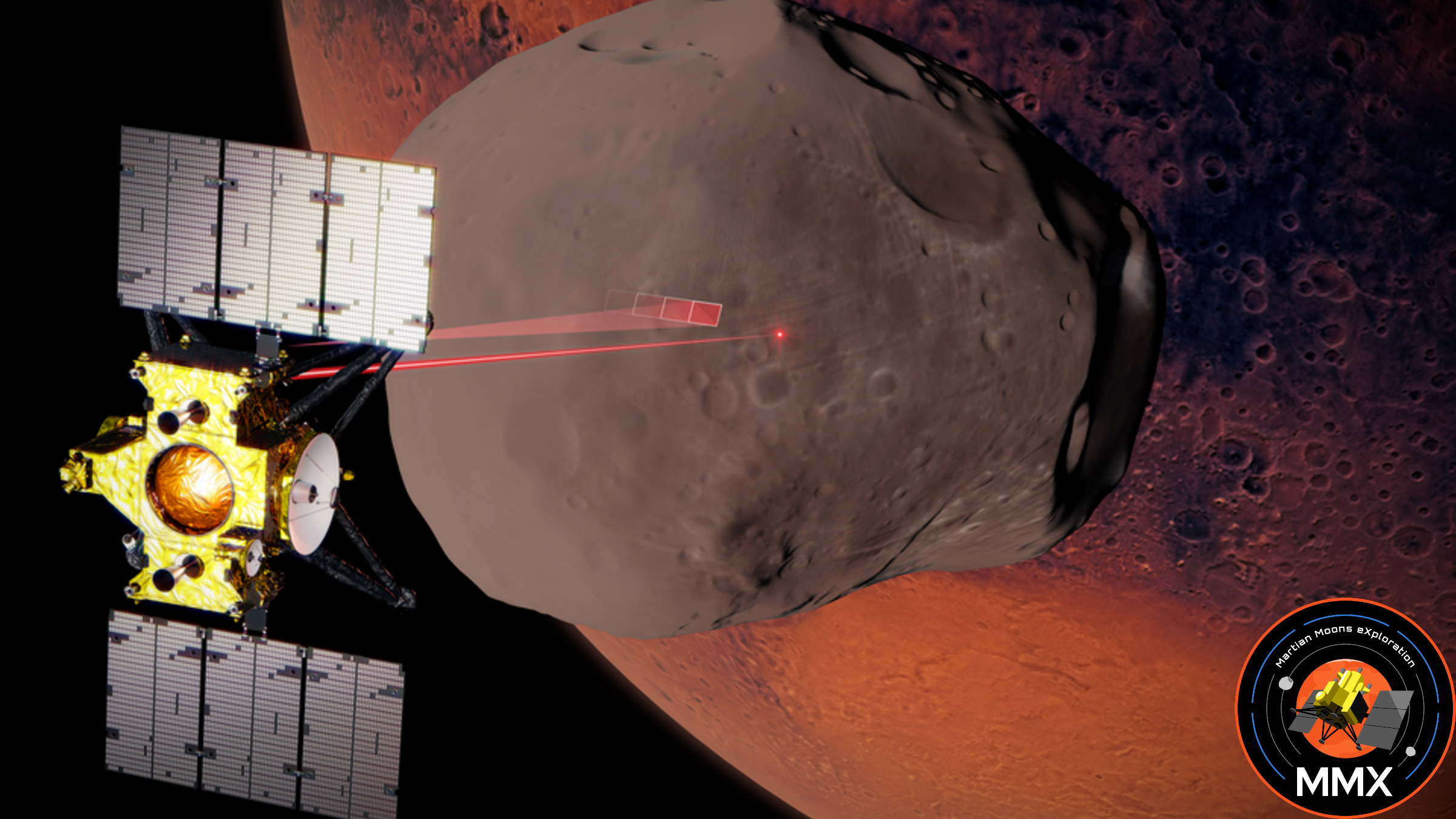
MMX will closely analyze Mars’ moons using nearly a dozen different sensors and instruments to help pin down the mysterious origin of the twin satellites.
(Image credit: JAXA/MMX)
The biggest mystery surrounding Phobos and Deimos is their origin. Some researchers suspect the satellites are asteroids, or maybe even comets, that have been captured by Mars’ gravity, while others think the moons emerged from the debris of an ancient impact on the planet’s surface, similar to how Earth’s moon formed.
EXCLUSIVE TO LIVE SCIENCE PRO
Neither theory is conclusive, meaning the moons’ origins “remain enigmatic,” Christopher Edwards, a planetary scientist at Northern Arizona University and one of NASA’s participating scientists for MMX, told Live Science.
For example, explaining how Mars captured the moons is “quite hard from an orbital mechanics perspective,” but if they did form from a debris disk from an ancient impact, they should have coalesced into better-defined spheres, Edwards said.
“MMX will solve this debate thanks to the spacecraft observations and the detailed analysis of the samples of Phobos on Earth,” Fornasier said. The data the probe collects from its flybys of Deimos will also allow researchers to generate a “full characterization of this body,” she added.
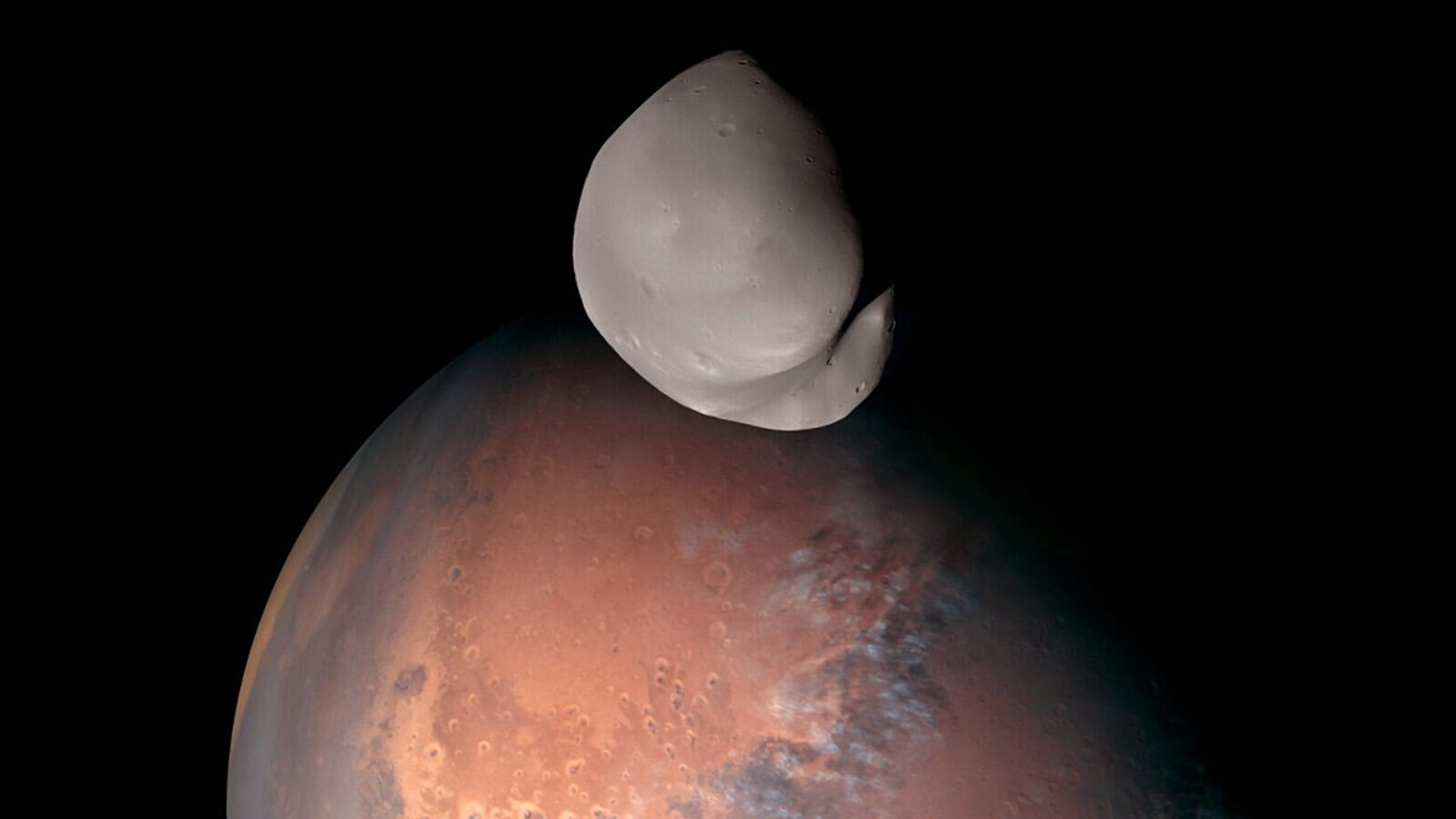
This photo of Deimos was snapped by the Emirates Moon Mission in 2023 and is one of the best images of either of Mars’ moons to date.
(Image credit: Emirates Mars Mission)
Fornasier is “particularly excited” by the possibility that the moons are captured asteroids because that would mean they would likely contain “organic and hydrated materials,” which would have a big “astrobiological implication” and would shed light on what the early solar system was like.
What could we learn about Mars itself?
Regardless of how the twin moons formed, researchers also stand to learn a lot about Mars and how planets form and evolve.
“Phobos and Deimos are interesting, but not just in their own right,” Tom Statler, an MMX program executive and scientist in NASA’s Planetary Science Division, said at the Oct. 15 news conference. “Their presence is a key piece of the larger story of the Mars system. By uncovering the moons’ origin, we’ll gain new insights into the history of both Mars and Earth.”
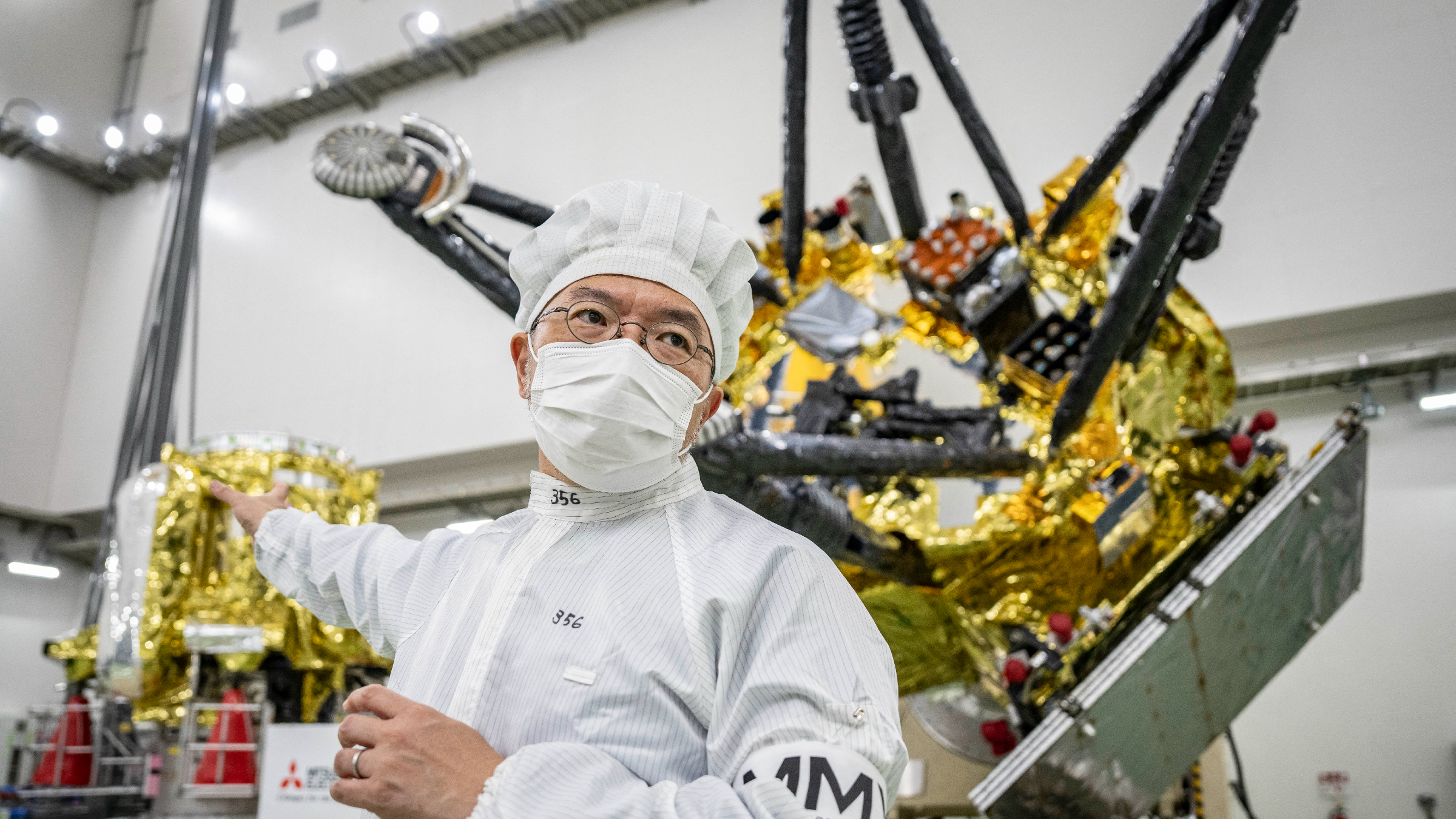
MMX has been more than a decade in the making and involved input from agencies and companies around the globe. This photo shows the project’s manager, Yasuhiro Kawakatsu, standing in front of two parts of the probe inside a clean room at the Tanegashima Space Center in August.
(Image credit: Yuichi YAMAZAKI / AFP via Getty Images)
If the moons did form via an impact scenario, the samples MMX collects may also contain actual pieces of Mars for researchers to study.
“If these objects are in fact pieces from the Martian surface that have coalesced moons, we’ll collect the best-preserved samples of the Martian surface,” Edwards said. Other fragments of Mars have already reached Earth as meteorites. However, entry into Earth’s atmosphere can transform them.
If Phobos is a chunk of Mars, that would be a real boon to NASA, which canceled its Mars Sample Return program — a mission that would have retrieved samples collected by the Perseverance rover — earlier this year. The agency’s researchers will receive up to 15% of the MMX samples to analyze.
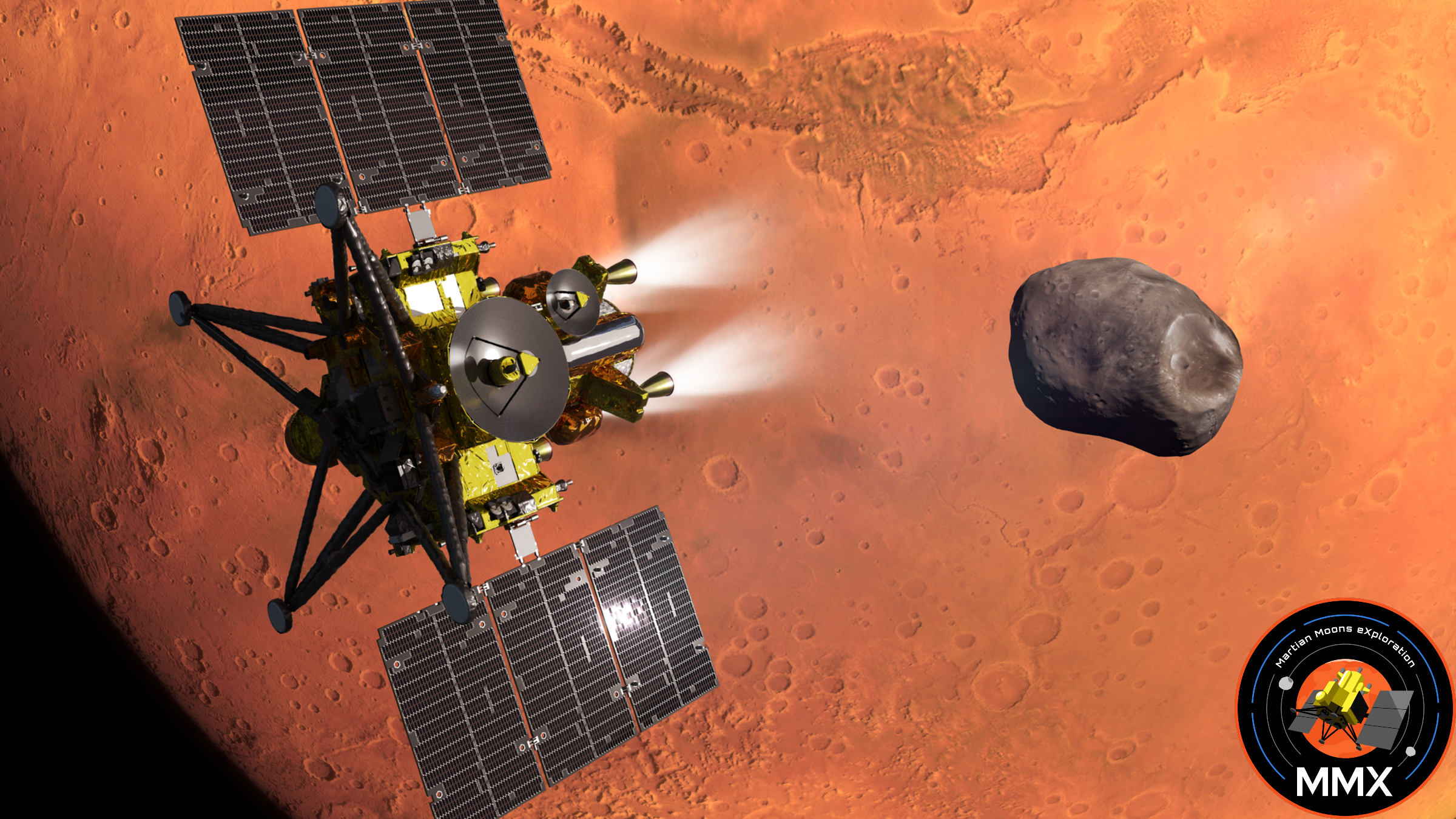
MMX will also shed light on Mars’ ancient history and evolution, as well as analyzing the planet’s moons. It will depart the Red Planet at some point in late 2030.
(Image credit: JAXA/MMX)
During its three-year stay in the Red Planet’s system, the Japanese probe will also collect lots of data on Mars that could contribute to a wide range of future findings. “MMX will conduct in-depth studies of the Martian atmosphere, with a particular emphasis on dust and water transport mechanisms and the escape processes shaping Mars’ atmospheric dynamics,” Fornasier said.
This atmospheric data could temporarily fill a gap left by the recent death of NASA’s iconic MAVEN spacecraft, which stopped sending data back to Earth late last year.
Analysis of craters on the Martian moons could also provide clues about other events in Mars’ history. For example, some researchers think the Red Planet may have once had rings like Saturn or a larger moon.
Experts have described MMX as a “transformative leap” and “paradigm-shifting” for Martian science.
(Image credit: DLR)
Other experts are hopeful that the MMX findings could help lay the groundwork for future missions to explore — and perhaps colonize — Mars. “The samples from MMX will bring forth paradigm-shifting science on the Mars system for generations to come, especially as NASA prepares to send the first humans to Mars,” Nicky Fox, associate administrator for NASA’s Science Mission Directorate, said in a recent statement.
The next sample-return trip to Mars will be China’s Tianwen-3 mission, which is scheduled to launch in 2028 and will aim to land on and retrieve samples directly from the Red Planet’s surface, according to Space.com.