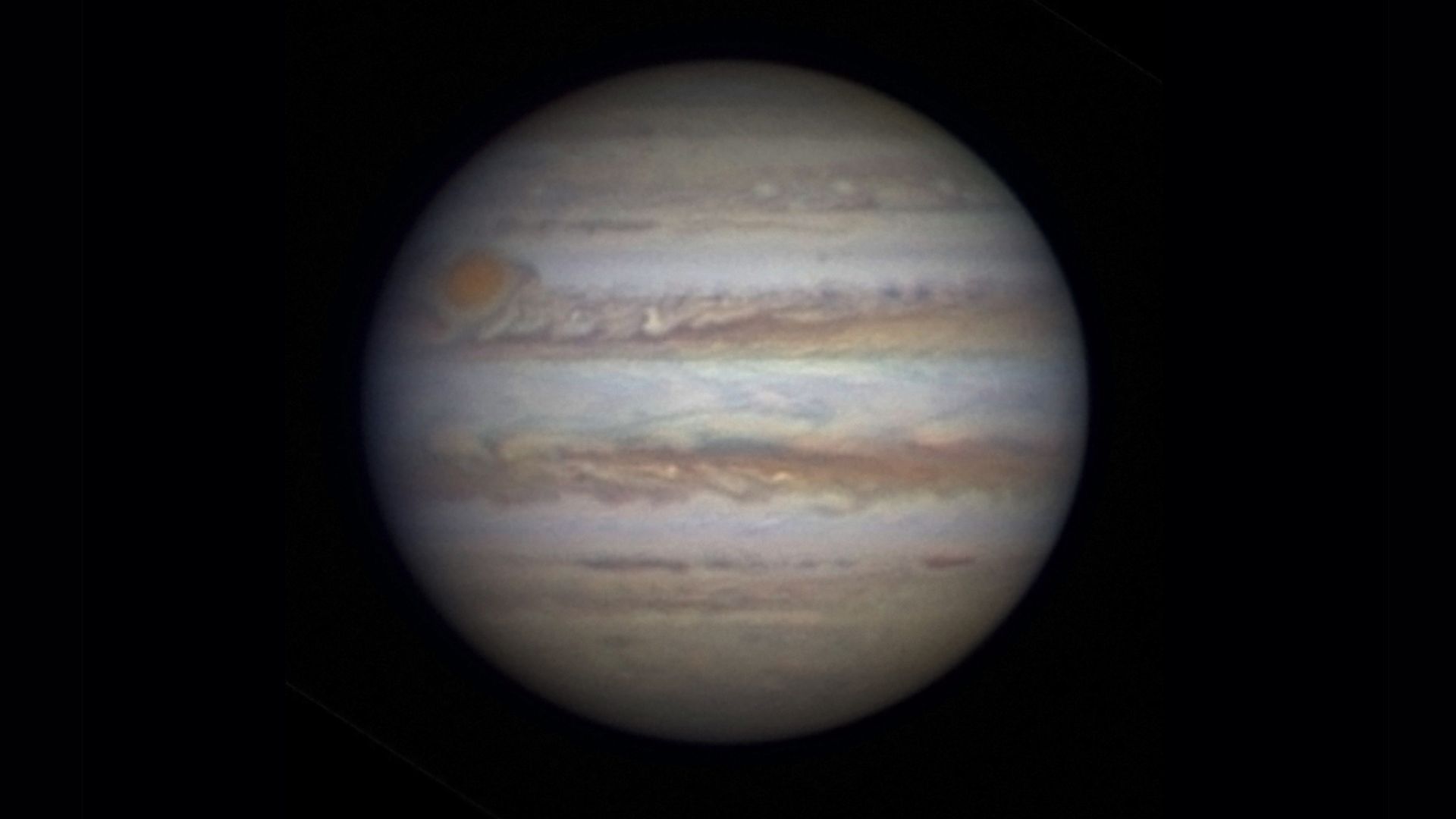
This weekend brings a prime opportunity to see the biggest planet in the solar system shining at its brightest all year.
After dominating the night sky for more than a month, Jupiter will reach opposition this Saturday (Jan. 10). This marks the point when Earth lies directly between Jupiter and the sun, putting the gas giant opposite our star in Earth’s sky. The result is a brilliant, unmissable light in the eastern evening sky that shines all night long. At magnitude -2.7, Jupiter will outshine every star for many weeks.
Shining in the constellation Gemini near the bright stars Pollux and Castor, Jupiter’s opposition is the best time to see the giant planet because it rises at sunset, climbs highest around midnight, and sets at dawn. It’s a prime opportunity for both novice and experienced skywatchers to get an extraordinary look at the “king of the planets.”
How to see Jupiter and its moons
To marvel at Jupiter’s dominance at night, you’ll need nothing more than a clear sky. However, even a modest pair of binoculars (8×42 or 10×50) will reveal Jupiter as more than just a bright dot; you’ll see a small, steady disk and the planet’s four largest moons: Io, Europa, Ganymede and Callisto. Known as the Galilean moons, they appear as tiny points of light lined up beside the planet, changing position each night.
With a small telescope, the view becomes even more impressive. Use a low-power eyepiece to center Jupiter in your field of view, and then switch to a higher magnification. Two or more dark cloud bands should be visible crossing the planet’s disk — signs of Jupiter’s powerful jet streams. Under steady atmospheric conditions, the famous Great Red Spot — a massive storm that’s been raging on Jupiter for around 190 years — also may come into view in the planet’s southern hemisphere.
While Jupiter steals the show, Saturn is also visible in the early evening sky, hanging lower in the southwest after sunset. Though fainter, its iconic rings are still visible through a telescope — a treat for any observer.
Jupiter will remain well placed for evening viewing throughout January and into February. It’s an ideal time to observe it under dark skies, before it gradually shifts westward in the coming months.
Jupiter won’t disappear after opposition. On June 9, it will form a striking triple conjunction with Venus and Mercury in the twilight sky. Then, on Nov. 15, it meets Mars in a spectacular close conjunction just before sunrise.
The next opposition of Jupiter will occur on Feb. 6, 2027.