QUICK FACTS
Name: Lchashen wagon
What it is: An oak wagon
Where it is from: Lchashen village, Armenia
When it was made: Circa 1500 B.C.
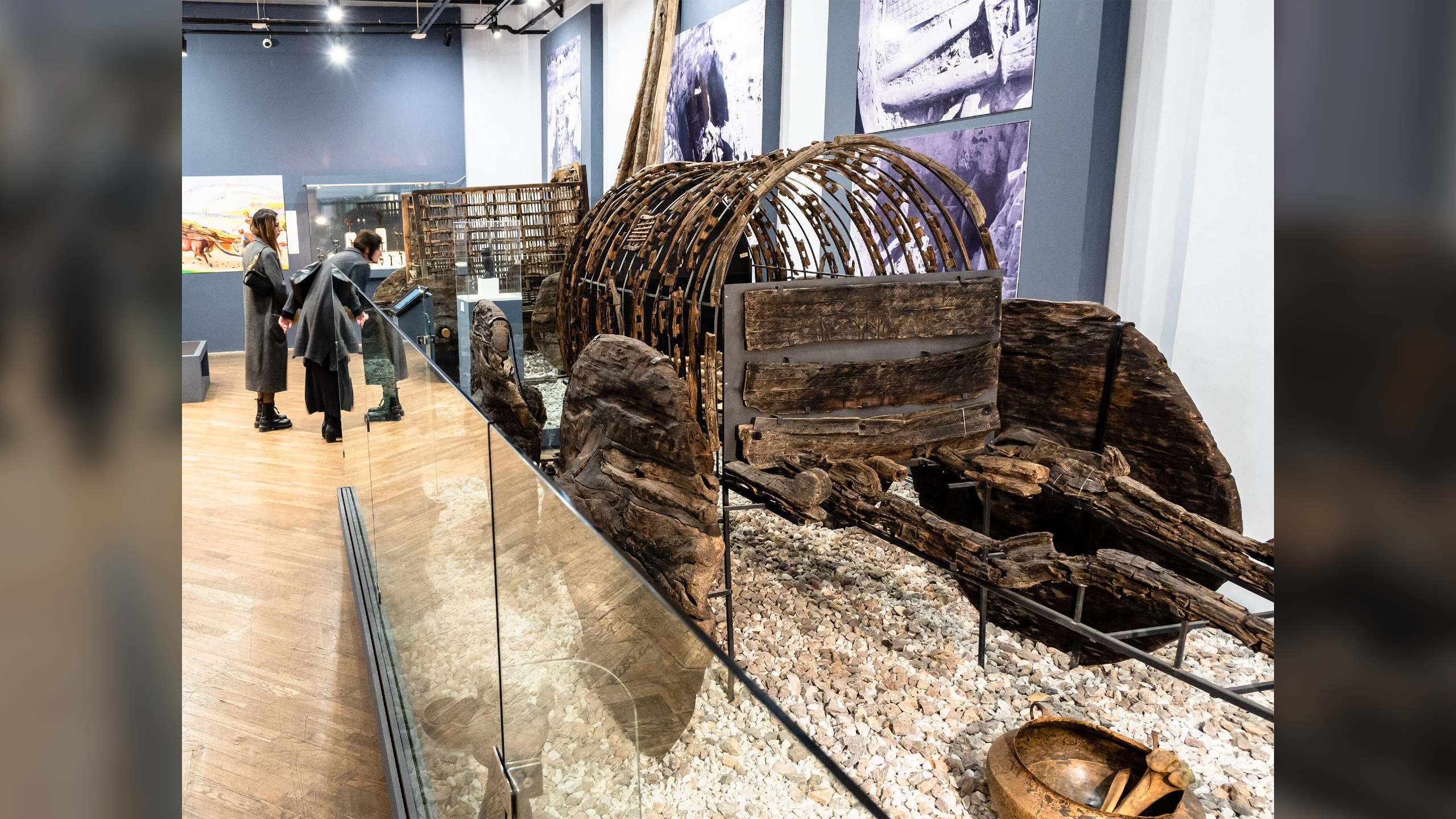
Covered wagons are often associated with the Old West. But the best-preserved example of an ancient covered wagon was actually found in a Bronze Age grave in Armenia, where it had been buried for 3,500 years.
On display at the History Museum of Armenia in Yerevan, the Lchashen wagon was made of at least 70 parts joined together by a mortise-and-tenon system involving slotted pieces of wood and bronze fittings. The frame of the canopy required at least 600 mortise holes, archaeologist Stuart Piggott wrote in a 1968 study, indicating the precise workmanship that went into creating the wagon.
The wagon measures approximately 6.5 feet (2 meters) in length. Each wooden wheel was made of two slabs of wood joined together and measured a whopping 63 inches (160 centimeters) tall, historian Christoph Baumer wrote in “History of the Caucasus” (Bloomsbury, 2021).
The Lchashen wagon was discovered in the 1950s, when construction workers from the Soviet Union drained part of Lake Sevan in Armenia to help irrigate a nearby plain. They found a Late Bronze Age cemetery that contained more than 500 burials, along with hundreds of grave goods. One distinctive feature of the Lchashen necropolis is the presence of two- and four-wheeled wagons, as well as bronze models of war chariots, archaeologist L.A. Petrosyan wrote in a 2016 study.
Although some claim the Lchashen wagon is the “oldest in the world,” there is abundant evidence of both wagon technology and covered wagons that predate this example. The exact invention dates are still being debated, but humans likely first invented the wheel and wheeled vehicles in Mesopotamia in the Copper Age, between about 4500 and 3300 B.C.
MORE ASTONISHING ARTIFACTS
But the Lchashen wagon is a very early — as well as the best-preserved — example of a covered wagon with spoked wheels on axles, demonstrating innovation in early wheeled vehicles. Whether this technology was invented in Armenia or came from Mesopotamia to the south or the Russian steppe to the north is still being investigated.
According to the History Museum of Armenia, burials with wheeled vehicles arose in the Middle Bronze Age (2400 to 1500 B.C.) in Armenia but became most popular in the Late Bronze Age, when they were used as vehicles for physically and metaphorically transporting the remains of a deceased leader into the next life.
For more stunning archaeological discoveries, check out our Astonishing Artifacts archives.