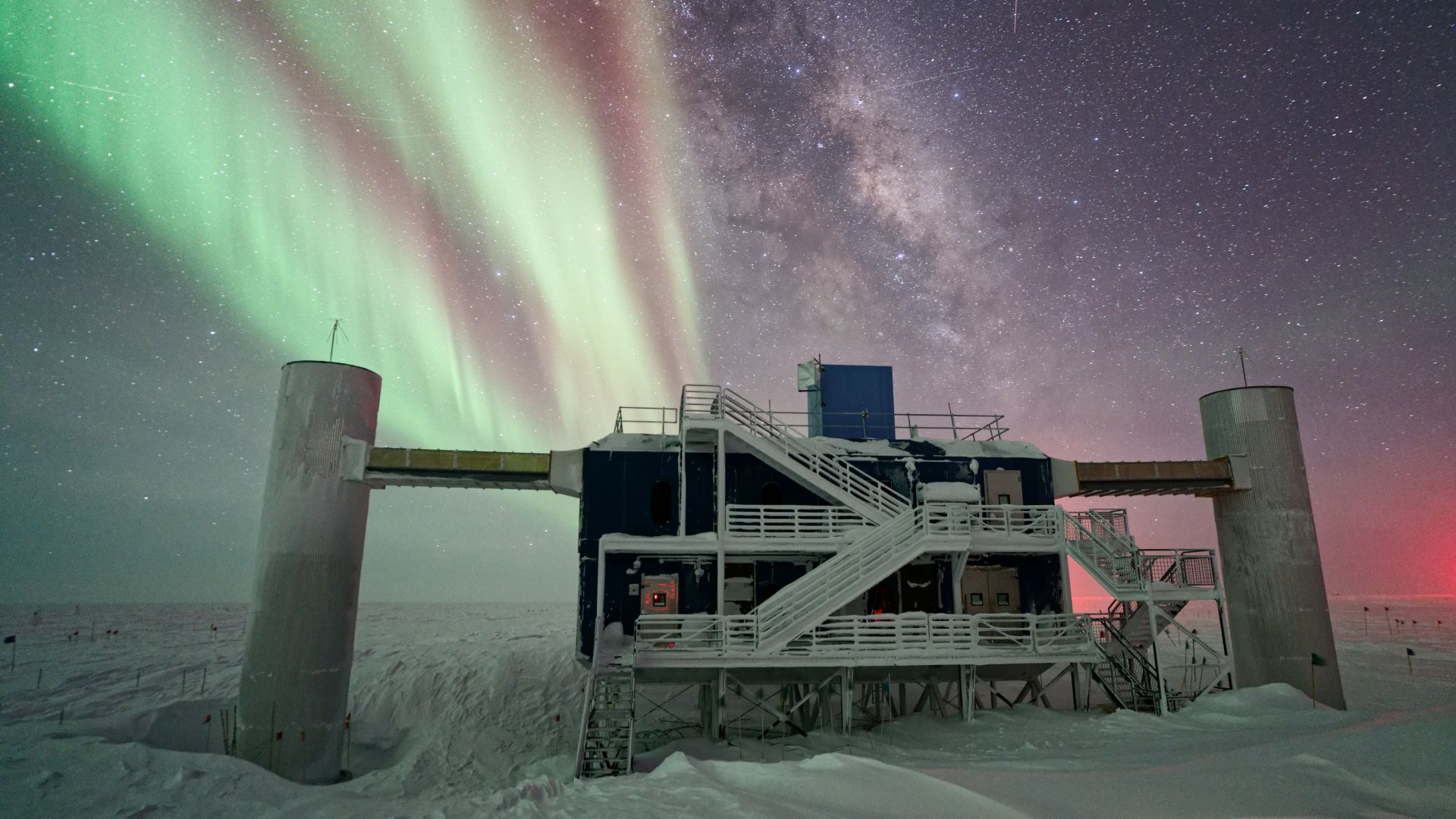
An ice-bound “ghost particle” detector at the South Pole just got a major upgrade.
The IceCube Neutrino Observatory has expanded for the first time in its 15 years of service. Technicians have added more than 600 new instruments to the bottom of the detector, which now consists of 92 strings of neutrino detectors buried in a cubic kilometer of ice near Amundsen-Scott South Pole research station.
The observatory is designed to search for high-energy neutrinos — nicknamed “ghost particles” because they are nearly massless and chargeless subatomic particles that zip through space and matter at nearly the speed of light. Neutrinos are everywhere; about 100 trillion pass through every person on Earth every second. But because they rarely interact with the matter they pass through, they’re hard to detect.
Scientists would like a better understanding of neutrinos because they’re produced in important processes, like the Big Bang that kick-started the universe, the nuclear fusion that powers stars, and the supernova explosions that signal violent stellar deaths.
At IceCube, scientists detect tiny flashes of light that occur when neutrinos do interact with matter and produce secondary particles. This requires a remote and quiet environment, which is readily available at the South Pole, as well as a lot of transparent matter in which to detect the light — in this case, ice. IceCube scientists have already successfully traced the arrival of a single neutrino from a blazar, a distant galaxy surrounding a supermassive black hole. They’ve also used the particles to map all of the matter in the Milky Way.
In 2019, the U.S. National Science Foundation (NSF) approved funding to upgrade the detector from 86 to 92 strings of detectors. The six new strings hold new detector modules with multiple types of photosensors in each module. It took three 10-week field sessions from 2023 to 2026 to drill more than a mile into the Antarctic ice and place the sensors.
The new sensors will allow scientists to more precisely measure properties such as neutrino oscillations, which happen when neutrinos formed by cosmic rays in Earth’s atmosphere change into different types. This will improve their ability to measure cosmic rays and to detect neutrinos from extraplanetary sources, such as supernovas, according to the IceCube Collaboration. Researchers will also be able to better calibrate the detector retrospectively, which will allow them to refine previously collected data from the past 15 years.
“This upgrade will secure the nation’s continued leadership in neutrino physics for years to come, paving the way for new cosmic discoveries,” Marion Dierickx, director of the NSF’s Antarctic Astrophysics and Geospace Sciences Polar Cyberinfrastructure program, said in a statement.