Many tiny specks of ancient water are locked within one of the oldest and most famous Martian meteorites ever to fall to Earth, a new study finds. The surprising discovery, achieved using a new form of “neutron scanning,” reveals more clues about the Red Planet’s watery past, which may have set the stage for extraterrestrial life to flourish.
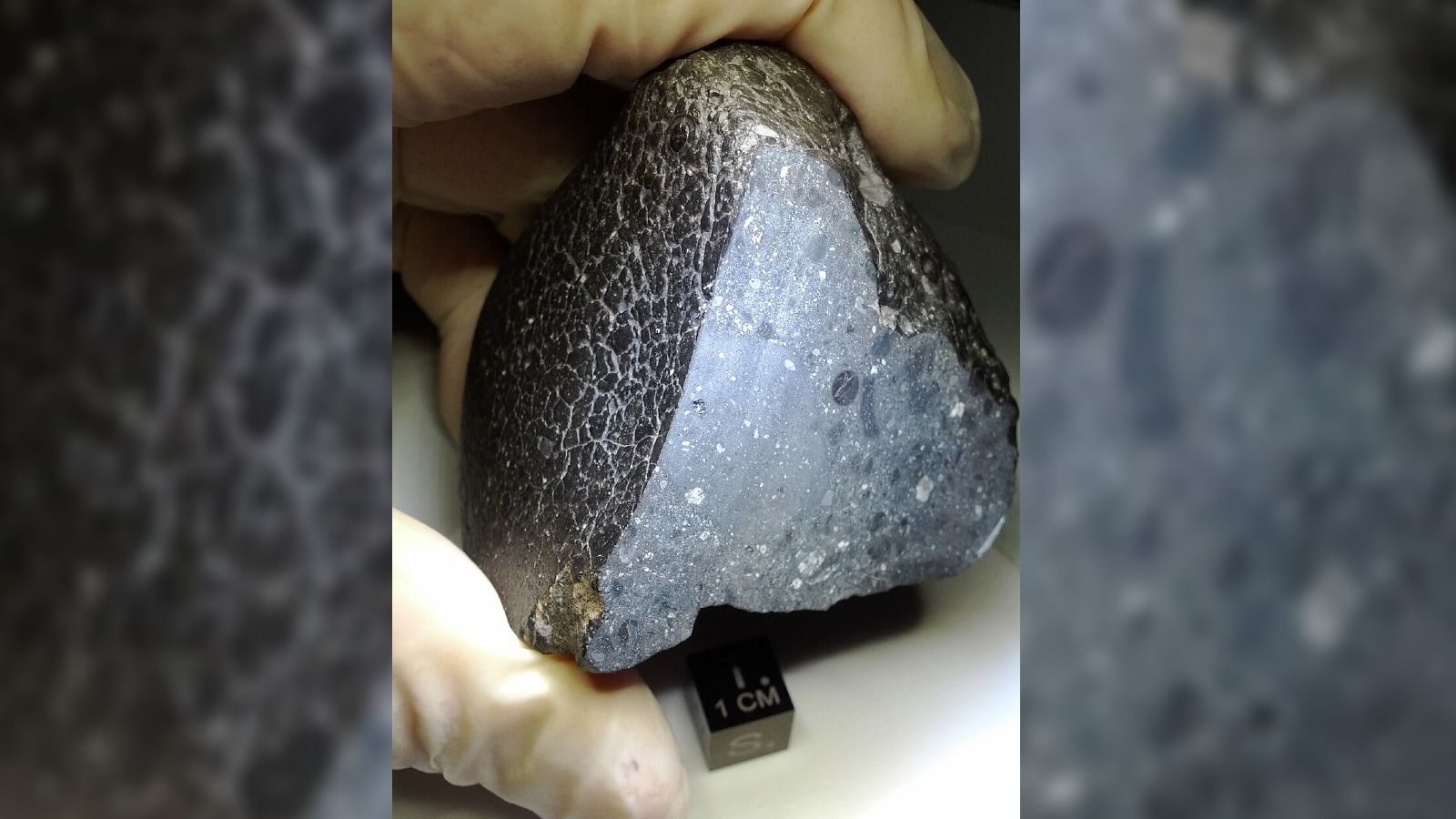
Meteorite NWA 7034, more commonly known as Black Beauty, is a roughly 11-ounce (320 grams) chunk of Mars that was ejected when another space rock slammed into the Red Planet. It was discovered in 2011 by nomads in the Moroccan region of the Sahara Desert, although it is unclear when it fell to Earth. The meteorite has since become famous for its dark hue, which has been further accentuated by heavy polishing on one of its faces.
Researchers have known since 2013 that Black Beauty contained traces of water. More recent analyses of the meteorite have revealed evidence that this water may have been partially heated, raising hopes that Martian microbes may have once thrived in warm waters on the Red Planet.
Until now, however, researchers have had to break off and destroy tiny chunks of the meteorite to properly study the water trapped within it, which has limited what they can learn from it, according to Universe Today.
But in the new study, uploaded Jan. 13 to the preprint server arXiv, researchers report that a new scanning method has allowed them to create the first in-depth analysis of the meteorite’s entire water content.
This examination revealed that water likely accounts for around 0.6% of Black Beauty’s mass, which equates to a piece of the rock around the size of a human fingernail, according to Universe Today. This may not sound like much, but it is much more than previous estimates had suggested.
Most of this water is locked within tiny fragments, or clasts, of hydrogen-rich iron oxyhydroxide (FeHO2), which is similar to the main component of rust and forms when iron reacts with water under high pressure, like during a meteor impact.
In the new study, researchers used a version of CT scanning, which builds an internal image of soft objects, like the human body, using X-rays. But instead of using electromagnetic radiation, the team bombarded the meteorite with neutrons, which proved to be particularly good at identifying hydrogen atoms embedded within the extremely dense sample.
You can see this process in action for yourself in a YouTube video shared by one of the researchers.
Water on Mars
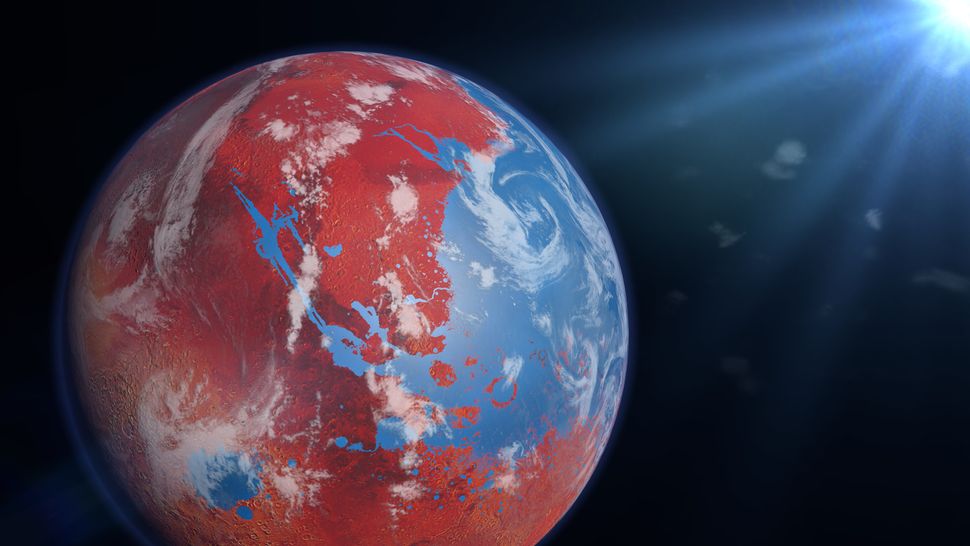

It is hard to imagine that the dusty red ball Mars is today was once a water world. However, a mounting body of evidence suggests the planet was once home to large, Earth-like oceans until around 3 billion years ago.
Most of this water has since disappeared, although some of it remains in the form of ice slabs buried near the planet’s equator, frosty deposits at the summit of Martian mountains, and a massive subsurface reservoir discovered in 2024.
Black Beauty is widely considered the oldest direct evidence of water on Mars, so it could help reveal how Mars first acquired its once-abundant water. As a result, researchers are keen to further analyze its insides.
Given that NASA recently pulled the plug on its Mars sample-return mission, which would have delivered samples collected by the Perseverance rover back to Earth, meteorites like Black Beauty are the only way to directly study Martian water.