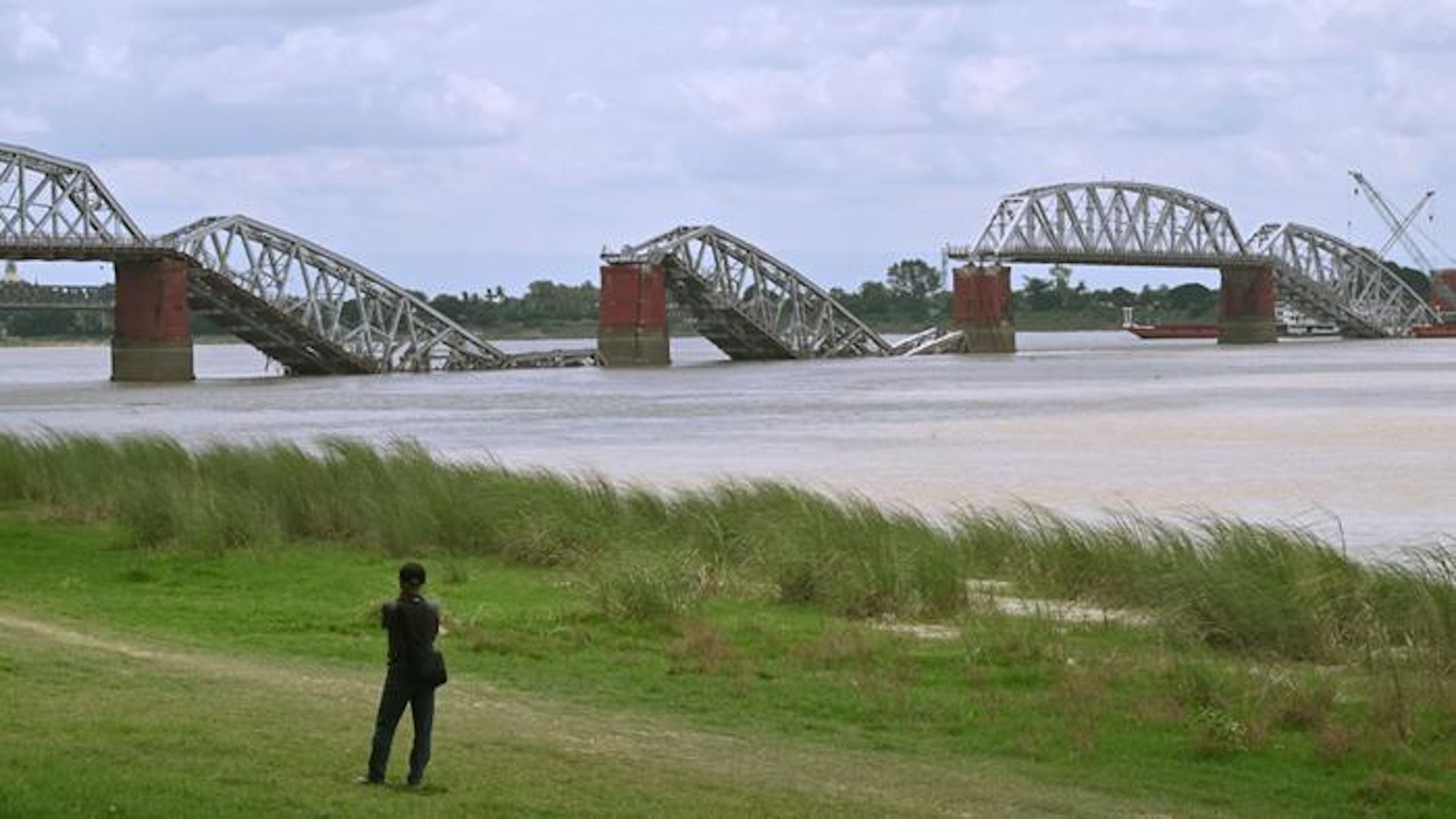
A fault that ruptured in Myanmar in March, fracturing hundreds of miles of the ground, was extremely efficient in transferring energy from deep below the ground to the surface.
In many earthquakes, the subsurface moves more than the surface. But the quake on the Sagaing fault was different because the surface moved just as much as the rocks miles deep, a new study shows. This was likely because the Saigang Fault dates back to between 14 million and 28 million years ago.
When the magnitude 7.7 quake hit on March 28, it ruptured about 300 miles (500 kilometers) of ground — a remarkably long surface rupture. Typically, Lindsey said, earthquake ruptures are more on the order of 19 to 37 miles (30 to 60 km). This rupture came with very severe shaking, and more than 5,400 people died.
Because of the infrastructure damage from the quake and ongoing armed conflict in Myanmar, Lindsey and his colleagues turned to satellite imagery to study the event. They used both optical imagery and radar data from the European Space Agency’s Sentinel-2 satellites to track ground motion down to a fraction of an inch.
Their findings, published Dec. 8 in the journal Nature Communications, showed that the earthquake was very efficient in transferring its energy up to the surface. Quakes originate deep underground. In the case of the Myanmar quake, the rupture started 6 miles (10 km) or so deep. Most of the time, the underground movement doesn’t entirely transfer to the surface — a phenomenon called “shallow slip deficit.” (Slip is the movement of one side of the fault against the other.) In the Myanmar quake, there was no shallow slip deficit.
“The massive amount of slip that happened miles underground was transferred 100% to the surface,” Lindsey said.
The ground surface on one side of the fault moved 10 to 15 feet (3 to 4.5 meters) in relation to the other. This movement was even caught on camera in a first-of-its-kind video.
Because of the efficiency of the energy transfer from deep underground to the surface, a quake on a mature fault like the one that hit Myanmar may cause more ground shaking than a quake on a more jagged fault line, Lindsey explained.
“The significance lies in safety,” he said. “This earthquake showed us that mature faults can be much more efficient at transmitting energy to the surface than younger ones, which has direct implications for how we build infrastructure to withstand the ‘Big One’ in the United States.”