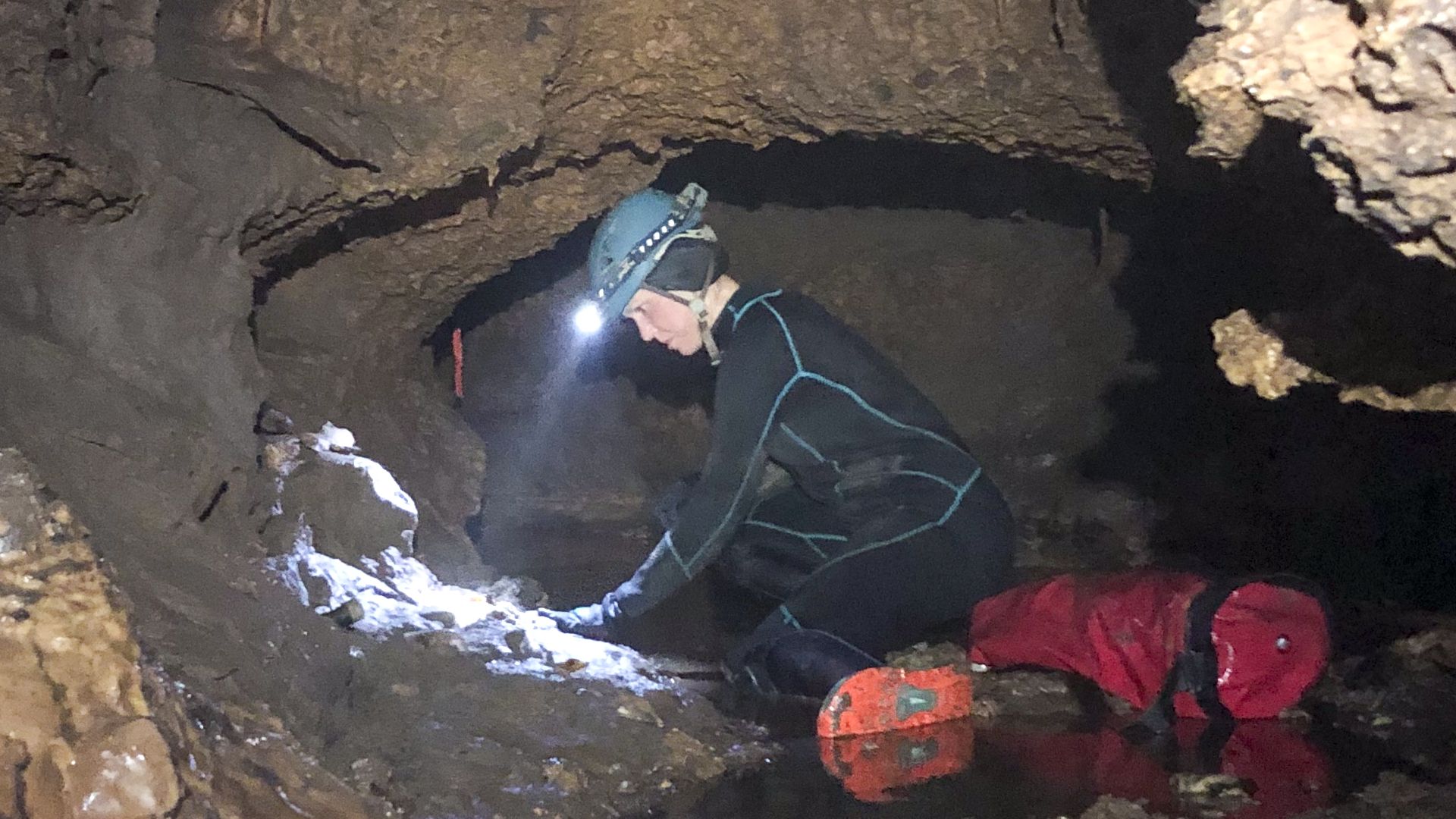





Beneath Earth’s surface lies a kingdom of undiscovered microscopic life. These “intraterrestrials” survive in some of the harshest conditions on the planet — and scientists are hunting for these microbes.
In this excerpt from “Intraterrestrials: Discovering the Strangest Life on Earth” (Princeton University Press, 2025), author Karen G. Lloyd, a microbial biogeochemist at the University of Southern California Dornsife, examines the idea of evolution among life that can survive for hundreds of thousands — if not millions — of years in a dormant state and what it might be waiting for to “wake up.”
How does one evolve to stop growing for thousands of years? Recent work suggests that microbes buried deep in oceanic seafloor sediments may be doing just that. Such organisms can be referred to as intraterrestrials, small microorganisms living inside Earth’s crust all around the globe. To answer this tough evolutionary question, first we have to think about what these organisms would experience in their lifetimes. These slow organisms wouldn’t be concerned about the length of a day. They’re buried so deep that they can’t detect the sun anyway. They probably wouldn’t even notice a change in season.
However, they might care about other, longer geological rhythms: the opening and closing of oceanic basins through plate tectonics, the formation and subsidence of new island chains, or new fluid flows brought on by slow formation of cracks in Earth’s crust. The biology I was taught in school considered these events to be evolutionary drivers for a species, not an individual.
For instance, Darwin’s finches evolved new beak shapes because they had been isolated on an island with a particular shape of seed to eat. This evolution happened over the geological timescale of island formation, but it occurred in a species lineage, not in an individual bird. We know, however, that individuals are also capable of changing along with the rhythms of their environment. An individual Arctic fox’s (Vulpes lagopus) fur changes from white to brown when the snow melts every spring. Many people (though sadly, not me) wake up at the same time each morning without the aid of an alarm. Daily and yearly rhythms seem like reasonable things for a person or an animal to keep track of.
Ice ages, less so. Anticipating changes over longer timescales seems ridiculous. It would be silly to suggest that an individual finch would have evolved the ability to swim because it had an innate anticipation that its island would subside into the sea in 100,000 years. Or that a beetle in the Gobi Desert could only reproduce when it ate an Amazon rainforest seed because it was born millions of years ago when South America and Africa were nestled into each other, and its DNA instructed it to reproduce when the tectonic gap closed again.
These scenarios make no sense for animals, but they may be reasonable for the intraterrestrials. An individual that lives for a million years might be evolutionarily predisposed to count on something as slow as island subsidence in the same way that we are evolutionarily predisposed to wait for the sun to rise tomorrow. To fully understand intraterrestrials, we may have to rethink what qualifies as an evolutionary cue.
Living for millions of years
The fact that living cells likely exist in a nongrowth state for very long timescales raises two important questions. Can a microbe be adapted to avoid cell division for thousands of years or longer, rather than having it just happen by accident? And, if so, how does evolution work for an organism that seemingly never produces offspring?
Let’s tackle that first question by stating it this way, in order to help us place this finding in the context of Darwinian evolution. Are these microbes evolutionarily adapted to hang out in this undead, dormant state for thousands or millions of years, or do they just persist because cells don’t need any special adaptations to stay alive for so long?
To me, living for hundreds of thousands of years seems unlikely to happen without adaptation. Too many physiological changes are required to support this lifestyle for it to be a side effect of a “normal” fast-paced life. Furthermore, if this lifestyle is accidental, then their main growth-supporting lives must occur in some other environment. But we rarely see the types of microbes we find in the subseafloor elsewhere. It’s not as if they were normal seawater microbes happily swimming around, dividing and growing when they fell to the seafloor and forgot to die.
On the contrary, most of this highly diverse group of microbes seem to exist only in marine sediments. Given this, they may be just as selected for in marine sediments as parrots are in a rainforest. Indeed, we find that at increasing depths in marine sediments, microbes make enzymes with a higher specificity for the type of substrates that are available in the subsurface, suggesting that they are specially adapted for this environment.
Subsurface microbes also have adaptations that enable ultraslow metabolisms and cell divisions. This suggests that they are somehow evolutionarily poised to be in a long-term nongrowing state. But here we have a problem. According to Darwin’s theory of natural selection, these cells must grow and make new progeny to evolve. Natural selection works because, during reproduction, organisms experience mutations. And when an organism has a mutation that is beneficial, the mutation increases the organism’s fitness, so the organism’s progeny outcompete those of the nonmutated organisms, resulting in more progeny that have the mutation. These further generations continue to do better than the nonmutated lineages, and eventually the mutation spreads throughout the population.
Voilà, adaptation has occurred through natural selection. But how can we even think about Darwinian evolution in populations that don’t reproduce? How can you become adapted to not have babies? I don’t think Darwin had nongrowth in mind when he described survival of the fittest.
Luckily, we have a good model in short-term seasonal dormancy. Here dormancy during winter has an evolutionary advantage because the dormant organisms have larger populations remaining once conditions are ripe for growth again in the spring. These organisms thus have a head start on other organisms and can pass their dormancy genes along to a larger population of progeny in the spring and summer.
This is textbook Darwinian natural selection. Let’s extend that model to dormancy that lasts for thousands of years in marine sediment. We have to think of an event that intraterrestrials could possibly be waiting for that would pull them out of dormancy when they’re buried hundreds of meters deep in Earth’s crust. If we encounter a dormant microbe in soil in winter, we can presume that it’s waiting to start growing again in summer. What is the equivalent situation for a deeply buried marine sediment organism that is dormant for thousands to millions of years?
Let’s do a thought experiment to jailbreak our brains from our implicit assumptions about lifespan. Imagine human lives only lasted about 24 hours. You’d be born at midnight, rebel against your parents at breakfast, settle down and have babies just before lunch, and pick up fishing as a retirement hobby around dinnertime. By midnight, your loved ones, who themselves were only born a few hours ago, would huddle close and hold your hand as you’d pass away peacefully at the ripe old age of a day. If everyone did that, hundreds of human generations would come and go within a single winter. Throughout that time span, which would represent a significant chunk of human history, the deciduous trees would remain brown and lifeless.
The permanent deadness of trees would be taken as an undisputed fact, and scientists like me would probably write grants to understand whether or not trees are alive, given that they don’t seem to grow or make progeny. Of course, if you stretched back far enough, humans would have been present for the fall or even summer, but that might have been so many generations back that a stable form of writing had yet to be invented.
We 100-year-lifespan humans know that trees are just waiting to take advantage of the summer sun. But the day-lifespan humans would be stumped. When we think about life in the subsurface, are we like day-lifespan humans contemplating a tree? Are long-lived intraterrestrials waiting for wake-up cues we don’t recognize because our lives are too short to see them? What is even the point of living for hundreds of thousands of years anyway?
There must be some reason these intraterrestrials stick around so long. There is evidence that long-term dormancy has a selective advantage. When you let the laboratory workhorse Escherichia coli sit around with no food for months or even years, many of the cells enter a state of long-term dormancy where they are alive and metabolizing, but they’re not growing nearly as quickly as they do when you feed them. If you mix these next-to-dead E. coli with a fresh batch of fast-growing E. coli and starve them both, the old geezers beat the living daylights out of the sweet little young ‘uns.
This growth advantage in stationary phase (GASP) may be the secret to why intraterrestrials live so long. Maybe they’re waiting for something that only happens thousands of years later so they can be the ones to take advantage of the new situation. They might act as monks, accustomed to deprivation while the gluttons die around them.
Life on geological timescales
So what are these microbe-monks waiting to wake up for? Seasonal cycles are way too fast. The only things slow enough are geological processes. For instance, island subsidence, floods, drought or storms often occur on hundred- to thousand-year cycles. Submarine landslides, earthquakes, tsunamis and volcanic eruptions might shift materials around on even longer timescales, exposing intraterrestrials to new food sources that coax them out of dormancy after hundreds of thousands of years.
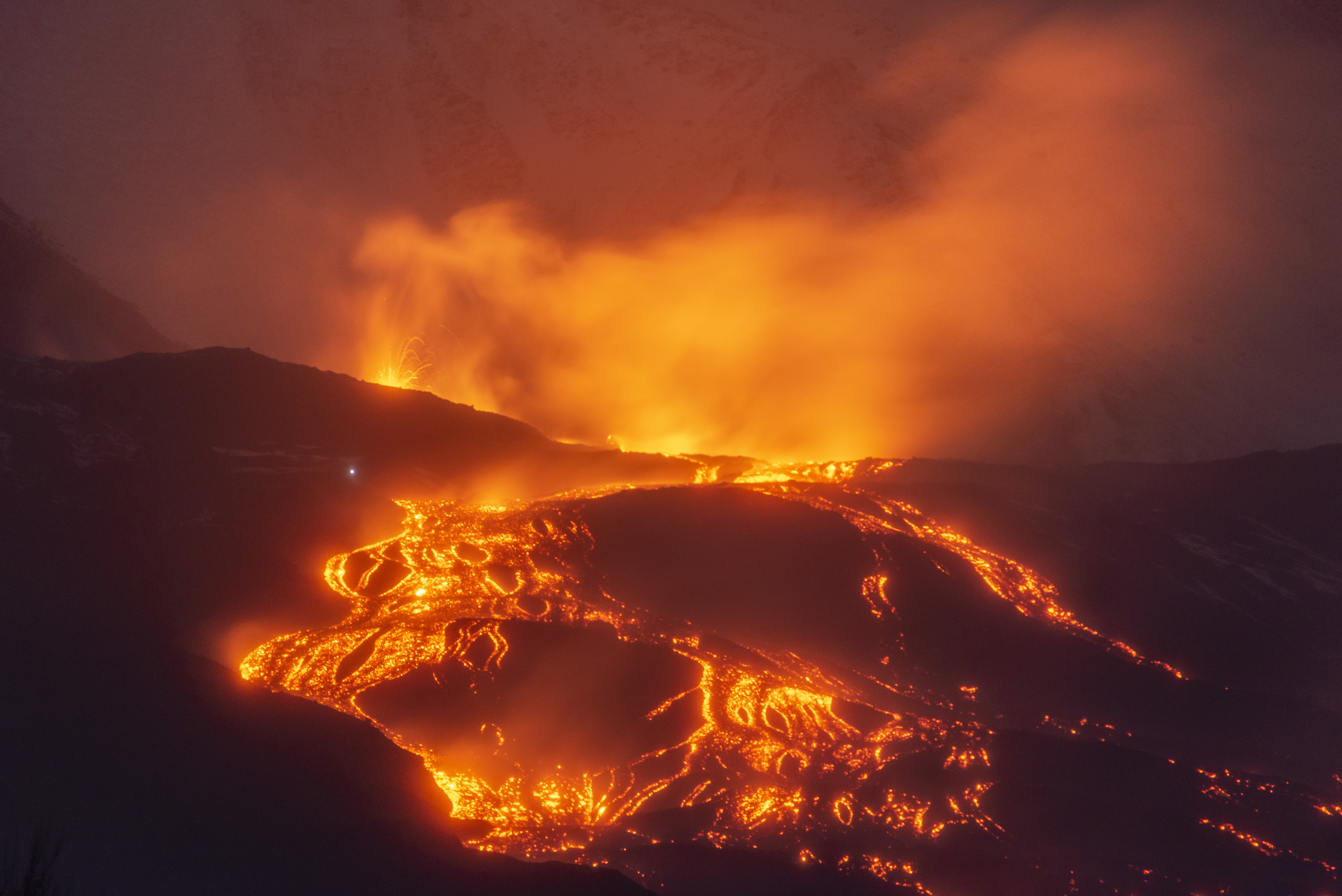

It seems odd to say that a microbe is adapted to wait for something as infrequent as a volcanic eruption, but Earth’s history shows that you can rely on volcanic eruptions, as long as you’ve got time to wait for them.
If we really let our imagination run wild, individual microbes might be adapted to events with even longer periods like glacial cycles, which shift every 30,000 years or so. Or the slow movement of tectonic plates. As new seafloor pops up in mid-ocean ridges, the existing seafloor is constantly being pushed away from the middle of the ocean, like a person standing on a moving walkway at an airport. The seafloor eventually jams into a continent in the slowest-motion train wreck ever. Some of the sediments and the intraterrestrials that live in them will get dragged on the subducting plate down to eventually be crushed at temperatures and pressures that kill all life as we know it.
Even for extremophiles, being dragged all the way down to the mantle would definitely be an evolutionary dead end. However, some of the sediments that are in the early stages of being subducted under continental plates might be returned through cracks and fissures that open in the overriding plate. During this collision, some of the seafloor sediments are shoved upward in accretionary prisms and the attendant faults created by earthquakes or other plate deformations.
Could all this piling up, faulting and burbling up to the surface be what the intraterrestrials are waiting for? Let’s think through the implications. This would mean that the individual microbial cells that we pull up in our drilling ships that appear to be dormant are just waiting patiently for the ultraslow movement of the plates to squish them into a continent, where they have a chance of resurfacing and recommencing growth.
The evolutionary payoff for waiting for millions of years in deep marine sediments would be to return to the upper seafloor again where the food is more nutritious, at which point the microbe would pass its genes along to future generations. Like any standard Darwinian natural selection, the individuals that have the best adaptations to being dormant for millions of years would have a growth advantage once they arrive back to the surface, ensuring that those adaptations become stable in the communities. Is getting tossed back up into surface sediments an intraterrestrial’s version of summer?
Adapted from INTRATERRESTRIALS: DISCOVERING THE STRANGEST LIFE ON EARTH. Copyright © 2025 by Karen Lloyd. Reprinted by permission of Princeton University Press.