Neanderthals purposefully collected and positioned horned and antlered animal skulls in a cave in what is now Spain, suggesting that these extinct human relatives had complex cultural practices over 43,000 years ago, a new study finds.
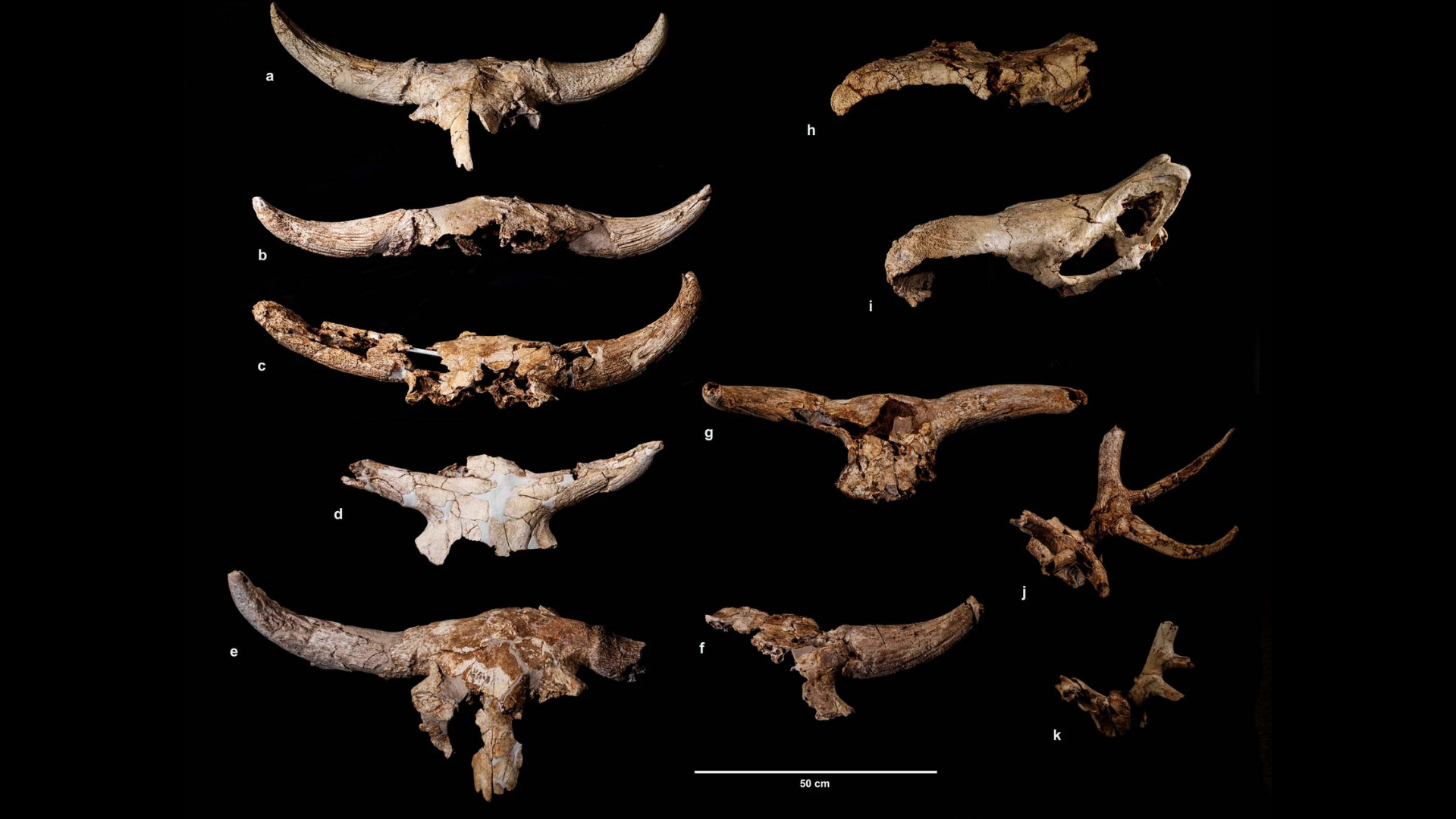
Des-Cubierta cave in central Iberia was initially discovered in 2009. In 2023, researchers announced the unusual discovery of an assortment of 35 large mammal skulls inside the cave. Most jaw bones were missing, but all skulls came from horned or antlered species like steppe bison and aurochs. Over 1,400 stone tools were uncovered in the same level, all in the Mousterian style typical of Neanderthals.
“At first glance, the deposit appears chaotic,” study first author Lucía Villaescusa Fernández, a doctoral researcher in archaeology at the University of Alcalá in Spain, told Live Science in an email. “What initially looked like a disorganised accumulation of materials turned out to preserve a clear record of both geological processes and human activity,” she said.
The cave experienced many rockfalls in the millennia following its use, so Villaescusa Fernández and her team teased the role of these disturbances apart from the Neanderthal activity. This confirmed the Neanderthals were collecting animal skulls over a long period of time in particularly cold periods between 135,000 and 43,000 years ago, according to a study published Jan. 3 in the journal Archaeological and Anthropological Sciences.
“This distinction is essential in archaeology because understanding past human behaviour requires first identifying which parts of the archaeological record were created by people and which were shaped by nature,” Villaescusa Fernández said.
To fill this gap, Villaescusa Fernández and her colleagues carefully mapped the location of all the archaeological remains. They then compared the rockfall debris distribution with that of the animal bones and stone tools. It became clear that the bones had been purposefully positioned within the cave. “These materials had different origins and were not introduced into the cave by the same processes,” Villaescusa Fernández said.
Although the timescale cannot be directly measured, and the precise duration of the practice remains uncertain, the team also found the animal skulls had been placed in specific areas of the cave repeatedly over a prolonged period of time. This suggests that this practice may have been maintained over generations and was not directly tied to economic or subsistence needs, Villaescusa Fernández said.
Exactly why Neanderthals collected the skulls is unclear, but the selection, treatment and placement of horned animal skulls in a cave they did not live in “highlights their capacity for cultural practices that are not directly related to survival,” Villaescusa Fernández said. “This has important implications for how we understand Neanderthal societies, particularly in terms of cultural transmission and shared traditions,” she added.
“Too often, discussions of Neanderthal symbolism rely on fragile evidence or optimistic interpretations,” Ludovic Slimak, an archaeologist at the University of Toulouse in France and author of the book “The Naked Neanderthal” (Penguin, 2024) who was not involved in the study, told Live Science by email. “Here, the authors take a more grounded approach, testing whether the spatial organization of the remains could be explained by natural processes alone,” he said.
Slimak said that the findings of this study add new evidence to the debate over Neanderthal symbolism. “Rather than asking whether Neanderthals were ‘symbolic like us,’ we should ask what kinds of meaningful behaviors they developed on their own terms. This site suggests that Neanderthal worlds of meaning existed, but they may have been structured very differently from those of Homo sapiens,” he said.
Villaescusa, L., Baquedano, E., Martín-Perea, D. M., Márquez, B., Galindo-Pellicena, M. Á., Cobo-Sánchez, L., Ortega, A. I., Huguet, R., Laplana, C., Ortega, M. C., Gómez-Soler, S., Moclán, A., García, N., Álvarez-Lao, D. J., García-González, R., Rodríguez, L., Pérez-González, A., & Arsuaga, J. L. (2026). Towards a formation model of the Neanderthal symbolic accumulation of herbivore crania: Spatial patterns shaped by rockfall dynamics in Level 3 of Des-Cubierta Cave (Lozoya valley, Madrid, Spain). Archaeological and Anthropological Sciences, 18(1). https://doi.org/10.1007/s12520-025-02382-5