









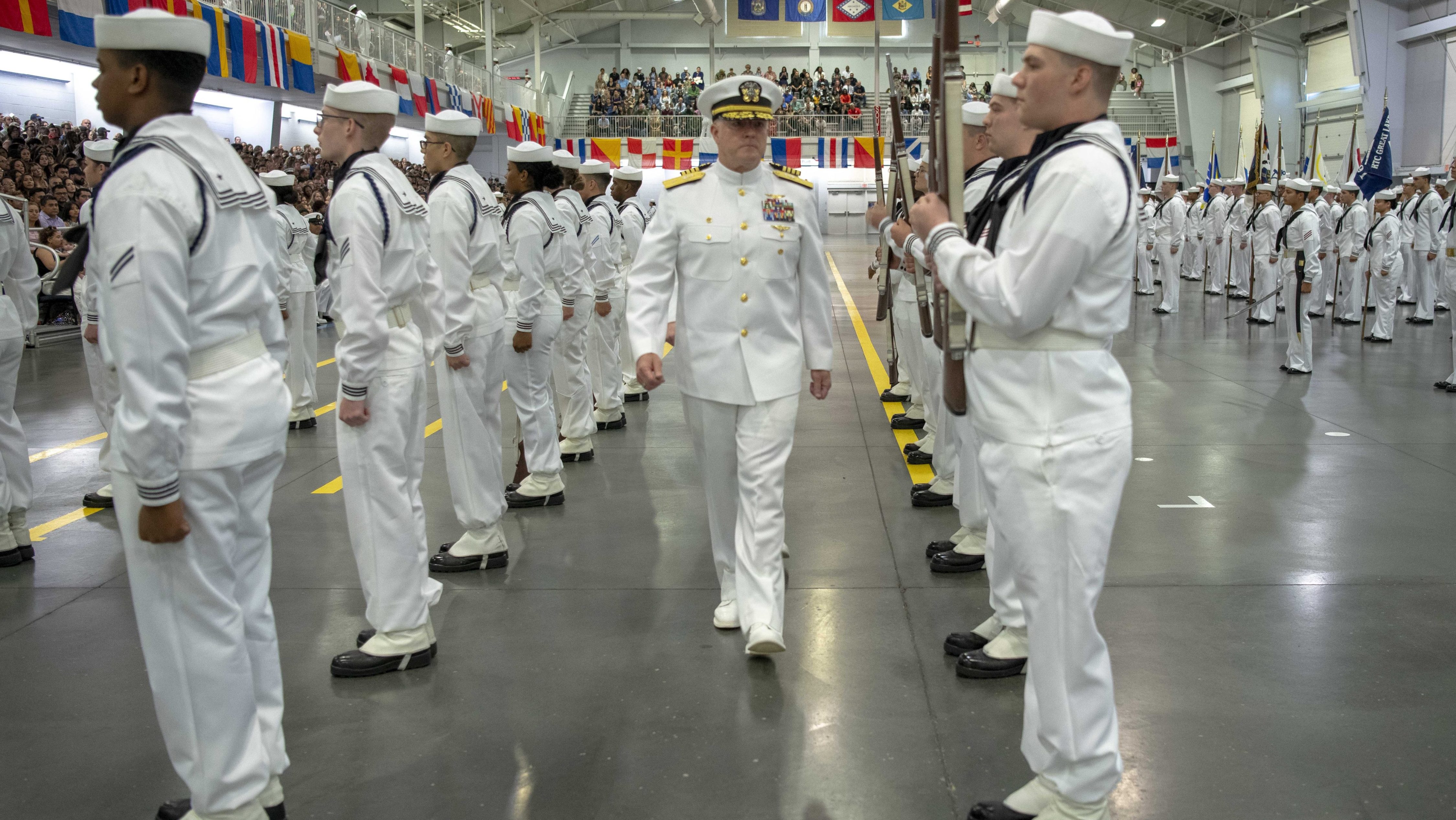
The Navy blew past its recruiting goal for new sailors this past year by meeting Gen Z recruits both online and in person with events like Sneaker Con.
The Navy signed up 44,096 sailors in fiscal year 2025, officials announced Wednesday, beating its goal for the year by almost 9%. A year ago, facing the same goal, the service squeaked past its annual quota by less than 1%.
“We haven’t recruited this number since the early 2000s. That dramatic change is by recognizing and adapting to the environment that exists and using smart marketing and advertising, freeing recruiters just to have more time to be out to prospect, rather than having to process the ones that they’ve already brought in to join,” Rear Adm. James Waters, commander of Navy Recruiting Command said Monday.
Officials spoke to reporters about the 2025 results on Monday ahead of the release of the final annual results on Wednesday.
Waters attributed the banner year to “smarter outreach both digitally and in person,” modernized marketing campaigns directed at Gen Z, and a simplified tattoo and medical waiver review process.
He also said the service increased the number of recruiters hunting for recruits, though the total number of sailors assigned to recruiting duty is drastically lower than in earlier eras. The service has 3,547 frontline recruiters now, officials said, or nearly “1,500 fewer recruiters today as compared to the number in the early 2000s.”
The surge in new recruits, which mirrors success in other services, comes after several years of lower numbers and missed goals. In fiscal year 2023, the Navy failed to meet its recruiting goals for new enlisted sailors by nearly 7,500 and officers by close to 450. The Reserves also missed their goals.
But the service has now hit its goal in both 2024 and 2025 , which was set at 40,600 new sailors each year. The 2025 haul was the service’s highest recruiting number in more than 20 years.
Waters said that the military continues to battle challenges like the “competitiveness of the economy” and lower propensity among younger generations to serve.
“It’s about how much we can make contact. Because the product, or the job, the service, is an incredible deal. It’s an incredible opportunity for young people, and once that is communicated to them, we’ve seen good prospects in that,” he said. “The job market and the competitiveness of it, the lower propensity — those factors are still there. Those headwinds are still there.”
Cdr. Stephanie Turo, a spokesperson for Navy Recruiting Command, told Task & Purpose that recruiters were directed to focus on conversations about service shaping recruits into a “stronger, better version of yourself.”
“For Gen Z, that means connecting their personal goals to something larger: teamwork, resilience, and a mission that matters,” Turo said. “That combination of personal growth and purpose is what resonates most with this generation.”
The Navy also offered enlistment bonuses, “quick-ship” opportunities to go to basic training in just a few weeks, and technical career fields with “clear advancement,” she said.
Top Stories This Week
The Navy implemented new programs to boost the pool of recruits like the Future Sailor Prep Course and private-sector style methods like targeted digital advertising and more data analytics. In November 2022, the Navy also raised the maximum age for enlisted recruits from 39 to 41 for most jobs outside of some special duties or physically demanding roles like SEALs and divers.
As recruiting has continued to tick up in 2025, President Donald Trump and Defense Secretary Pete Hegseth have both laid claim to credit for the boost in numbers.
Navy officials said they would not discuss the influence of politics on recruiting numbers or any impact on the numbers from service members brought back after being separated for refusing the COVID-19 vaccination.
“To maintain the nonpartisan nature of military service, this roundtable will not address questions or recruiting outcomes to partisan political factors or specific elected officials,” Turo told reporters Monday.
Gen Z
As part of its pitch to Gen Z — a marketing term loosely applied to audiences born just before, during or just after the 2000s-decade — between their mid-teens and upper-20s — the Navy sent trucks and Jeeps with virtual reality simulators to events where users could get a taste of Navy life, either behind a joystick flying a simulated plane, being inside a submarine control room, or launching an F-35 from the deck of the carrier.
The Navy also went all in on sponsoring events aimed at younger people including the high school All-American Bowl in San Antonio, Texas, a worldwide sneaker-head gathering known as Sneaker Con, competitions for Robotics and Water Polo, and SkillsUSA, a major STEM conference.
The Navy’s “data-informed” focus on where to spend its money, whether through paid search or social media advertising, “contributed to significantly more leads being provided to recruiters in the field,” Waters said.
As part of its marketing strategy, the Navy dropped a new series of recruiting ads for special duty jobs like SEALs, aviation rescue swimmers, explosive ordnance disposal technicians, and special warfare combat crewmen which highlighted the service’s departure from “dirt wars” and move towards maritime operations.
“Those ads really approach Gen Z in a way that is more relatable and has generated a lot of those leads,” Waters said.
The Navy also simplified its tattoo review process. Gen Z, said Waters, is also “much more inked than they were even a few years ago.” The service ditched a process that made recruits submit handwritten statements documenting each tattoo.
“Tattoos with extremist, obscene, or gang-related content — or anything contrary to good order and discipline — remain strictly prohibited. What has changed is that the process is now faster and more straightforward for both recruiters and applicants, while ensuring our standards are consistently applied,” Turo said.
For the coming year, the Navy is looking to improve the recruitment of doctors, dentists, and psychologists as the military’s hospitals face workforce shortages. With lessons learned from a private sector medical recruiting organization, one of the Navy’s takeaways was to have recruiters focus nationally instead of on a local market.
“That led us to take a team of medical recruiters that we had distributed among our districts or Navy talent acquisition groups and centralized them, and that had a significant positive effect,” Waters said. “We’re going to grow that centralized group because of how successful it was to drive further into the medical recruiting market, which you can imagine is just extremely competitive, as not only is it competitive between the services, it’s competitive with large medical networks throughout the country.”


