Follow us
Add us as a preferred source on Google
Subscribe to our newsletter
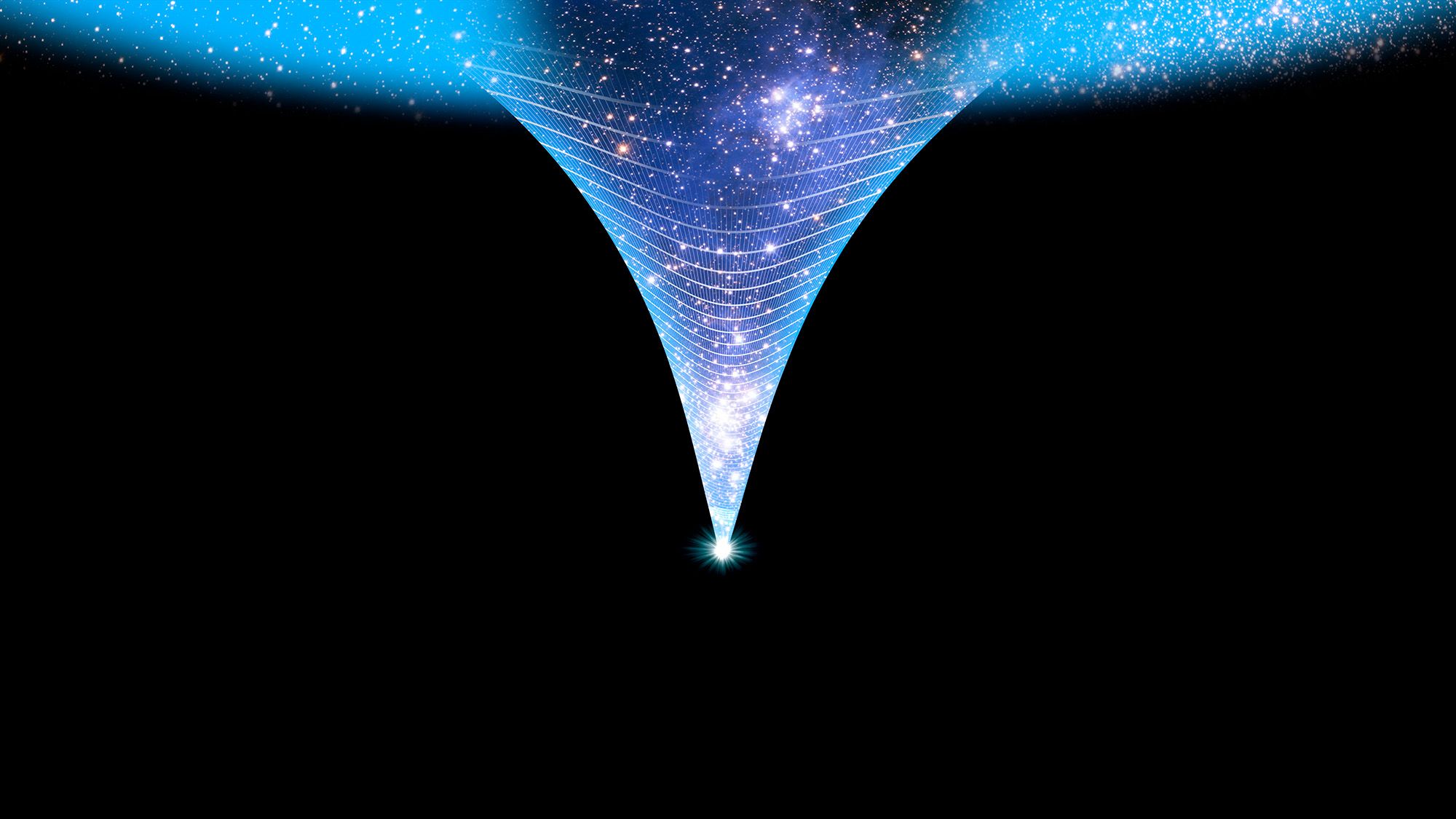
A neglected “ghost particle” may have dominated the universe right after the Big Bang — changing how the cosmos expanded in its first moments and reshaping the conditions under which matter won out over antimatter, a new study suggests. In other words, it may explain why anything exists at all.
The particle, a hypothetical “right-handed” neutrino, briefly could have held more energy than everything else in the infant universe combined, which would have sped up cosmic expansion and delayed key particle interactions, the study proposes. The research was published Sept. 8 in the journal Physical Review Letters.
Neutrinos are ghostly particles that rarely interact with anything. A typical neutrino from the sun could pass through a slab of lead a light-year thick — about 5.9 trillion miles (9.5 trillion kilometers) — before striking a single atom. Neutrinos come in three types, or “flavors,” and switch between them as they travel, making use of a subtle quantum effect that works only if they have mass. Yet the Standard Model of particle physics predicts they should be massless.
Latest Videos FromLive Science
One popular fix involves “right-handed” neutrinos. Particles spin a bit like tiny tops, and physicists call them left- or right-handed depending on how they spin relative to their direction of travel. A right-handed particle rotates like an ordinary screw being driven in, turning clockwise as it moves away from you. Every neutrino detected so far is left-handed and turns counterclockwise as it flies away, like a screw with a reverse thread.
“Right-handed neutrinos are hypothetical particles that do not feel the weak nuclear force, “unlike their left-handed counterparts, which are part of the Standard Model,” study co-author Rishav Roshan, a theoretical physicist at the University of Southampton in the U.K., told Live Science via email. “They are characterized by having no electric charge and being much heavier.”
“Right-handed neutrinos may mix with left-handed neutrinos, helping to explain the mass of the latter” and why they switch flavors, Roshan said.
The IceCube facility, photographed here beneath the Southern Lights, is Earth’s premier neutrino detection facility. The proposed ‘right-handed’ neutrino has not yet been detected.
(Image credit: IceCube/NSF)
The cosmic seesaw
In quantum physics, particles that mix can exist as a blend of two identities at once. In a theoretical framework called the seesaw mechanism, each ordinary neutrino carries a faint trace of a heavy right-handed partner, and that trace gives it a tiny mass. The heavier the partner, the fainter the trace and the lighter the ordinary neutrino — hence the name, after the playground ride whose ends move in opposite directions.
Get the world’s most fascinating discoveries delivered straight to your inbox.
The particles could solve other puzzles, too. They “aim to address several issues, including the origin of neutrino masses, the matter-antimatter asymmetry of the universe, and the nature of dark matter,” Roshan said.
The Big Bang should have made equal amounts of matter and antimatter, which would have annihilated each other, forbidding the universe as we know it from ever taking shape. Right-handed neutrinos play a crucial role in models’ proposals that the “observed matter-antimatter imbalance arose from processes involving these neutrinos in the early universe,” Roshan said.
In this picture, decaying heavy neutrinos left behind a slight excess of leptons — the particle family that includes electrons — that later became today’s surplus of matter, he explained.
The seesaw framework usually includes three right-handed neutrinos, but because two are enough to explain the data, physicists often ignore the third, assuming it is too heavy or interacts too feebly with matter.
How the heaviest neutrino took over
In the new study, Roshan and Sudipta Show, a physicist at the Indian Institute of Technology Kanpur, examined what this neglected particle — which, in the team’s main example, was about 100 trillion times as heavy as a proton — would have done after the Big Bang.
At first, the particle would have zipped around at nearly light speed, so its energy would have faded like that of light, which would have both spread out and stretched to weaker wavelengths as space expanded. But as the cosmos cooled, the particle would have slowed down and most of its energy would have become locked in its mass, which would have been only spread out. Its share of the cosmic energy therefore would have grown until it dominated, and the long-lived particle would have stayed in charge until it decayed into other particles, according to the team’s computations.
The study reveals that the neglected right-handed neutrino “significantly impacts the early universe’s expansion dynamics, driving a period of early matter domination,” Roshan said. This change “affects various Standard Model interactions” that could help to explain the matter-antimatter asymmetry, Roshan added.
Each interaction would have switched on only once it outpaced the expansion of space. Because a universe dominated by the heavy neutrino would have expanded faster, the interactions would have had to wait until it cooled further.
These interactions would have let the early universe distinguish lepton flavors, which would have affected how the matter surplus formed. Thanks to the delay, the team found, a lighter right-handed neutrino about 100 billion times as heavy as a proton could have produced the observed amount of matter before the flavors could be told apart — even after the heavy neutrino’s decay diluted part of it.
Hard to test, but not out of reach
The heavy neutrino is far too massive to create in any particle accelerator, so tests must be indirect.
Gravitational waves — ripples in space-time — offer one such route. An era dominated by the heavy neutrino would have left a telltale kink in the background of early-universe gravitational waves, such as those from “cosmic strings” — hypothetical thread-like defects in space. The results can be tested through forthcoming facilities such as the Laser Interferometer Space Antenna (LISA) and the Square Kilometer Array Observatory (SKAO), Roshan noted.
LISA, a space-based European Space Agency mission, is scheduled to launch around 2035, while SKAO, a giant radio telescope project being built in Australia and South Africa, could catch such waves by timing distant pulsars. Tests could come “as these facilities come online and begin data collection,” Roshan said. A faint hum from the hot primordial plasma would carry the era’s imprint too, but at frequencies beyond what existing detectors could pick up.
Roshan, R., & Show, S. (2026). Delayed charged Lepton Yukawa equilibration in minimal seesaw. Physical Review Letters, 137(11), 111802. https://doi.org/10.1103/nfkx-q6z7