









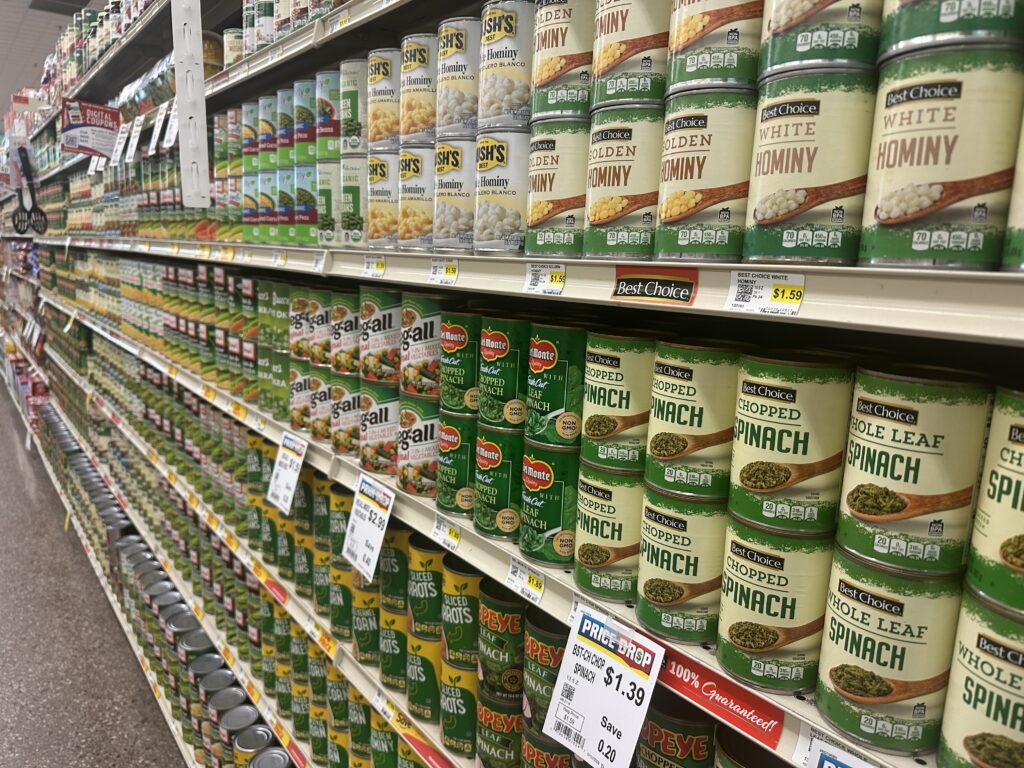
Canned foods on grocery store shelves. (Photo by Cami Koons/Iowa Capital Dispatch)
Ohio Gov. Mike DeWine is ordering the Ohio Department of Job and Family Services to give $7 million to regional food banks and up to $18 million in emergency relief benefits to more than 63,000 low-income Ohioans.
DeWine’s executive order requires ODJFS to allocate $7 million to regional food banks using Temporary Assistance for Needy Families (TANF) funds. The order also requires ODJFS to double the monthly benefit for the state’s 63,000 Ohio Works First recipients — which include more than 57,000 children.
Ohio Works First provides assistance to low-income families with children — at or below 50% of the federal poverty level — using TANF funds.
SUBSCRIBE: GET THE MORNING HEADLINES DELIVERED TO YOUR INBOX
Ohio Works First recipients will receive their usual monthly benefits on Saturday and will receive an additional weekly benefit equaling a quarter of their typical monthly allotment.
“While we will always do everything we can to support Ohioans who need it most, this is not a viable, long-term solution,” DeWine said in a statement. “SNAP is a federal program that is specifically federally funded.”
About 1.4 million Ohioans receive SNAP benefits and the U.S. Department of Agriculture said federal food aid would not be issued Nov. 1 because of the government shutdown, which started on Oct. 1.
Ohio’s average SNAP benefits are $190 a month, ODJFS Spokesperson Tom Betti said. Ohioans must have a net income at or below federal poverty guidelines — $32,150 a year for a family of four — to qualify for SNAP.
“Not every family is going to get additional funds, but we want to target specifically those families where we thought that they really desperately would need the money and would need the help,” DeWine said to reporters.
Food banks across Ohio have said the need will be beyond what they can bear with SNAP benefits not being distributed.
“Governor DeWine’s approach allows us to allocate funds using ordinary distribution channels – providing targeted support to families in greatest need, while also assisting food banks, which can reach people quickly and directly,” ODJFS Director Matt Damschroder said in a statement.
Ohio’s minority leaders in the House and the Senate expressed gratitude while also asking DeWine to do more.
“I am grateful that there will be some relief for those in need, but this executive order does not go nearly far enough to help,” said Ohio House Minority Leader Dani Isaacsohn, D-Cincinnati. “We are on the tipping edge of a crisis and the governor needs to do more.”
“While we’re glad the governor has taken steps to protect Ohio families that are caught in the middle of political debates taking place in Washington, this is not nearly enough to make up for the potential gap in funding,” said Senate Democratic Leader Nickie J. Antonio, D-Lakewood.
Ohio Democratic lawmakers have been calling on DeWine to authorize funds during a lapse in federal food assistance. DeWine’s spokesperson Dan Tierney, however, says there is no mechanism for the state to directly fund Supplemental Nutrition Assistance Program payments, “regardless of funding source.”
“Ohio does not run the SNAP payment system,” Tierney said in an email. “We do not have access to that system to fund SNAP. Ohio’s role is to verify if beneficiaries are eligible for SNAP and to transmit that to the federal government.”
Ohio Republican lawmakers are blaming U.S. Senate Democrats. Congressional Democrats have refused to sign on to a funding bill if Republicans don’t agree to extend subsidies to buy health insurance on marketplaces created by the Affordable Care Act.
“The easiest and best way to help Ohioans in need of food assistance is for U.S. Senate Democrats to end its filibuster of SNAP benefits and other important federal programs and approve the clean continuing resolution passed by the U.S. House,” DeWine said in a statement.
Ohio Republican lawmakers also argue this needs to be solved at the federal level, not the state level.
“Everyone’s heart is in the right place on this,” state Sen. Terry Johnson, R-McDermott, said during the most recent Senate Session. “If you want a solution to this, it’s at the federal level. It’s not at the state level.”
State Rep. Latyna Humphrey, D-Columbus, introduced Ohio House Bill 502 which would make an appropriation through the Budget Stabilization Fund (also known as the “Rainy Day Fund”) to continue to fund SNAP and some other federal programs if there were to be a lapse in federal funding, but the bill has had no hearings.
“Ohio families are truly going to be in crisis,” she said during a recent press conference. “We can’t stand by while families wonder how they’ll put food on the table.”
The Ohio Senate Democratic Caucus sent a letter to DeWine asking him to use the state’s $3.9 billion “Rainy Day Fund” as a way to continue funding SNAP benefits to Ohioans, saying funding SNAP benefits for one month would cost $263 million.
“The sole purpose of the Budget Stabilization Fund is to support a previously enacted budget if state revenue decreases in an economic downturn,” Tierney said in an email. “The fund may be accessed only if the Ohio General Assembly enacts legislation to do so.”
Several other states — including Republican-led Iowa, Louisiana, Nevada, South Carolina, Virginia, and West Virginia — have also announced plans to help those who are losing SNAP benefits, according to NBC News.
The Ohio House Democratic Caucus also sent a letter to DeWine asking him to declare a state of emergency and to work with lawmakers to make sure food banks have enough resources to feed people.
Ohio Sen. Kent Smith, D-Euclid, offered up an amendment during the most recent Ohio Senate Session that would have allowed the use of the Ohio Budget Stabilization Fund to fully fund the SNAP program during a lapse in federal funding and allowed the state to ask for reimbursement from the federal government for those funds.
“These (SNAP) funds are vital drivers for our local economy, generating commerce at our grocery stores and neighborhood markets,” Smith said. “Losing this spending power would inflict substantial harm, not only on families, but on small businesses and employees.”
The amendment was voted down in a party-line vote.
“I’m very sympathetic to the idea in this amendment that we do need to restore SNAP funding, but unfortunately, this is a very expensive endeavor,” said Ohio Sen. Bill Blessing, R-Colerain Twp.
Ohio Senate Republicans argued there’s no guarantee the state would get reimbursed from the federal government.
“The potential damage to our budget as a result of this could be devastating,” said Ohio Sen. George Lang, R-West Chester.
Sen. Jerry Cirino, R-Kirtland, called the SNAP amendment “appalling.”
“If Ohio and other states might follow in our footsteps of backfilling the federal government, all that does is encourage them to remain closed because we will backstop them whether or not we get reimbursed at some point,” he said. “… Do we want to encourage that human behavior?”
The longest government shutdown took place during Trump’s first term as president in 2019 and lasted 35 days.
Ohio Capital Journal Reporters Marty Schladen and Susan Tebben contributed to this report.
Follow OCJ Reporter Megan Henry on Bluesky.
SUPPORT: YOU MAKE OUR WORK POSSIBLE


