Stunned astronomers have discovered a zombie star relatively near Earth that is inexplicably emitting a persistent, rainbow-like shock wave as it speeds through the Milky Way. The undead stellar remnant, which is currently devouring its companion star, has left researchers scratching their heads.
Every star in the Milky Way is constantly spinning around the supermassive black hole at the heart of our galaxy, dubbed Sagittarius A*. Most of these stars, including the sun, are preceded by a bow shock, which pushes material around the star, similar to the waves generated around the bow of a ship as it moves through the water. These bow shocks are created by outflowing gas and dust from the star, which collides with and pushes against the interstellar medium — the leftover matter and radiation that exists in the gaps between stars.
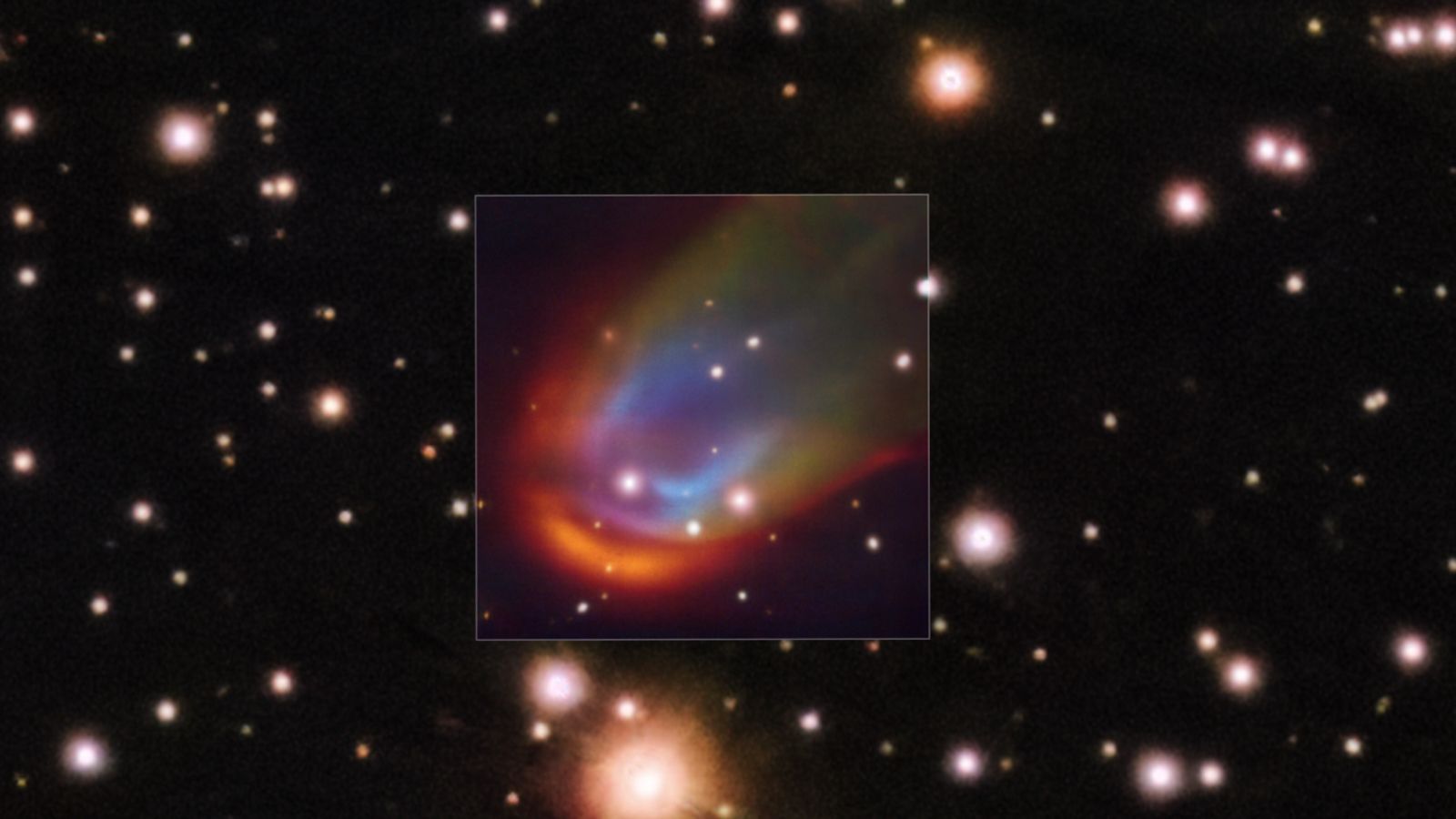
But in a new study, published Jan. 12 in the journal Nature Astronomy, a group of astronomers discovered a white dwarf, named RXJ0528+2838, that is surrounded by a bow shock. The rule-breaking star is located roughly 730 light-years from Earth and is part of a binary system, alongside another sun-like star that is slowly being devoured by the cosmic zombie.
Using observations from the European Southern Observatory’s (ESO) Very Large Telescope (VLT) in Chile, the study team mapped out this surprising shock wave, which extends around 4,000 Earth-sun distances from the stellar pair and is at least 1,000 years old. Images also show that the bow shock contains a dense cloud of multicolored gas and dust, or a nebula, which only adds to its mystery.
“We found something never seen before and, more importantly, entirely unexpected,” the study’s other co-lead author Simone Scaringi, an astronomer at Durham University in the U.K., said in an ESO statement.
“Our observations reveal a powerful outflow that, according to our current understanding, shouldn’t be there,” added the study’s other co-lead author Krystian Iłkiewicz, a postdoctoral researcher at Poland’s Nicolaus Copernicus Astronomical Center. “This discovery challenges the standard picture of how matter moves and interacts in these extreme binary systems.”
Given that RXJ0528+2838 is part of a binary star system, the obvious explanation for its bow shock is that its partner star is outflowing material that is colliding with the interstellar medium. However, the researchers strongly believe this is not the case.
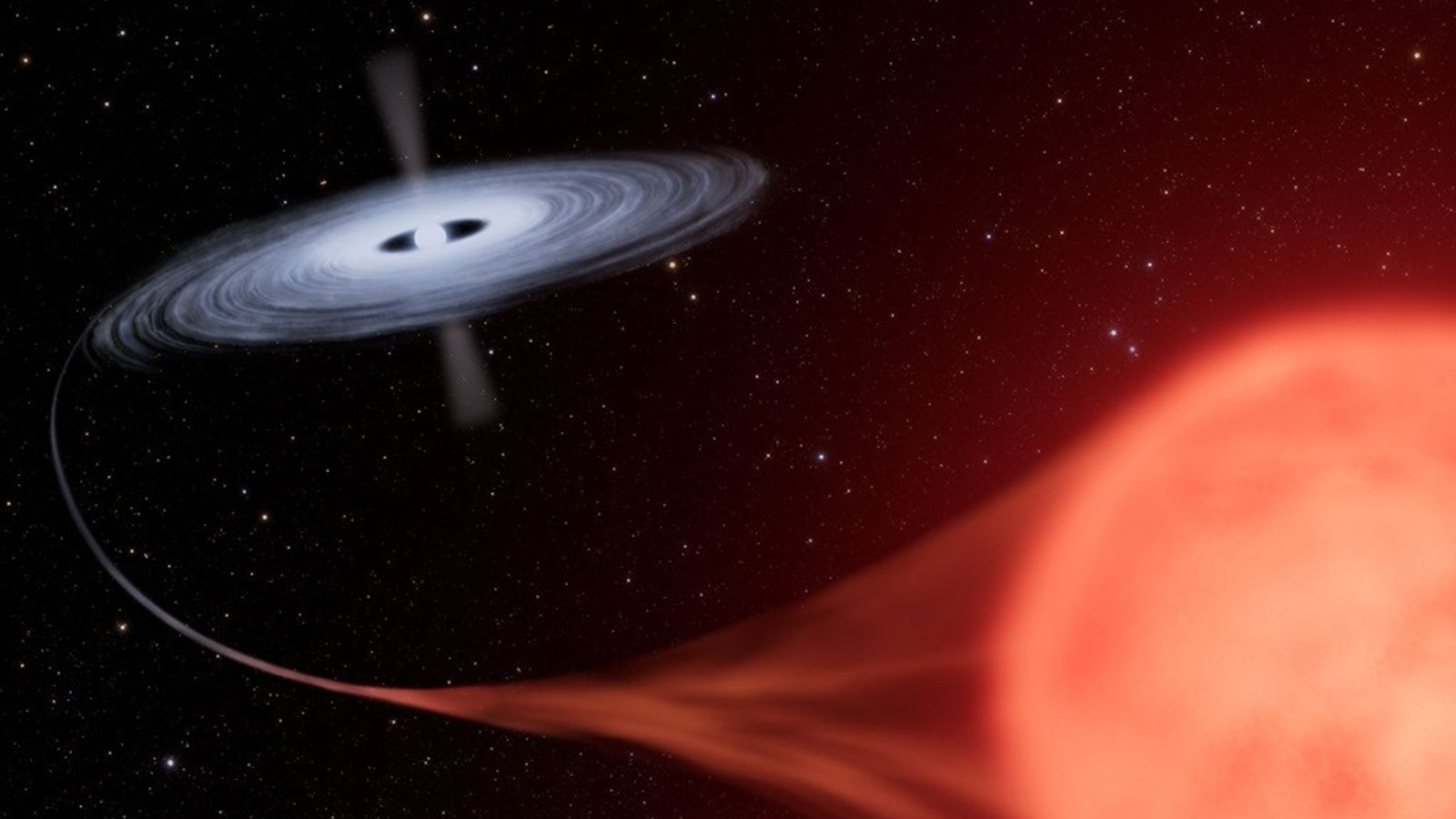
In a binary system like this, the most massive star — which, in this case, is the superdense white dwarf — slowly devours its partner by pulling material from its surface. This means that RXJ0528+2838’s partner does not outflow like similar stars of its size, because the white dwarf also hoovers up any outflowing material.
This process normally leaves a disk of excess stellar material circling the more massive star, which could also generate a similar type of stellar outflow. However, there is no visible disk around RXJ0528+2838, which strongly suggests this isn’t happening.

“The surprise that a supposedly quiet, diskless system could drive such a spectacular nebula was one of those rare ‘wow’ moments,” Scaringi said.
Instead, the researchers suspect that RXJ0528+2838’s mysterious “outflow” may be tied to its immensely strong magnetic field. This invisible energy source is also the reason why the white dwarf has no disk, because it is sucking up everything around it, similar to a black hole.
However, the researchers cannot identify the exact mechanism by which the magnetic field acts to replicate the effects of a stellar outflow, which they have dubbed the “mystery engine.”
The researchers are now on the hunt for similar systems that may offer clues as to what is going on with RXJ0528+2838. Luckily, ESO’s upcoming Extremely Large Telescope (ELT) — the successor of VLT, which is due to go online as early as 2028 — will likely help with this.
ELT will allow astronomers “to map more of these systems as well as fainter ones and detect similar systems in detail, ultimately helping in understanding the mysterious energy source that remains unexplained,” Scaringi said.