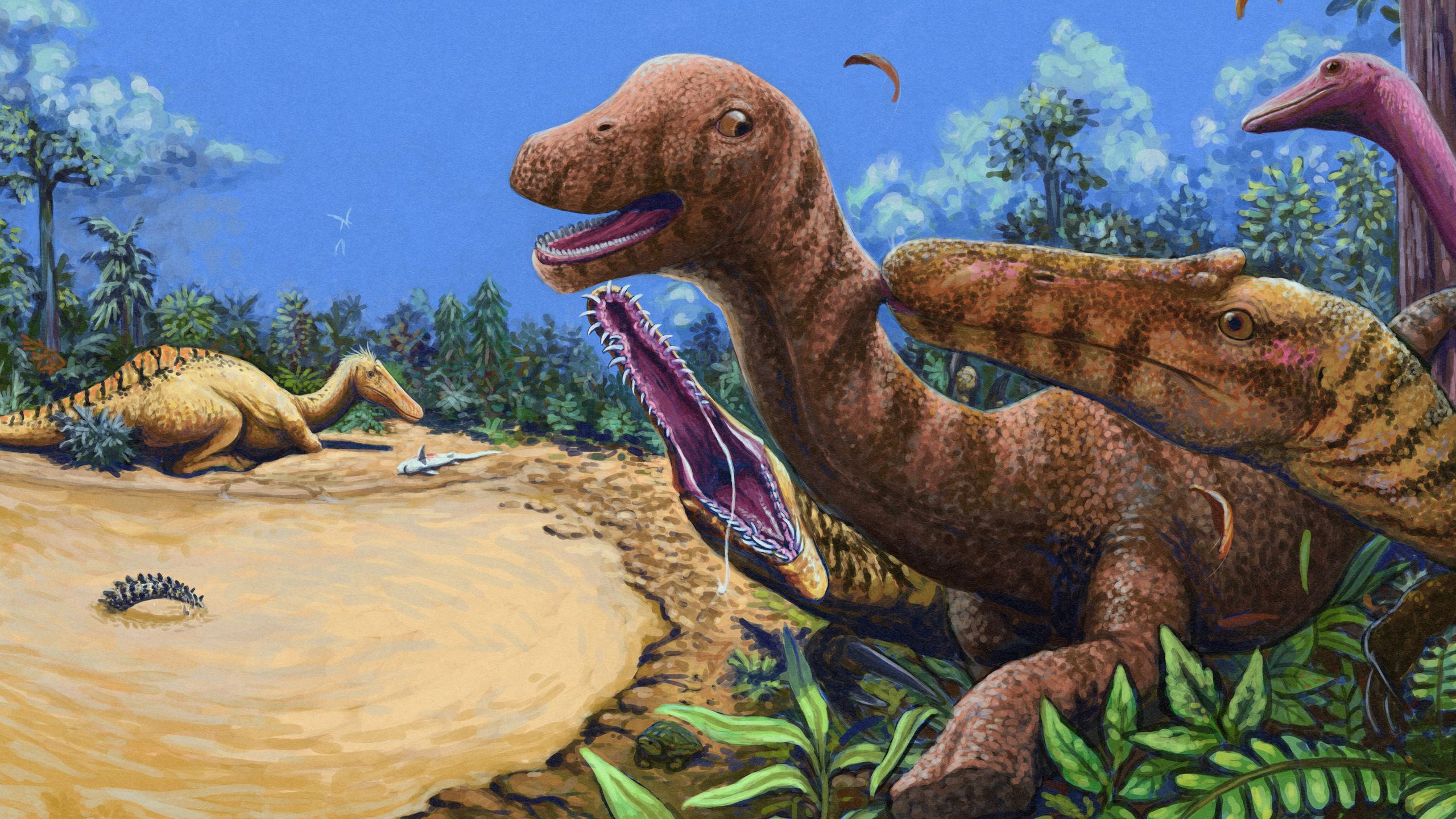
Around 125 million years ago, a dinosaur longer than a pickup truck stalked rivers to gobble up fish in what is now Thailand.
Spinosaurids were a family of bipedal predators with elongated snouts, crocodile-like teeth and, in many species, sails on their backs. Researchers believe that the Thai specimen, first discovered in 2004, belonged to the Spinosaurinae subfamily, which included the longest-known carnivorous dinosaur genus, Spinosaurus — a potential swimming predator from North Africa that grew up to around 50 feet (15 m) long.
“This discovery from Thailand helps us better understand what spinosaurines looked like and how they evolved in Asia,” Adun Samathi, an assistant professor at the Walai Rukhavej Botanical Research Institute and Mahasarakham University in Thailand, told Live Science in an email. “[The fossils] also show that dinosaur diversity in Southeast Asia was richer than previously known and expand our understanding of how these unusual fish-eating predators were spread around the world.”
Samathi presented the spinosaurid findings Nov. 12 at the Society of Vertebrate Paleontology 2025 annual meeting in Birmingham, England. The findings haven’t been peer-reviewed, as Samathi and his colleagues still have to submit them to a journal.
The researchers don’t have an official name for the dinosaur. However, they’ve nicknamed it the Sam Ran spinosaurid, as it was found in the Sam Ran locality (area) of the Khok Kruat rock formation in northeastern Thailand, according to Samathi, who studied the spinosaurid as part of his doctoral thesis. (Samathi is one of several students and researchers to study the specimen since its discovery.)
Here’s my https://t.co/maqjE6ji5r. project, a spinosaurid from the Early Cretaceous Khok Kruat Formation of Thailand or “Sam Ran spinosaurid”. #spinosauridae #spinosaurus #paleontology pic.twitter.com/qtn8mHK6pHApril 13, 2022
The team quickly identified the dinosaur as a spinosaurid because it has several of the group’s characteristic features, including long neck vertebrae and tall spines on its back vertebrae. However, the species also had features that distinguished it from known spinosaurid species, including shorter spines than Spinosaurus and more paddle-like spines than Ichthyovenator from Loas, which borders Thailand.
The team suspects that the Sam Ran spinosaurid was more closely related to Spinosaurus from North Africa than Ichthyovenator from Laos. However, there’s a lot of uncertainty surrounding the evolution of Asian spinosaurids, as well as spinosaurids in general, and the researchers’ findings are only preliminary at this stage.
The Sam Ran spinosaurid died beside a shallow river before some of its remains were fossilized. Samathi doesn’t think that this spinosaurid could swim, but it seemed to be using the river ecosystem, which was teeming with life when the dinosaur perished relatively early in the Cretaceous period (145 million to 66 million years ago).
“The new spinosaur lived (or at least [was] found) in a river system with gently flowing water and occasional floods, within a dry to semi-arid landscape,” Samathi said. “The site has yielded a variety of animals, including freshwater sharks, bony fish, turtles, crocodiles, and dinosaurs such as a sauropod and an iguanodontian.”