The bright stars and constellations that dominate the night sky around the turn of the year are much-loved, from Orion and its spectacular M42 nebula, super-bright Sirius and the Pleiades open cluster. However, all of these jewels exist in the Orion Spur of the Milky Way — the same spiral arm that our own solar system calls home. But as the sky turns and the stars of March rise in the east, they bring with them a clear view away from the Milky Way — and into the realm of the galaxies.
While there are galaxies visible across the night sky, there’s a dense concentration within (though, ultimately, behind) the constellations of Leo, Virgo and Coma Berenices. Add Canes Venatici and Ursa Major nearby in the northern sky, and the scene is set for galaxy season — when all you need is one of the best telescopes or best beginner telescopes, observing when your target is 30 degrees or more above the horizon. Or you can invest in one of the best smart telescopes to see these faint yet spectacular targets in real-time images sent straight to your smartphone.
From a string of galaxies and distant spirals to edge-on views and more, here’s everything you need to know about galaxy season — the best targets, the best time to see them and what kind of optics you’ll need.
Article continues below
1. Whirlpool Galaxy (M51 and NGC 5195)
31 million light-years from the Milky Way, M51 in Canes Venatici is a great example of a faint galaxy (magnitude 8.4) that’s accessible in modest apertures, but truly shines in larger scopes. It looks spectacular in the best smart telescopes. For example, train the ZWO Seestar S50 smart telescope on it, and you’ll get a clear view of this grand-design spiral galaxy popping up on your smartphone after just a few seconds. You’ll immediately see its face-on spiral structure — it was the first to be classified as a spiral galaxy — but if you have the patience for some more image integration, you’ll also see the tiny galaxy NGC 5195, which sits at the end of one of M51’s spiral arms.
2. Bode’s Galaxy and the Cigar Galaxy (M81 and M82)

These two neighboring galaxies in Ursa Major are icons of the northern night sky. Best observed in spring, Bode’s Galaxy (M81, a spiral galaxy at magnitude 6.94) and the Cigar Galaxy (M82, a starburst galaxy at magnitude 8.41) are typically observed and photographed together. As a bonus, they’re a great target for beginners, with a 660 mm focal length refractor — such as the Celestron Inspire 100AZ — enough to give you a glimpse under dark skies.
3. Pinwheel Galaxy (M101)

Large but low in surface brightness, M101’s sprawling arms demand dark skies. The Vaonis Vespera II smart telescope excels at automatically stacking faint deep-sky targets, even in light-polluted areas. If you want to get a little more serious, the Celestron Advanced VX 8 Edge HD is well-suited to teasing out faint structure when paired with a DSLR or dedicated astro-camera for stacked exposures.
4. Leo Triplet (M65, M66 and NGC 3628)

For any observer dusting off a telescope or astrophotography rig to glimpse seasonal deep-sky objects, the Leo Triplet is always near the top of the list. Visible below the belly of Leo, the Lion, it’s a unique opportunity to get three galaxies in one frame. The Celestron Origin Intelligent Home Observatory produces sharp, colorful deep-sky images with minimal set-up, making it ideal for capturing the full trio in a single composition.
5. The Whale and the Hockey Stick (NGC 4631 and NGC 4656)

Here’s an elongated, edge-on spiral in the constellation Canes Venatici that resembles a breaching whale (NGC 4631), with a flatter-looking galaxy (NGC 4656) close by to add interest. The Celestron NexStar Evolution 9.25 provides the aperture needed to show its stretched profile, while the Unistellar eVscope 2 will stack images to reveal structure even from suburban skies — though you will need to let it do its thing for at least an hour.
6. Markarian’s Chain and the Virgo Cluster

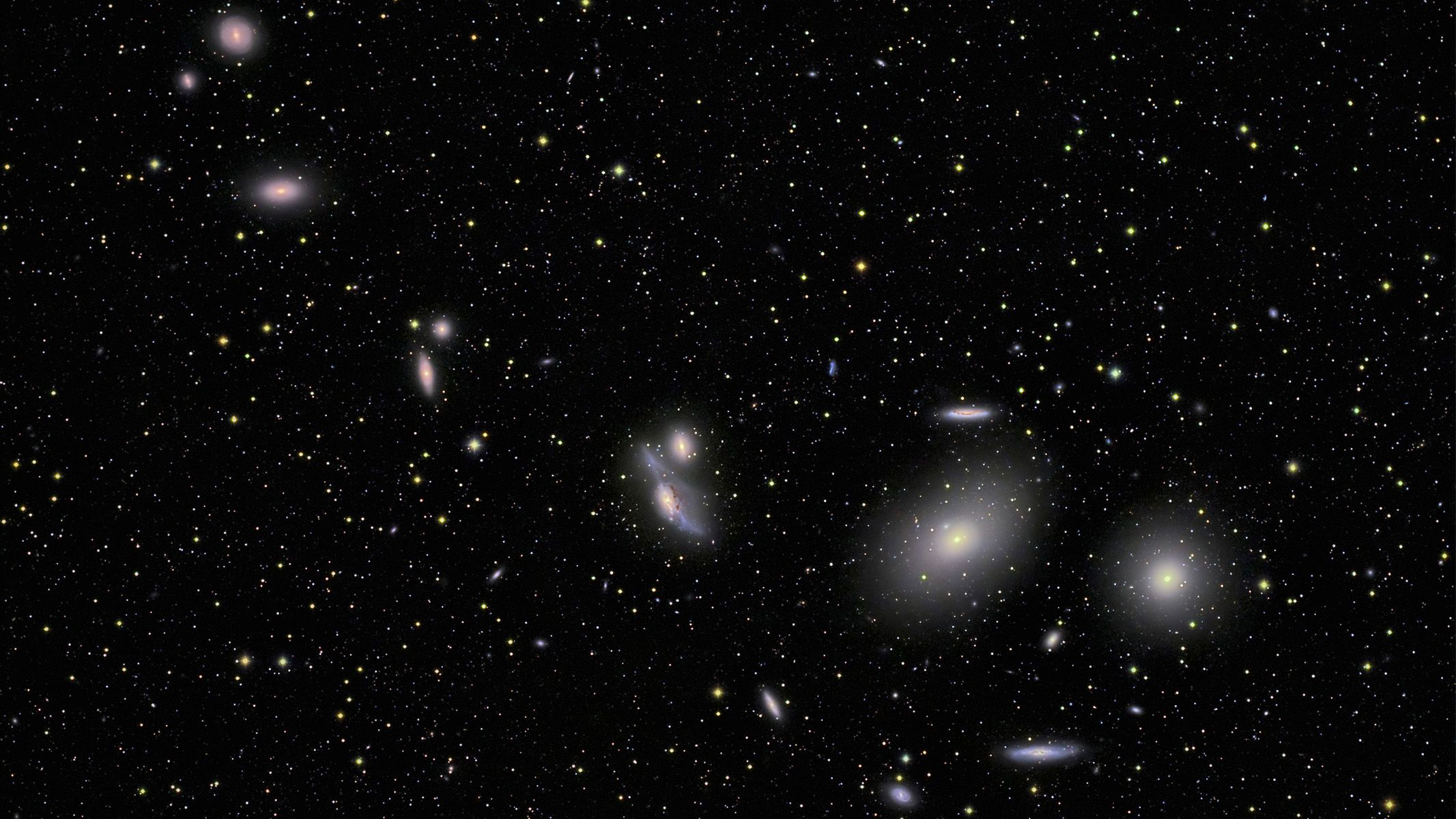
Found on the border between the constellations Virgo and Coma Berenices, this cluster of a dozen or so galaxies seemingly on a string spans about 1.5 degrees of the night sky — a little more than the width of your little finger at arm’s length. The brightest are M84 and M86, while the Eyes Galaxies (NGC 4435 and NGC 4438) are seemingly linked, interacting galaxies. The Skywatcher Evostar 80ED is a good choice for both observing and astrophotography, the latter when paired with a dedicated astro-camera.
7. Sombrero Galaxy (M104)

About 28 million light-years from the Milky Way in the Virgo constellation, we see this iconic galaxy almost edge-on, with noticeable starlight from its core. It’s best seen in May, with a small telescope like the Celestron NexStar 127SLT, which delivers crisp, high-contrast views of its luminous central bulge.
The ‘Messier Marathon’

Galaxy season is also when to try the annual Messier Marathon — an intense, dusk-to-dawn observing challenge. The aim is to locate as many of the 110 deep-sky objects in 18th-century French astronomer Charles Messier’s catalog as possible in a single night. Many of the galaxies listed above — from M51 to M104 — are essential stops along the way.
Something of a rite of passage for amateur astronomers, the sweet spot typically falls between mid-March and early April, with the best weekends in 2026 being March 14-15 and March 21-22. Observers begin in the west with views of M74, M77, M33 and M31 (the Andromeda Galaxy) before they set, and work east towards the Virgo Cluster, finishing in the east before dawn. A GoTo or smart telescope will make the task much easier and quicker, but for purists, it’s a great opportunity to get to know your telescope and the night sky.