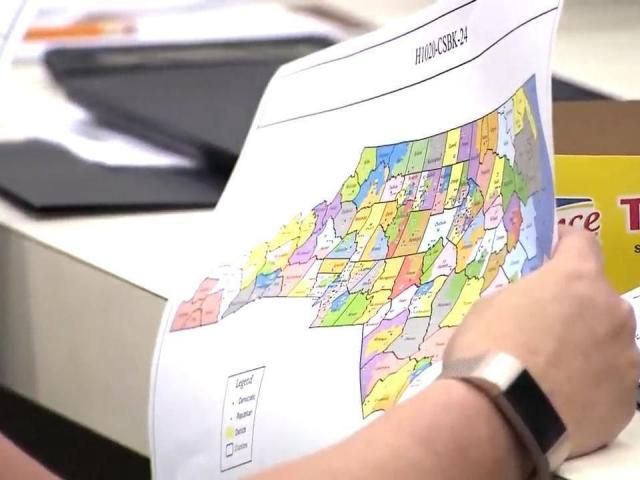
North Carolina lawmakers advanced a proposal to redraw the state’s congressional districts on Monday — part of a nationwide, Republican-led effort to help the GOP maintain control of Congress in 2026.
The Senate Elections Committee approved a new map released last week by state legislative leaders — the first official legislative approval in a multi-step process that is expected to give North Carolina Republicans another seat in Congress. The approval came as protesters accused Republican lawmakers of racism; the changes are expected to oust one of the state’s three Black members of Congress, by carving up an area of eastern North Carolina with a large Black population.
State lawmakers determine the voting districts in North Carolina, with few rules restricting how aggressively they can draw the districts for partisan advantage.
Republicans control both chambers of the state’s General Assembly. The full chambers are expected to approve the full map later this week. The map would eliminate the state’s only competitive U.S. House district — won by a Democrat in 2024 — and turn it into a more Republican-leaning seat.
Republicans hold 219 seats and Democrats hold 214 seats in the U.S. House of Representatives. There are two vacancies. Democrats have been projected to flip control of the U.S. House in the 2026 midterm elections, as Republican President Donald Trump’s approval numbers have fallen. Trump has responded by urging Republican-led states to gerrymander their maps to get rid of seats that Democrats might be able to win. North Carolina Republican state lawmakers said they’re happy to oblige.
“The motivation behind this redraw is simple, and singular,” Sen. Ralph Hise, R-Mitchell, a top redistricting leader, told the committee Monday. “We’re drawing a map that will bring an additional Republican seat to the North Carolina congressional delegation. Republicans hold a razor-thin margin in the United States House of Representatives. If Democrats flip four seats in the upcoming midterm elections, they will take control of the House and torpedo President Trump’s agenda.”
Republican legislative leaders have pointed to Trump’s history of carrying North Carolina in presidential elections as a reason to gerrymander the state further to help protect Republican control of Congress. Trump won the 2024 presidential election with 49.8% of the vote nationwide, including 50.9% in North Carolina.
North Carolina is represented by 14 members in the U.S. House — currently 10 Republicans and four Democrats. The newly proposed map has 11 districts that lean Republican and three Democratic-leaning districts.
The target of the new map is the state’s 1st Congressional District, currently represented by Democratic Rep. Don Davis, one of the state’s few Black representatives.
“Redistricting is taking away the voices of hard-working minorities, for the racist Republican agenda,” Rebecca Warren, a Wilson County voter, told lawmakers Monday. She’s one of those who would be moved into a new district by the new map — which takes Wilson, Wayne, Lenoir and Greene counties out of Davis’ district.
The legislative redistricting committee approved the map in a party-line vote. Lawmakers could give the map final approval as early as Tuesday.
Analyzing the new map
The Princeton Gerrymandering Project, which analyzes and grades every state’s congressional map, says North Carolina’s current map is already heavily gerrymandered to give Republicans an advantage and the new version would skew further in the GOP’s favor.
The group is politically nonpartisan and uses scientific and political analysis to take stances against gerrymandering by both Democrats and Republicans. Its founder, says North Carolina’s current map fails to adequately represent the state’s electorate, and that the proposed new map goes further in the wrong direction.
“It appears to be carefully engineered to give Republicans an advantage in the 1st district … squeezing out just a little bit more partisan advantage,” Sam Wang, a Princeton University professor who founded the group, said in an interview.
During committee debate Monday, state Sen. Gladys Robinson, D-Guilford, asked Hise how he could defend an 11-3 map when North Carolina typically votes roughly 50-50 in statewide elections. Hise told her that Democrats tend to cluster in smaller geographical areas — cities — while Republicans are more spread out, which he said makes the districts naturally favor Republicans.
Robinson told reporters after the meeting that she agreed with protesters who called the redistricting a racist endeavor.
The proposed map turns the state’s 1st Congressional District from a competitive one into a Republican one by taking out more diverse counties — which are also more politically competitive since Black voters overwhelmingly support Democrats — and sticking them into a neighboring Republican-leaning district, and replacing them with whiter, more conservative areas in and around the Outer Banks.
The 1st district has been represented by a Black Democrat for decades — the result of previous U.S. Supreme Court rulings that found states needed to intentionally protect Black representation in politics. But last week, the Supreme Court took up a new racial gerrymandering case in which the court’s conservative majority hinted at undoing that precedent.
On Monday, Hise said Republicans didn’t use racial data to specifically target Black voters when they drew the map. But Sen. Mujtaba Mohammed, D-Mecklenburg, said it’s no secret which areas of eastern North Carolina are or are not home to large Black populations.
“You have common knowledge that there’s a heavily Black voting bloc in eastern North Carolina,” Mohammed told Hise, adding: “It’s clear that you’ve diluted the Black voting population in this new map. It’s just the facts.”
Hise acknowledged that he does know that some eastern North Carolina counties have above-average Black populations but reiterated that he didn’t use racial data when specifically deciding how to draw the map.
Protesters object to maps
At another point in his speech Monday, Hise exhibited an accidental slip of the tongue, using the word “totalitarian” while describing the new map and eliciting jeers from protesters gathered in the audience.
Several dozen protesters made it into the room ahead of Monday’s committee hearing. Larger protests are being planned Tuesday. On Monday, lawmakers allowed several dozen members of the public to speak about the proposed new map. None spoke in favor of it. All were opposed, and many accused Republicans of intentionally trying to suppress Black voters.
Alamance County farmer Ron Osborne, a former Democratic candidate for the state legislature, compared the proposal to Jim Crow era laws.
“I came from my farm this morning,” he told the committee Monday. “I fed the animals and was hoping to work on my barn, but it was more important to be here. Frankly, the manure is deeper here than in my barnyard. … It’s the same effect as poll taxes, grandfather laws and literary tests on the population.”
Mark Swallow of the group Democracy Out Loud called GOP lawmakers “liars and cheats” during the hearing. “You can prove me wrong,” he said. “You can turn this aside and deny this bill’s passage.”
Greg Flynn, a former Wake County Board of Elections member, told lawmakers they’re harming democracy by gerrymandering the state so severely. “Just because you can eat everything at the buffet doesn’t mean it’s a good idea,” he said.
After the comment period ended, many of the protesters began chanting “racist maps make racist reps” and were ejected by security. They then gathered in a circle outside the legislative building, singing protest songs.
Sen. Sydney Batch, D-Wake, the top Democrat in the state Senate, had earlier pushed for more time for public comment before using her own time to grill Hise on details of the map and the decision to redraw it.
State Senate leader Phil Berger has previously denied an allegation by a progressive political group that he agreed to redraw the maps in exchange for an endorsement from Trump in Berger’s own competitive primary election this year. Hise largely declined to answer Batch’s questions alluding to that allegation, saying he hadn’t personally talked to Trump about the map and couldn’t speak for anyone else.
Hise also described the legislature’s actions as part of “a political arms race that Republicans did not start,” blaming Democratic-led states for doing even more aggressive gerrymandering. However, no Democrat-led states have changed their maps ahead of the 2026 elections. But several other Republican states have, including Texas, Utah and Missouri. Sen. Julie Mayfield, D-Buncombe, said Hise was pushing a false claim.
“It is, frankly, shocking to me that the intelligent and thoughtful Republicans that I work with continue to perpetuate this picture,” Mayfield said. “So I hope we can just do away with that. It’s a nice message. I get why you’re doing it. It’s the national message. It is also completely and utterly false, and everyone knows it, including every Republican in this room.”
Shifting representation
Davis, the congressman targeted by the new map, is a moderate Democrat whose area of the state has been represented by Democrats for decades.
The new map would all but guarantee a GOP victory in Davis’s district in any election, except for in a major Democratic wave, according to data provided by Republican lawmakers. Trump in 2024 likely would’ve won more than 55% of the vote in the new version of the district, substantially higher than his statewide margin of victory.
To turn Davis’ district red, the new map would swap some more diverse and politically competitive counties he represents with some more heavily conservative counties currently represented by U.S. Rep. Greg Murphy, a Greenville Republican. Murphy’s congressional district would still favor Republican candidates.
The map also carves Davis’ house in Snow Hill out of his district, placing it in Murphy’s district. Members of Congress don’t have to live in their districts, so that wouldn’t necessarily stop Davis from running for reelection.
Democratic lawmakers and Gov. Josh Stein, also a Democrat, have accused Republican legislative leaders of abusing their power with the new proposal, saying they’re stealing a congressional seat while ignoring other priorities, such as passing a state budget.
“I’m extremely disappointed by this cynical power grab,” Stein told reporters at a press conference on Monday. “Understand that the Republican legislature is abusing its power to take away yours in our representative democracy. Voters are supposed to choose their representatives, not the other way around.”
In North Carolina, the governor is banned from vetoing any redistricting plans, meaning whatever Republican leaders ultimately approve will likely become law.
Democrats would have to turn to the courts to stop any new maps, as they have multiple times in past years. Once lawmakers approve a new map it’ll be the seventh congressional map since 2016. Many of those various maps have been drawn, struck down as unconstitutional, and drawn again, due to gerrymandering lawsuits against the legislature in state and federal court.
The GOP-majority North Carolina Supreme Court reversed precedent on partisan gerrymandering in 2023, giving the legislature wide latitude to draw maps that favor one political party.
The state had an even split in its congressional delegation — seven Republicans and seven Democrats — until that 2023 ruling, after which Republican lawmakers quickly redrew the lines to create the current 10-4 map.
As for why they waited until now to make it an 11-3 split, Wang, the gerrymandering expert from Princeton, said it’s likely because state lawmakers feared being sued for violating the Voting Rights Act of 1965 and engaging in racial gerrymandering. But now that the U.S. Supreme Court appears poised to undo protections against racial gerrymandering, he added, Republicans in North Carolina and other states appear to feel more empowered.
“Any district that’s drawn to be majority Black — or ‘opportunity districts,’ where Black or Hispanic populations have the opportunity to elect — is conceivably on the chopping block,” Wang said. And I think the question is not if, but when.”