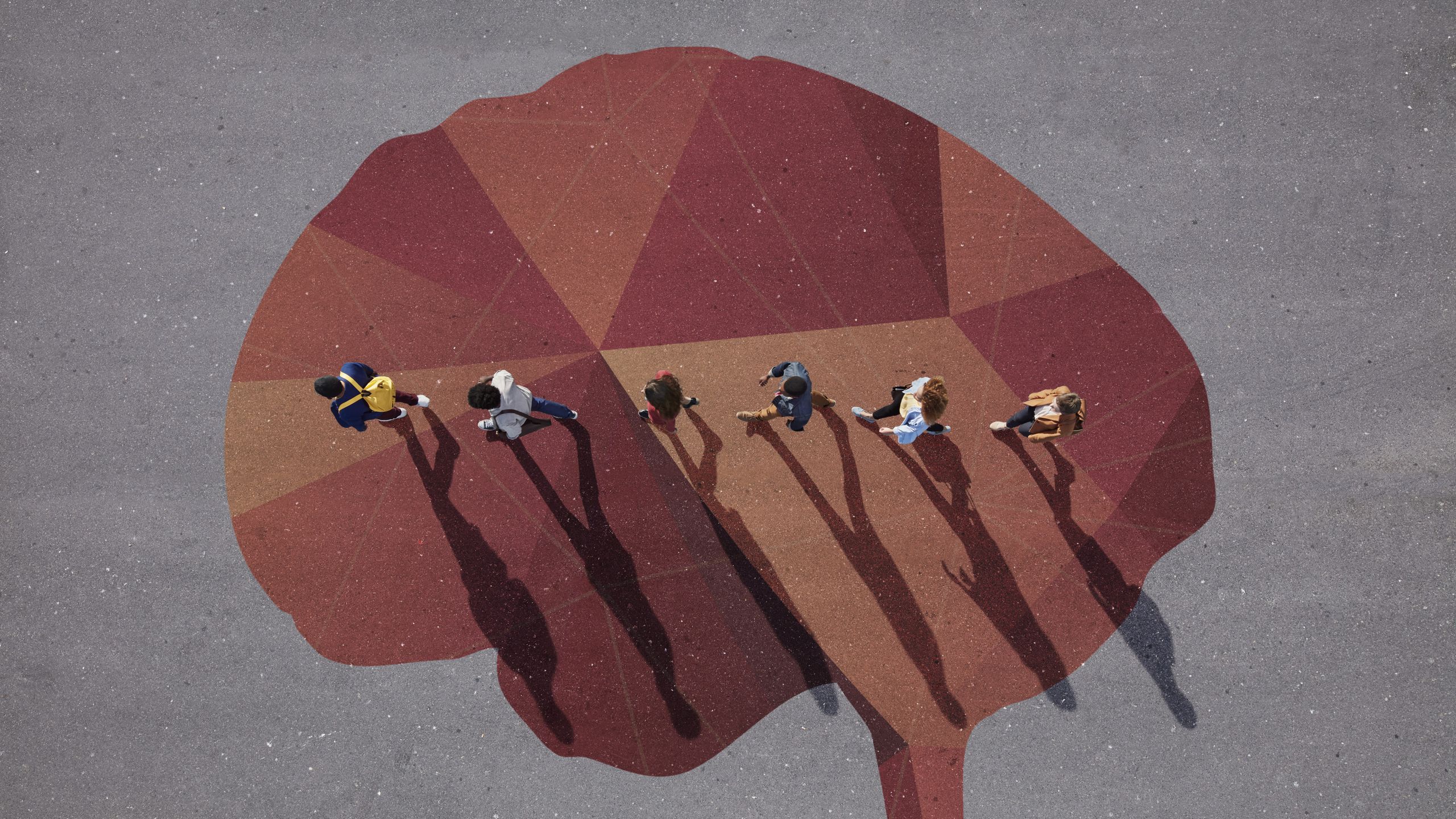
In his book “One Hand Clapping: Unraveling the Mystery of the Human Mind” (Prometheus/Swift Press, 2025), New York University neuroscientist Nikolay Kukushkin traces the evolution of human consciousness. He starts the story with the emergence of the first DNA on Earth and then highlights key evolutionary landmarks that paved the way to us — namely, modern-day humans. In the following excerpt, Kukushkin describes the “social brain hypothesis,” which posits that human intelligence arose, in part, to help us keep track of our increasingly complex social groups.
What made us human
In the past, many explanations of human uniqueness focused on what gave us the ability to become as intelligent as we are, rather than why we would want to be so intelligent. We often take it for granted that intelligence is what every animal obviously wants, and we just figured out a better evolutionary path toward it. One classic explanation for this involves, for example, walking on two legs, caused by a transition from trees to grasslands, which freed the hands from climbing and allowed us to do more complicated things. Another explanation focuses on our increasingly meat-based diet, which allowed for larger brain sizes. These factors certainly played critical roles in allowing us to become who we are. But they alone don’t necessarily explain what is so good about being intelligent in the first place. We just assume that to be self-evident.
I think it’s a bit of a self-serving assumption, like jellyfish wondering why no one else has managed to evolve stinging cells. We like to believe that we somehow won evolution — a notion we discussed in chapter 3 when talking about complexity and perfection. We have this image of an ape standing up, picking up a stick, and being rewarded for this achievement with a massive brain.
But the truth is, intelligence comes at a price, and for many species, the benefits just aren’t worth it. A brain such as our own takes prodigious amounts of energy away from a body already burning through its fuel: a gram of brain tissue uses ten times the amount of nutrients as an average gram of the human body. Besides, a bigger brain is heavier and easier to damage. So there are considerable evolutionary costs to an enlarged brain. For any given species, these costs eventually outweigh the diminishing returns of brain enlargement. All brains have an evolutionary stage at which they are large enough. If a double-sized brain provided rhinos with a survival advantage, over millions of years their brain would have certainly doubled in size — you have to have very little awareness of evolutionary history to believe that we alone cracked some code that eluded everybody for eons. For rhinos, there wasn’t any extra advantage in larger brains, so their brains turned out just as they did. The question is not why humans succeeded where others failed — as we tend to think — but why we needed supercomputers when others were fine with calculators.
There’s an interesting pattern that may explain it. If you measure the size of the cerebral cortex — the brain’s “machine of understanding”— in different primate species relative to the rest of their brain and plot it against the number of group members typical for each of those species, the two numbers fall on a straight line: the more members, the bigger the cortex. Humans are number one on both accounts — our cortex is the largest relative to the rest of the brain, as is our typical group size, estimated around 150 — that’s the number of people in a typical hunter-gatherer society and a typical cap on the number of active social acquaintances that we moderns can maintain. For example, corporate organizations often naturally fragment into units of about 150 people.
Why would that be? This is far from a resolved question, but the proponents of the so-called social brain hypothesis say that reason is that social behavior is a uniquely demanding task, putting unprecedented strain on our brain’s capacities. All mammals, to some extent, use their brain as a mirror, understanding others’ behavior by modeling it inside their own mind. But primates, whose defensive groups swell into the tens and even hundreds, had to contend with tens and hundreds of these complex, interconnected models of other group members — their personalities, their emotions, their mutual relationships — which one of them did what to whom at what point and so on, a tremendous trove of complex data that we, humans, take to be as natural as eating dinner but that would befuddle even the smartest non-primate. In short, the social brain hypothesis states that social life is what pushed us to become intelligent.
The way this explanation differs from others is by offering an incentive rather than simply means to achieve it: yes, free hands, meat diet, and many other factors made our brain possible, but the reason we needed it in the first place was to remember all our friends who helped us fight monsters.
As cheesy as it sounds, I think about it all the time. There have been many different fables told about the birth of the human species: that it was work that made us human (this was the communist narrative — an ape picking up a tool) or maybe that it was violence (this is the narrative from “2001: A Space Odyssey” — an ape picking up a weapon). Those were not just scientific theories — they were origin stories, as important for a modern mind to make sense of itself as myths were to an ancient mind. An origin story is told to explain what you are really about, and in doing so, it doesn’t simply describe the past but provides a template for the present. If you are about work, then work is the pillar on which your life should naturally stand. If you are about violence, then there is no sense trying to avoid it. But the more we learn about ourselves, the clearer it becomes that we are really about others. Our entire essence is to carry tens and even hundreds of peers inside our brains, to navigate the vicissitudes of their emotions and relationships, to derive both meaning and joy from living life together. It has long been recognized, for example, that happiness depends far less on individual well-being than on the richness of social contacts. Social life has a profound effect on us, and not just mentally but physically: for example, the Harvard Study of Adult Development, which began in 1938 and tracked hundreds of people for several decades, famously showed that close relationships are better predictors of long and happy lives than social class, IQ, or even genes. Too often, modern lives let us forget a firmly established fact: friends are worth living for. The social brain hypothesis puts an origin story behind this simple truth.
It also puts the birth of our species in a broader context. Our brains started swelling in size long before the first Homo sapiens. All primates share the relationship between group size and the cerebral cortex, which means that it always took a large brain to handle many peers.
And that, in turn, means that sooner or later, something like a human was inevitable.
When eukaryotes first started extracting energy from other organisms, this set the trajectory toward the human species — eventually there was bound to be someone who could control fire and even nuclear fission. There’s something similar that the social brain hypothesis points to, at the deepest level. Once primates were swept in a drive to enlarge their groups and brains, eventually there was bound to be someone with groups large enough and with brains advanced enough to start talking to each other, inventing symbols and abstract categories — and from that, finally, there was bound to arise some form of culture, art, and civilization.
It is this final essence — an abstract, symbolic language passed from person to person by cultural transmission — that completes the design of a human being that we had seen gradually crystallize over billions of years. But to understand why language was so important for our species, we must now take a detour. Most books about human evolution begin right about here and proceed through the past few million years to the present, during which apes gradually evolved into several species of Homo, of which today only one survives — the “wise” one, or sapiens. But our quest instead takes us inward, into the human brain, into the sea of electrical signals pulsing through this astounding machine that runs our conscious minds.