





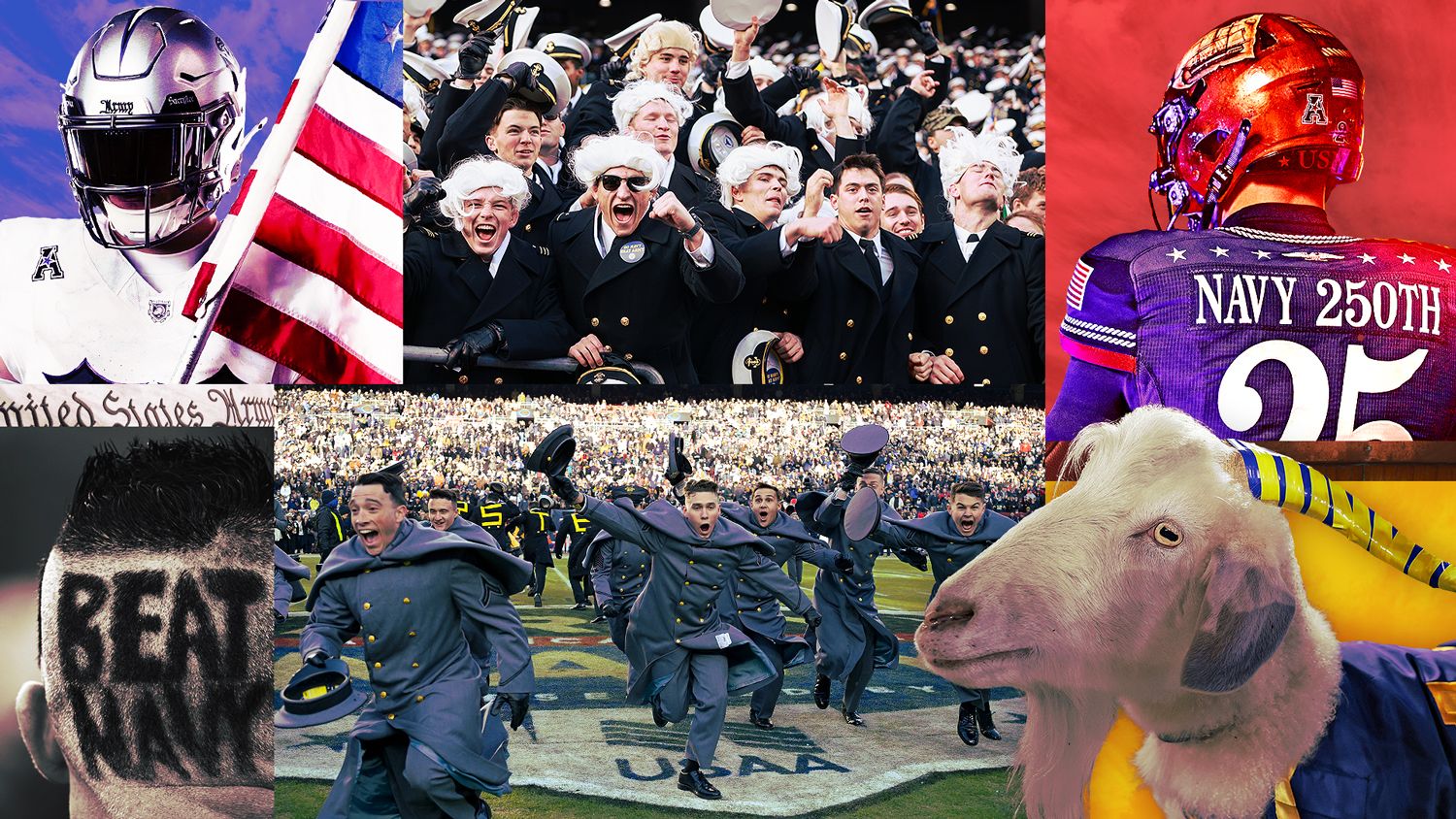
ANNAPOLIS, Md. — When Navy quarterback Blake Horvath returned to his dorm room during Army-Navy week last season, he found pictures of Army quarterback Bryson Daily taped all over his door. Elsewhere, banners had mysteriously appeared in the dining hall, reading, “GO ARMY, BEAT NAVY.”
The likely suspects? West Point cadets spending a semester in Annapolis, Maryland, as exchange students. It’s a program that will celebrate its 50th anniversary this year — one of several enduring traditions between the two academies.
“I can neither confirm nor deny if that was us that evening,” Army senior cadet Jayram Suryanarayan said, “but I can say we were up to some shenanigans — so it could have been.”
The shenanigans were unfolding simultaneously in West Point, where the Navy exchange students’ clothes and uniforms had disappeared and been replaced by costumes — including a smelly fish outfit and a Teenage Mutant Ninja Turtle — to wear the entire week.
“They bought a Marine Corps raincoat, cut it as fabric, and then sewed — and then this is what impressed me because it took time and skill — they sewed together a miniskirt for me to wear and they got a Marine Corps sweatshirt and they cropped it,” Navy senior Michael Middleton said. “They stole all of my uniforms, all of my civilian clothes. It wasn’t just to school — I had to work out in it. It was really quite a scene. It was really fun.”
(Last year’s antics were relatively tame compared to “Operation Black Knight Falling” in 2022, when five Navy midshipmen led three flight crews in formation over the United States Military Academy in West Point, New York, and dropped thousands of BEAT ARMY ping-pong balls and leaflets on campus.)
After spending a semester at their rival school, the tradition culminates when the exchange students stand front and center on the 50-yard line ahead of the Army-Navy football game in what is casually referred to as a “prisoner exchange.” The men and women on the field who annually participate in that program embody everything that follows in the global game — tradition, respect, pageantry, precision — and a deep understanding that one of college football’s longest and strongest rivalries is also about an immeasurable bond that infiltrates beyond the field.
“Army and Navy, West Point and Annapolis, we’re not that different,” said Middleton, who will be a ground officer in the United States Marine Corps after graduation. “We like to have this friendly banter, and we say we’re going to beat Army by a million because that’s what we’re going to do — that’s a fact you can quote that — but really it’s one fight and one team.
“We’re all in the Department of War,” Middleton said. “We all work for each other. If we’re in some far-flung place, having to do a job the nation has called us to do, I don’t care where you graduated because we’re all out there for each other.”
On Saturday at M&T Bank Stadium in Baltimore, this year’s group of exchange students will be released to their classmates and hoisted back into the stands to watch the 126th Army-Navy game together. It’s one of many traditions from America’s Game that don’t involve the players: From the “demonstration of discipline” as thousands of classmates from each academy “March On,” to the grit and fortitude of the relay teams who deliver the game balls after running from their schools along backroads, through states and cities, and into the stadium. It’s the thoughtful, historically accurate and detailed uniforms, which this season will celebrate respectively the 250th anniversaries of the United States Army and Navy. It’s the nearly 800 celebrities and high-ranking dignitaries, including President Donald Trump, who will attend. It’s the live mascots — one mule and two goats — who need careful delivery and their own parking spaces.
The players earn the spotlight in the final and most emotional tradition — singing their alma maters on the field after the game. And woe to the team that lost and has to sing first.
“You just feel like you not only let yourself down, your teammates down,” Army center Brady Small said, “but you feel like you let the Army down.”
While you might be familiar with some or all of these traditions from watching the game on TV, ESPN interviewed more than a dozen people from both academies who make it all come together, taking you behind the scenes for how each tradition unfolds and what it means to be a part of them.
Jump to section:
Alma mater | Uniforms
Ball run | March On
Mascots | Presidential visit
Alma mater
In preseason camp, every Army football player is tested on the school’s alma mater. It’s something they learn from the “Book of Knowledge,” which is required reading during Cadet Basic Training and has been published since 1908. It includes the history and traditions of West Point.
“I can’t tell you the exact page number,” said receiver Noah Short of where the alma mater appears, “but it’s definitely in the first few pages.”
Hail, Alma Mater dear,
To us be ever near.
Help us thy motto bear
Through all the years.
Let Duty be well performed.
Honor be e’er untarned
Country be ever armed.
West Point, by thee.
“I make them write it down,” Army coach Jeff Monken said, “they have to write it out.”
“If you don’t do it right — literally word for word — Coach Monken will not travel you,” Army linebacker Kalib Fortner said.
Both schools sing their alma maters at other games and events, but the tradition of singing it after the Army-Navy football game is unlike any other. The winner sings second.
“It’s awesome,” Monken said, “and there’s just so much emotion and relief that we’re the ones standing there singing second. … It’s equally as gut-wrenching and emotionally just rips you apart to have to stand there and mumble the words of your alma mater if you’ve gotta do it first.”
Horvath, Navy’s quarterback, said the Midshipmen are quizzed on their alma mater about four days into their plebe summer. They’d sing it before they went to bed each night around 10 p.m.
Now colleges from sea to sea
May sing of colors true
But who has better right than we
To hoist a symbol hue
For sailors brave in battle fair
Since fighting days of old
Have proved the sailor’s right to wear
The Navy Blue and Gold
“Singing first, it physically hurts a little bit,” Horvath said. “You know that your fans aren’t singing with as much enthusiasm, you’re not singing with that same sort of loudness and excitement as you would if you were singing second. It’s sort of, as a player, an embarrassment to sing first. On the flip side, singing second, you can feel the joy and excitement like after the Army-Navy game last year. It’s the loudest I’ve ever heard our alma mater sung.”
Uniforms
Army and Navy reveal special uniforms each season, but don’t bother trying to sneak a peek at either before they’re publicly announced — it’s classified, for a whopping two years.
“We don’t really keep files stored here, we just kind of keep things very hush-hush,” said Mike Resnick, associate athletic director in charge of internal operations at West Point. “Nike’s really good on the shipping. It’s West Point; we have some trustworthy people here.”
Just for added security, though, some nondisclosure acts are signed along the way. There are only about 14 or 15 people who know what Army’s uniform will look like — including the history department.
“We don’t let the Pentagon know,” Resnick said. “We keep it pretty close to the vest.”
As parts of the uniform and other sideline gear are shipped, Navy stores everything in a warehouse on the other side of the Severn River. The artist who handpaints their helmets is in Langhorne, Pennsylvania, so when Navy played at Temple this year, a few members of the equipment staff visited him to check on the progress.
A uniform 250 years in the making…https://t.co/168T92kRln#GoNavy | #Navy250 pic.twitter.com/N0LVQkHCKG
— Navy Athletics (@NavyAthletics) November 18, 2025
Every detail in both uniforms has a meaning. For Navy, the six strands of rope on the helmets represent the six original frigates of the U.S. Navy, and the knots were a spin-off of the 126 knots on the sides of the pants to represent and pay homage to the 126th Army-Navy game. On the jersey, there are 250 knots around the neck and sleeves to represent 250 years of the Navy.
“The guys always want hints,” Navy senior associate athletic director Greg Morgenthaler said. “From our first team meeting with Coach Newberry. I talked to the team in November about expectations and stuff, and they’re all like, ‘What are we wearing this year? G, what are we wearing?'”
Around noon on Nov. 17, Navy players, coaches and staff started to file into the auditorium in Ricketts Hall. It wasn’t a mandatory team meeting, but nobody was going to miss the highly anticipated uniform reveal for the Army-Navy game.
“Nobody’s posting anything regarding the unis, everybody good?” Newberry said.
“Yessir!”
Proud to honor an enduring symbol of service and sacrifice for the past 250 years.https://t.co/QlUpMO7VlC#GoArmy pic.twitter.com/5DeHAW0pm9
— Army Football (@ArmyWP_Football) November 15, 2025
Army’s marble print uniforms are designed to mirror the marble headstones at Arlington National Cemetery and the ultimate sacrifice that has been made. The Great Seal on the right shoulder indicates Army’s duty to the United States in peace and war. There is an old guard espontoon etched into each helmet to symbolize Army’s role as the tip of the spear, starting on the back of the helmet and culminating in a tip on the front.
Lieutenant Colonel John Zdeb teaches in the department of History and War Studies at West Point and has been helping with the accuracy of the football team’s uniforms for five years. He’s a graduate of the academy and also had two deployments to Iraq, one to Afghanistan, another to Eastern Europe and another to Kuwait.
“There’s always different elements where they’re asking us, my team in particular, ‘Hey, the way we’ve depicted this, is it historically accurate? Is it representing the historical event in the correct way? And if it is going to veer away from that a little bit, is that a creative liberty that makes sense? That’s worth doing?’ And so we have a lot of feedback.”
Ball run
At 3:30 a.m. Thursday morning, a group of 17 cadet marathoners, four officers and three vans departed from the West Point superintendent’s house on campus to run 240 miles across four different states — all while carrying an Army game ball to be delivered to M&T Bank Stadium in Baltimore at 2 p.m. ET on Friday. On Saturday, each of the teams will jog the ball onto the field at a designated time and present it to their First Captain or Brigade Commander.
At approximately 7 a.m., on Thursday the team will pass from New York into Mahwah, New Jersey, and then continue along Route 202 into Pennsylvania. The marathon team will then run through southeastern Pennsylvania before entering Maryland, near Rising Sun. The final portion of their journey will lead them to downtown Baltimore via Route 1.
“The ball itself is always in a cadet’s hands and is moving nonstop from when we leave up until we reach the stadium,” said senior cadet Michael Clay, who is part of his fourth Army-Navy relay team and estimated he has run about 90 miles total to the past three stadiums.
The Navy relay team has a slightly more advantageous route this week — by more than 200 fewer miles from Annapolis to Baltimore. The Midshipmen will meet in front of Bancroft Hall on Friday before leaving at noon and heading out Gate 8. They will arrive at Fort McHenry in Baltimore at sunset and finish the final few miles to the stadium on Saturday.
“It’s kind of fun because we have the rest of the company there waiting at the stadium for the ball to get there, and then the people that are running that last leg kind of run up to the stadium,” Midshipman Connor Mollberg said. “The whole company’s there. It’s a big celebration that we got the ball there.”
Though not without someone occasionally fumbling along the way.
“It never intentionally hits the ground,” Clay said, “especially in those subfreezing temperatures with gloves on, it can be really hard to tell how firm of a grip you have on the ball. So yes, it has been dropped, but never intentionally — and never more than 13th company.”
The tradition began with Navy’s 13th company, which has about 120 Midshipmen in it, and while nobody is required to participate in the ball run, “people are usually more than willing to run the ball a couple of miles and help out,” said Mollberg, who is on Navy’s parachute team — not track or cross country.
While Army’s relay team is much smaller because it comprises the school’s marathon team, they tend to pass the ball around with anyone who joins them for the last few miles — typically members of the community, first responders and high-ranking West Point officers.
Because Army has a longer trek, their runners will aim for between six and 13 miles per stretch, while Navy will run seven legs of four miles per runner. Along their way, they have both cultivated relationships with small communities they routinely pass through. Elementary and school-aged kids line the streets, cheering for both teams along the way — even at 2 or 3 a.m. when the runners least expect it.
“They let us know who they’re rooting for pretty early on,” Clay said. “Certainly a healthy mix.”
‘March On’
The spectacle of watching roughly 3,000 cadets and another 4,000 Midshipmen march onto the field in unison before the Army-Navy game — entire schools of uniform-clad future military leaders taking their seats in the stadium — is one of the most recognizable traditions of the pregame ceremonies.
The cadets and midshipmen will start to march from Camden Yards about a half-mile away. Navy will be on the first-base side, Army will be in left field, and will come down Ravens Walk before entering the stadium at noon.
“We use it as a demonstration of discipline within the corps, everybody moving in the same uniform, at the same time, in the same place,” said Adam Brady, who has done this as a cadet and now as the Operations Officer at Army. “It’s one of the few times when we have the entire corps of cadets marching.”
At Army, it’s the same 30-inch step. It’s the same arm movements for thousands of students who must keep in line with the person to the right. They guide right (keep the group moving in a straight line), dress right (fine tune everyone’s position so the formation looks perfectly straight), and are centered on the person in front of them. It’s something they practice for a total of four or five hours on one of the campus athletic fields.
Aden Alexander, a plebe at Navy, will be marching onto the field for the first time and said a key to staying in line is listening to the drum beats.
“Typically over the plebe summer we’re taught with a cadence, so our detailers will be saying out loud, ‘left, right, left, right,'” Alexander said. “And we’ll have little ditties or songs that we’ll sing along to get our brains trained to walk in-step, so we’ve gotten pretty good at that.”
Everything is a competition.
“Army always marches on better than Navy,” said Jeff Reynolds, Chief of Protocol, United States Military Academy, West Point. “That’s our first win of the day.”
Mascots
It might be the only game on the planet where two goats and a mule get together before kickoff.
The Army has two mules — Paladin and Ranger IV — but only Paladin will be traveling to Baltimore. Army has an equestrian team, and cadets whose members earn the positions of “mule wranglers.” At Navy, there are eight Midshipmen in the Goat Squad, the group that takes care of Bill(s) the Goat(s) at events and games. Once you’re chosen, the job is yours until graduation. The identity of the daily caretaker, who keeps the goats on a nearby farm, is classified.
Senior Myles Brown leads the Goat Squad and has been a member since his sophomore year. He said the two goats — both named Bill — will arrive at the Stadium around 10 a.m. and be available in the parking lot to visit with fans. The Goat Squad will enter the stadium between noon and 12:30 p.m., and they’ll look for a spot on the field secluded from the football players “so they’re not overstimulated.” After Bill 37 retired, Bill 38 took his place — and Bill 39 is the new addition (for anyone who might be counting).
“They like to be together,” said Brown, who worked on a sheep farm during high school in Georgia. “They’re a lot more calm when they’re around each other.”
The goats will be on leashes, with two handlers per goat, one person to clean up any messes they leave behind (literally), one to carry water and treats, and everyone else is “crowd control.” Though the goats will eat just about anything, Brown said, “they really like animal crackers.”
The mules eat hay and the mule wranglers will bring four bales for Paladin to travel with as well as a hay net filled for him to eat on the field.
“I always think about Bevo,” said LTC Adam Brady, of the Texas Longhorns’ mascot. Brady is a member of the commandant’s staff responsible for training and operations. “Nobody cares about Bevo until something goes wrong. We’ve got to be aware of that. They’re a huge draw. Kids love them, parents love them. People try to get on them. But they are something that we are concerned about. We have to take care of the animals, but we also do have to recognize that they are wild animals, and they’re significantly larger than the Navy goat.”
“There are some things we have to be aware of,” Brady said. “Logistically, some of that is, hey, can we even get them in the stadium? Just from a safety perspective, how can I get a spooked mule out of a stadium safely? We have to evaluate that, whether it’s here at home with our construction that we’ve been doing, or the different stadiums. The sidelines are a lot tighter than you’d expect.”
This year, one other live mascot might try to steal their spotlight.
Chesty, an English bulldog who is the mascot of the United States Marine Corps, could make a surprise appearance during the coin toss.
“That’s what we’re planning,” said Ann McConnell, the Naval Academy’s director of protocol. “However, that may change. The Secretary of War may come over to our side to walk out with the President. That’s still a little bit in flux.”
Presidential visit
Dear Mr. President:
On behalf of the Department of the Navy and the Department of the Army, we are honored to invite you and Mrs. Trump to attend the 126th Annual Army-Navy football game, on Saturday, December 13, 2025, at M&T Bank Stadium in Baltimore, Maryland.
The home team sends the official invitation to the White House and this year that is Navy. Both schools confirmed President Trump will attend — along with hundreds of other high-ranking officials, dignitaries and celebrities. It’s a massive coordination effort that takes a year of planning and above all else — security.
Jeff Reynolds, Chief of Protocol, United States Military Academy, West Point, said he was expecting close to 800 celebrities and dignitaries in Baltimore, and is in charge of credentialing more than 600 seats on Army’s 50-yard line — extending from the first row up to the first few rows on the upper deck.
Throughout his career, Reynolds has credentialed Elon Musk, Phil Knight, Gary Sinise, Rachel Ray, Charles Barkley, Mark Wahlberg, Peyton and Eli Manning. There’s one person, though, at the top of his list — Army superintendent Lieutenant General Steven W. Gilland, “who for me, outranks everybody else. I work directly for him. I got to make sure he’s taken care of.”
Reynolds, whose first Army-Navy game was in 2008 when President George W. Bush attended, has worked with Presidents Bush, Barack Obama, Bill Clinton, Joe Biden and Trump.
“The challenging part is to try to make sure the fan experience is still great,” Reynolds said. “We want everybody coming to the stadium to have a great time, to enjoy America’s Game.
“But the logistics,” he said. “The White House staff determines the itinerary of the President. The Secret Service’s job is to make sure that itinerary is secure for the President — and everybody — but really they’re focused on the President. My job is to meld all that into the fan experience and the team, so they can still take the field at the right time, do whatever the coaches need them to do.”
Ann McConnell, who has worked in the Naval Academy’s protocol office for 27 years and been its director for nine, said there would be an additional 500 distinguished visitors (DVs) on Navy’s 50-yard line and will include senators, congressmen, cabinet members, and senior military leaders. This year’s coin toss will include: President Trump, the secretary of the Navy, chief of naval operations, master chief of navy, command master chief at naval academy, president from USAA, superintendent, commandant of marine corps, and the sergeant major of marine corps.
(And Chesty.)
While most of the dignitaries start to arrive between 11 a.m. and noon, the President typically comes just before kickoff for security reasons.
“I actually don’t ever sit,” said McConnell, who enlisted in the Navy in 1992 as a yeoman to follow in her father’s footsteps. “I am constantly moving. I am down on the field making sure everyone’s where they need to be for the coin toss and the crossover. I am up in the Midshipmen’s seats when our [distinguished visitors] come up to interact with the Midshipmen, I am down on our seating section making sure everyone has what they need. I am up in the warming room making sure everyone is all set. Sometimes I end up at gates making sure people that can download the tickets are able to get in. So I really from the time we arrive at eight o’clock, I do not sit until I get in my car at seven and head home.”


