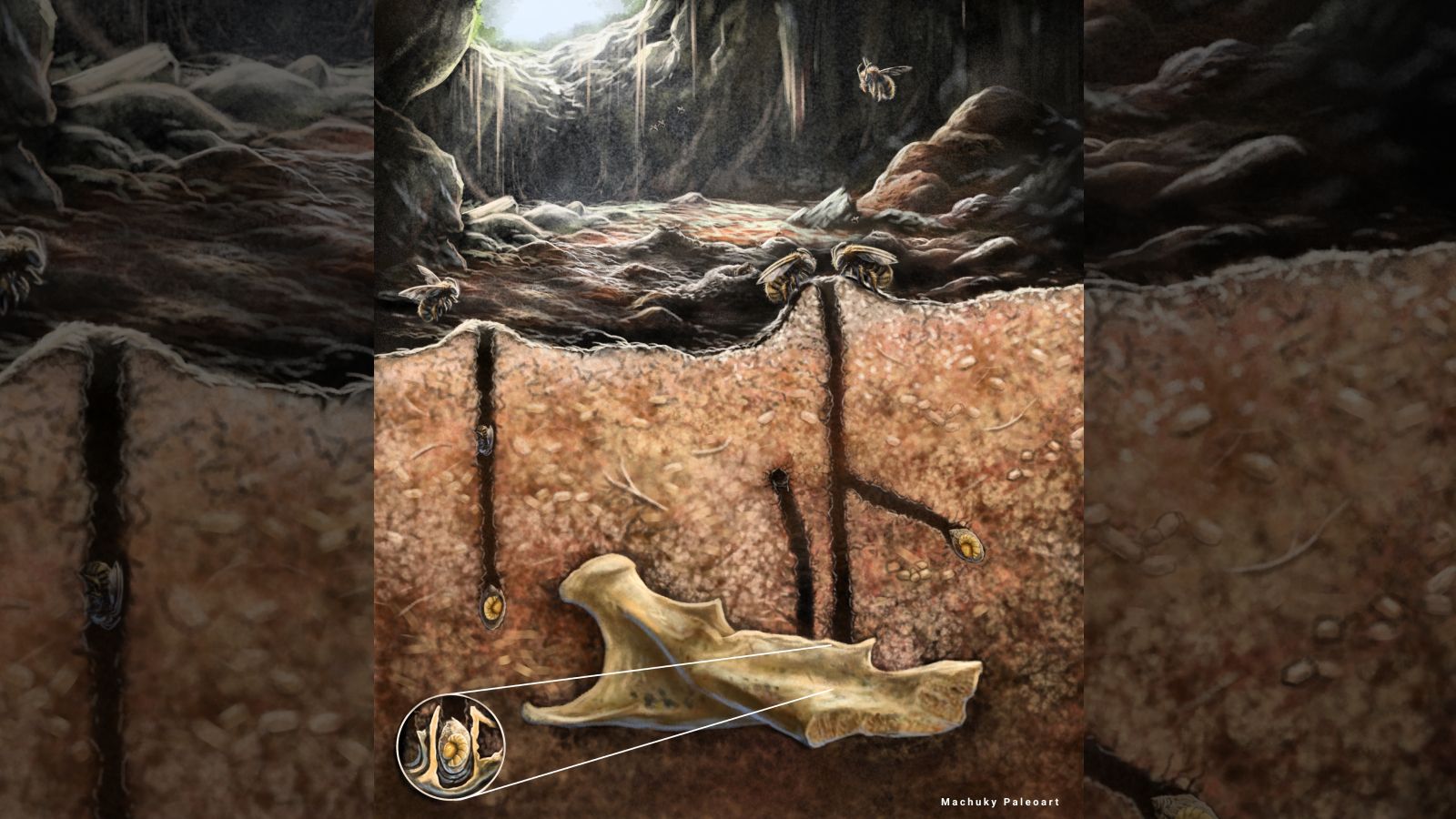
More than 5,000 years ago, burrowing bees made their homes inside heaps of rodent bones buried in a cave on Hispaniola, the Caribbean island that comprises the Dominican Republic and Haiti, a new fossil study suggests.
The bees encountered the bones while digging to their preferred depth in the soil. They stopped to build nests inside tooth and vertebra cavities, which turned out to be the perfect size, researchers found. Most of the bones the scientists recovered were from hutias — chunky rodents that look like a cross between squirrels and beavers — but a handful were the remains of an extinct type of sloth.
“The cells of Osnidum almontei [the name given to the fossilized nests] appear highly opportunistic, filling all bony chambers available in the sediment deposit,” the researchers wrote in the study.
The bees found the hutia bones a long time after they were deposited in the cave by Hispaniolan barn owls (Tyto ostologa), the researchers posited. Evidence shows that these owls, which are now extinct, sometimes transported hutias into the cave whole, discarding the bones as they devoured the rodents, and sometimes regurgitated pellets containing the remains of hutias they had eaten while hunting. Barn owl bones found in the cave indicate the species lived there, the researchers noted.
These piles of bones became buried over time as sediments washed into the cave from outside. And several generations of burrowing bees took advantage of this much later, even though these bees typically make their nests in the open, according to the study.
In one tooth cavity, the researchers found six nested bee nests, indicating that successive generations made their homes in the same spot after previous nests had been abandoned.
The bees may have chosen to nest in the cave rather than outside it because the surrounding landscape had little to no earth for burrowing. “The area we were collecting in is karst, so it’s made of sharp, edgy limestone, and it’s lost all of its natural soils,” study co-author Mitchell Riegler, a teaching assistant at the University of Florida, said in a statement.
After one of the scientists’ last visits to the cave, plans had been submitted to turn it into a septic storage facility.
“We had to go on a rescue mission and get as many fossils out as possible,” study lead author Lazaro Viñola Lopez, a paleobiologist at the Field Museum of Natural History in Chicago, said in the statement.
The plans to build a septic tank eventually fell through, but the scientists removed abundant fossils regardless. These fossils have yet to be analyzed, and the team plans to publish more studies about their finds.