


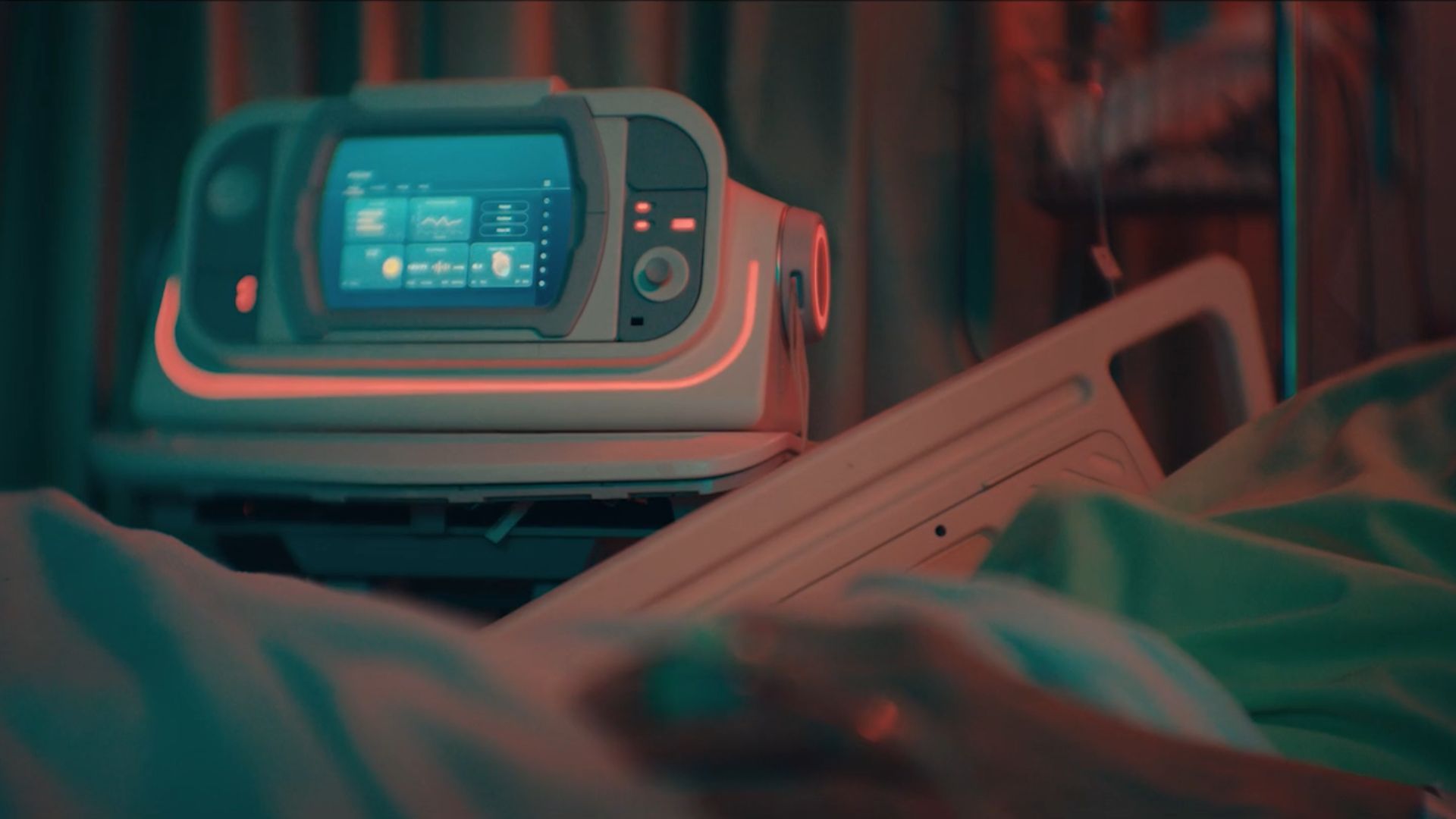
Hospitals may soon be able to rely on a “self-driving” machine to help patients recover from heart attacks. This machine would deliver treatments to the patient, collect data on how their body responds, and then adjust their medications to stabilize the patient within parameters preset by their doctor.
This is the vision for the Autonomous Closed-Loop Intervention System (ACIS), a device being developed by scientists at NTT Research, an arm of global technology company NTT. The device has been tested in animal experiments but not in human patients yet.
The researchers’ eventual goal is to allow the heart to rest and minimize its oxygen use in that critical recovery window after a patient experiences a cardiac emergency. The jobs that would be handled by ACIS are usually done by medical providers — but the idea is that the device could standardize and optimize the process to deliver better outcomes while relieving strain on doctors’ already-limited resources.
“We think that this system will outperform the standard of care,” said Dr. Joe Alexander, director of NTT Research’s Medical and Health Informatics (MEI) lab.
ACIS stemmed from a larger effort spearheaded by the MEI Lab known as the Bio Digital Twin program. Its aim is to construct advanced virtual models of organ systems that can be personalized with an individual patient’s data, providing a detailed and dynamic representation of their medical status and a testable model for developing treatment plans.
Live Science spoke with Alexander about Digital Twins, ACIS and his vision for how they might transform health care.
Nicoletta Lanese: When we’re talking about a Bio Digital Twin, is it fair to say it’s a virtual copy of the patient?
Dr. Joe Alexander: Probably the layperson would think of a Bio Digital Twin as a copy of the person. But actually, it’s just a system of equations, modeling and simulation to represent a person to the extent that is relevant for the disease. It’s a very specific application, so there’s no single Bio Digital Twin representing the [whole] person.
In our case, although we set out to build a family of Bio Digital Twins to represent different organ systems for different types of important diseases, we’re starting with the cardiovascular system. So when I talk about a Cardiovascular Bio Digital Twin, I’m not talking about even a copy of the heart; I’m talking about a mathematical representation of all of the systems necessary for looking at the cardiovascular system in a particular patient.
In the case of ACIS, we’re looking at acute heart failure and acute myocardial infarction [colloquially known as a heart attack].
NL: Could you talk about what kind of data goes into the model?
JA: This Cardiovascular Bio Digital Twin is representing pressures and flows throughout the cardiovascular system, including pressures and flows generated by all four chambers of the heart. … We are able to represent the cardiovascular system dynamics in pressures, flows and volumes.
NL: And how do you make that actionable for an individual patient?
JA: We’re in the early stages of it, but we have a road map for how to do it. Basically, we first go after representing the “normal” cardiovascular system for patients. So, if we can get data around “normal,” then that’s very good. [Editor’s note: The MEI Lab is working with partners such as the National Cerebral and Cardiovascular Center in Japan to get access to this kind of data.]
But probably what’s most important is finding populations that are relevant to the particular patient — so, in this case, patients with cardiovascular disease or patients with heart failure. So we go after that population-level data; let’s say for heart failure. Then, from that data, we can estimate parameters for our cardiovascular model that represent the general population of patients with heart failure.
Within that population, as you know, there’s a lot of variability. So are there other characteristics specific to our patient that we can use? Maybe results from echocardiogram [EKG]; maybe age; maybe comorbidities [other medical conditions]; sex, male or female; or environment. And if there is genetic information available, then we can find a subpopulation that’s even more relevant to the patient.
Now, with ACIS, we [would] actually hook up a patient to the “first guess” of our Cardiovascular Bio Digital Twin for what would match that patient based on population-level data. Since it’s a feedback control system, the feedback will automatically adjust the parameter values to deliver the necessary drugs or device therapies that that particular patient needs for some prespecified cardiac output. In that way, we can further fine-tune the Digital Twin for that patient.
NL: Can you describe how ACIS and its feedback loop work?
JA: The idea is that it’s a “self-driving” therapeutic, just like a self-driving car. But in this case, “self-driving” is delivering the appropriate drugs or, in severe cases, medical-device therapies that a patient may need.
We have a system where we specify — just type in the keyboard — the desired cardiac output, heart rate, left atrial pressure, arterial pressure that we want the patient to achieve. Then, syringes that are filled with the appropriate drugs to create those changes are driven by our model, or “best guess” for that particular patient. This is all after a patient has had the primary lesion [like a blood vessel blockage] treated in the cath lab.
Let’s say they had a vessel that was occluded; it’s already been opened up or a stent has been placed, and they go to the ICU [intensive care unit] or CCU [coronary care unit] in order to recover. Recovery means that the heart needs an opportunity to rest. That means letting the heart work as little as possible to maintain the desired cardiac output.
We have a certain regimen of drugs that are given. Catecholamines improve the ability of the heart to contract. Nitrates reduce afterload of the heart so it doesn’t have to work against such a high load when it tries to inject into the arterial system. Diuretics decrease the circulating blood volume and remove blood from the lungs, which has built up due to the acute failure.
These drugs are typically given by a physician; they’ll give one drug and look at the response, give another drug, the response, and manage that patient over several days. When our system achieves proper function — and we’re almost there, I think — all those drugs can be given at once if we know how the system will respond. That saves us a lot of time in treating the patient.
The drugs are delivered by these autonomously controlled syringes; then the patient responds to them, and that response is fed back in this system. Those values are compared to the ones that we typed in the keyboard, and if there’s a difference, then feedback systems work to reduce that difference. It also gives information to our Digital Twin for that patient, so that in the future, we have better representations of those resistors and capacitors in the model.

NL: What stage of development has ACIS reached at this point?
JA: So, in animal experiments in dogs, last year for the first time, we experimentally induced acute heart failure and we were able to let this autonomous system correct the cardiac output, arterial pressure autonomously, while minimizing myocardial [heart muscle] oxygen consumption.
Since that first successful experiment about a year ago, we’ve had several other successful [animal] experiments, all the while improving our feedback system to be more complex, making it so that it can operate based on intermittent data, so you don’t have to be continuously sampling. You can do it episodically.
We have several more years of work in optimizing this system, we think, in animal experimentation — probably about three years more. And then we’ll be ready for first-in-human studies where ACIS will be used but with a clinician in the loop [for the initial human tests]. What ACIS would do is tell the physician what doses of these various drugs to deliver, and the physician would then make a decision whether to do it or not, as a safety measure.
Now, what I’ve been describing so far has mostly been about drugs, but the same algorithms work for medical devices, such as left ventricular assist devices [LVAD, a type of mechanical pump] or extracorporeal membrane oxygenation devices [ECMO, which circulates the blood to let the heart and lungs rest]. This is all within the scope of what we expect to achieve in experimental animals within the next three years before going to first-in-human studies.
NL: What are the next steps toward getting ACIS approved? What might the trials look like?
JA: It would be kind of like [testing] an autonomous or self-driving vehicle — level 1 through 4 degrees, or stages, of autonomy.
In other words, allowing the system to have increasing responsibility and watching the performance until settling into acceptance of an autonomous system where then, still, probably a specialist would monitor it — like someone sitting in the seat of a self-driving car, ready to take over if things go wrong. I see that kind of progression, similar to the self-driving vehicle.
NL: And in the long run, would ACIS always have some kind of clinician supervision?
JA: I still hold to the concept of “autonomous,” but I suspect that there will be a cardiologist somewhere roaming around, monitoring, perhaps, a number of patients at once.
I’m very committed to the idea that the device that we conceive of can actually outperform the cardiologist. And I know that we’ll rub some cardiologists the wrong way. But we expect to demonstrate that point, or strongly suggest that that’s true, by doing experiments in animals where we compare the ACIS system to clinically trained cardiologists. We expect reduced infarct size [degree of heart tissue death] from ACIS compared to the standard of care from cardiologists.
NL: Assuming this device gets approved in the future, where do you see it having the most benefit?
JA: There’s the so-called Quintuple Aim of Health Care, which says to improve the patient experience, improve the physician experience, improve population health, reduce the cost of care, and improve health equity. These aims, I think, are all addressed by ACIS.
The patient would have more attention and minute-to-minute care — you wouldn’t have a resident trying to juggle many patients at once. You could have a less-specialized clinical caretaker who is watching the behavior of the device, and so that would improve not only the patient experience and quality of the patient’s care but also the health care provider’s experience. They wouldn’t have to be overworked to such an extent.
We think that this system will outperform the standard of care because [on paper] you more rapidly converge on the minimization of myocardial oxygen consumption and have better recovery during the hospital stay. So the patients have fewer readmissions and complications after being released. There’s always some injury to the heart [with these cardiac events], and maybe, there may be some infarction of the heart. So we think that this level of care could reduce infarct size, so you preserve more of the heart, during treatment.
NL: And when you eventually hand off ACIS for clinical testing, what would the next project be?
JA: For us, the natural progression within the next 10 years, probably within the next five years, would be chronic heart failure. In chronic heart failure, you have to deal with more complexity, such as [tissue] remodeling, where the ventricles get thicker or get dilated. That kind of remodeling changes the mechanics.
You also have to deal with data from patients who are not in the hospital. We plan on building registries of patients [with Digital Twins] who would have been acutely ill to have access to that data for treating them outside. But then we have to also rely on things like wearable technologies, and we’ve been working on that as well. We have collaborations with folks at the Technical University of Munich who are developing special biosensors and biomaterials and implantable sensors and so forth that could help provide the data that would be important to doing predictive health maintenance in patients with chronic heart failure.
And in chronic heart failure, we have to deal with comorbidities and complications like kidney failure … and anemia. The combination of fluid overload and anemia all due to renal failure really makes the heart suffer from a lack of oxygen and causes slow deterioration.
I’m sure that complexity alone will keep me busy for the rest of my life. We have a lot of work to do with chronic heart failure; that would be next for sure.
Editor’s note: This interview has been lightly edited for length and clarity.