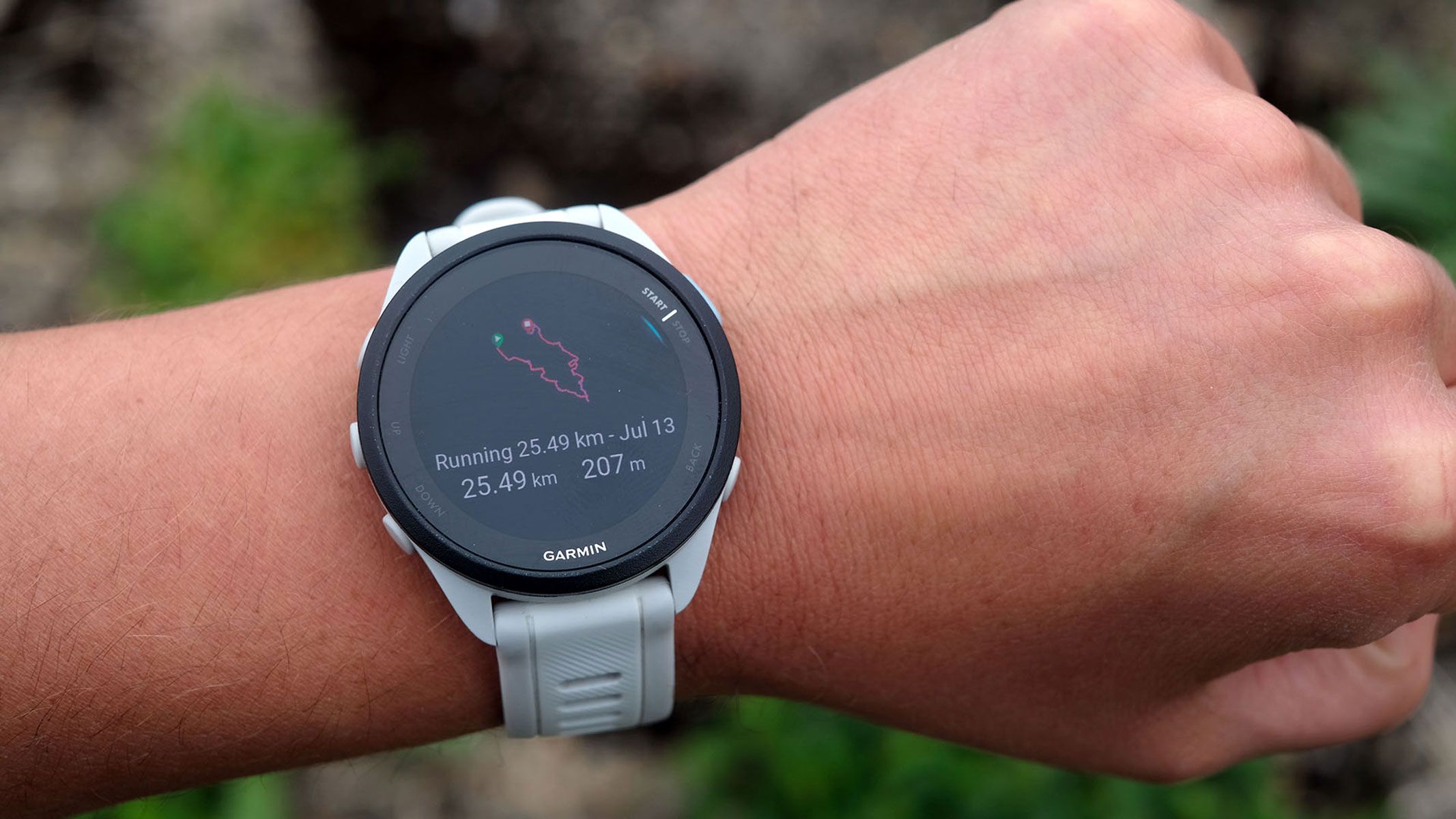
Garmin makes many of the best fitness trackers. There are dedicated models for divers, hikers, mariners and even truck drivers. But the number one audience for these watches? Runners.
Any Garmin watch available will make a decent run tracker. A great one, even. Some are truly made for the job, though, and some others shine in a specific style of running discipline. For example, we don’t think Garmin’s lowest-end watches are ideal for triathlons, because the ones a step or two up have modes designed to track the entire event. Those who take part in multi-day running events or epic ultramarathons will also need to consider battery life more than most.
But it’s also important to find a watch you can simply get on with, as England Athletics coach Stuart Sahan, who offers personalised run coaching over at Run Fit Coach, told us. “From a runner’s perspective, ease of use is key. A good watch should show clear pace, time, and heart rate without being overcomplicated,” he said.
Here, we’ll take a look at the top recommendations among current Garmin watch models for 2026. From the best Garmin watches for tight budgets and beginner runners to the one we’d don for an ultramarathon, there’s something for every type of runner.
- On the hunt for running footwear? Don’t forget to check our guide to the best running shoes
The quick list
Best for beginners
The Garmin Forerunner 165 may be stripped of some of the more sophisticated features, but it is reliable, easy to use and relatively budget-friendly — a great pick for novice runners.
Read more below

Best for ultramarathons
With up to 36 days of battery life in smartwatch mode or 90 days with solar charging, the Garmin Enduro 3 is a top-tier smartwatch for ultramarathons and multi-day hiking trips.
Read more below

Best for triathlons
The Garmin Forerunner 970 offers peak screen brightness, excellent multi-sport features and stacks of on-watch maps, making it a go-to option for serious runners and triathletes.
Read more below

Best for trail running
If budget is no issue and you are a dedicated trail runner who wants the absolute best, most durable, and most capable navigation tool available, the Garmin Fenix 8 is nearly impossible to beat.
Read more below

Best on a budget
The Garmin Forerunner 55 may be the oldest model in this guide, true, but it works just as well for beginners as it does for experienced marathon runners, and it costs less than $199.
Read more below

Best for comfort
Tired of big, chunky monstrosities? Consider the Garmin Vivoactive 6 instead. This beginner-friendly running watch is sleek, lightweight and exceptionally comfortable to wear all day.
Read more below
The best Garmin running watches we recommend in 2026: Tried and tested by a running enthusiast
Why you can trust Live Science
Our expert reviewers spend hours testing and comparing products and services so you can choose the best ones for you. Find out more about how we test.
Best Garmin running watch for beginners
Image 1 of 7


Buy it if
✅ You want a cheaper enthusiast running watch: It’s Garmin’s cheapest serious OLED running watch.
✅ You want a smaller watch: Its 1.7-inch (43 mm) diameter makes this one of Garmin’s more petite models.
✅ You want OLED pop: It’s small but the 1.2-inch (30 mm) screen is just as sharp and colorful as the expensive ones.
Don’t buy it if:
❌ You want Garmin’s most serious stats: Metrics like Training Load are absent.
❌ You need maps: The Forerunner 165 does not support map data.
❌ You want lots of music space: 4GB isn’t much these days.
The bottom line
🔎 Garmin Forerunner 165: The Garmin Forerunner 165 is one of the best deals among Garmin watches, and most runners probably don’t need anything more than what it offers. ★★★★★
The best affordable tech makes you ask, “Do most people really need any more than this?” That was the impression the Forerunner 165 left.
This watch can easily take you from not running at all, through the 5K distance, to training for and completing a marathon. And it’s all because Garmin got so many of the essentials right with this watch.
First up, while it doesn’t have the latest GPS and heart rate tech, it does provide reliable stats and data 99% of the time. It’s still fairly recent hardware. You can also use Garmin’s daily Suggested Workouts to effectively act as a running coach — minus a real coach’s monthly fees!
And while the Forerunner 165 doesn’t have the very longest battery life in the family, we found it can last around a week of solid use — Garmin claims up to 11 days for lighter use. The OLED screen is lovely, too. It’s colourful and just as sharp-looking as the far more expensive watches, just lacking the next-level brightness of the Forerunner 570 and 970.
Where’s the catch? While it comes in some fun colors, the Forerunner 165 isn’t the most luxurious watch. Its casing is Garmin’s basic (but surprisingly resilient) “fibre-reinforced polymer.” Fancy plastic, basically. And the glass isn’t as scratch-resistant as that of higher-end watches.
You also miss out on on-watch maps, and have to pay a supplement to get music support, which only gets you 4GB of room for tracks — like an MP3 player from 2007.
The Forerunner 165 also lacks some of Garmin’s most useful stats, Training Load and Training Readiness. These really help balance a truly packed exercise schedule. But the watch does have the next best thing: Body Battery balances your sleep, stress and activity to signal when you may be getting run-down.
This will also feed into the workouts the Forerunner 165 suggests. Can you ignore these? Of course, but one of the real strengths here is how close you can get to a digital personal trainer if you embrace the 165’s features — albeit a trainer who won’t shout you off the couch.
|
Attributes |
Notes |
Rating |
|---|---|---|
|
Design |
Good-looking, relatively durable and comfortable to wear. |
★★★★★ |
|
Performance |
Good tracking accuracy and decent battery life. |
★★★★★ |
|
Functionality |
A good selection of beginner-friendly features. |
★★★★ |
Best Garmin running watch for ultramarathons
Image 1 of 7


Buy it if
✅ You want the longest battery life: Month-long stamina can be tripled (with light use) through solar charging.
✅ You want top durability: 10ATM water resistance, Sapphire and titanium are three bullet points in its favour.
✅ You don’t want a smartwatch: A non-attention grabbing screen makes this an Apple Watch antithesis.
Don’t buy it if:
❌ You demand smartwatch pop: The screen isn’t pin-sharp or vibrant.
❌ You want a svelte watch: A large and thick (if not heavy) casing isn’t to all tastes.
The bottom line
🔎 Garmin Enduro 3: The Garmin Enduro 3 caters perfectly for the long-term Garmin fan not tempted by the bright lights of OLED screens and digital assistant features. In return you get brilliantly long battery life, alongside the usual roster of high-end features. ★★★★
The last couple of years have seen Garmin invest heavily in OLED screen tech and smartwatch features. But the Garmin Enduro 3 is here for those who prefer a slightly more traditional style, and would rather prioritise battery life.
It uses a large, 1.4-inch (35 mm) transflective MIP screen instead of OLED. Put it next to an OLED and its colors will look quite dull, the image a little low-resolution. But it has one massive advantage. The Garmin Enduro 3’s screen gets clearer in direct sunlight, while using no additional power. It feeds off sunlight rather than competing with it. Thanks to a solar element in the screen, its battery is even charged while under sunlight, leading to battery life of up to 90 days.
That’s in ideal conditions without masses of GPS usage. But this is still our number-one recommendation for multi-day events, running holidays and ultras. Battery life is also far more consistent than the trendy OLED crowd, as only music playback is a real battery killer here.
The Enduro 3 has 32GB storage for tunes, podcasts and audiobooks. And that room can also be used to store map data. There’s enough room for many countries’ worth here, although we do prefer the presentation of maps on Garmin’s OLED watches.
In other areas, the Garmin Enduro 3 is a high-spec watch. It has excellent 10ATM water resistance, and a Sapphire screen covering for top-tier scratch resistance. And despite being fairly large, with a 2-inch (51 mm) diameter, everyone we showed the watch to commented on how light it feels. At 2.2 ounces (63 g) with strap, it’s suitable for all-day, all-night wear, although we typically prefer something a little daintier for sleep tracking.
Garmin classes this as an adventure watch. It’s ideal for an outdoors life, and can help out in the dark too, thanks to its integrated LED flash. But it’s just as capable for simple run tracking as the core Forerunner models. Our takeaway from a few weeks living with it is how low-maintenance it is, with almost zero upkeep required.
- Read more: Garmin Enduro 3 review
|
Attributes |
Notes |
Rating |
|---|---|---|
|
Design |
Rugged, durable and water-resistant, but also quite chunky. |
★★★★ |
|
Performance |
Excellent tracking accuracy and battery life. |
★★★★★ |
|
Functionality |
High-end specs at a premium price. |
★★★★ |
Best Garmin running watch for triathlons
Image 1 of 7


Buy it if
✅ You want peak outdoor clarity: Peak screen brightness is awesome.
✅ You demand Garmin’s best: This watch has all the best Garmin running features.
✅ You’ll appreciate on-watch maps: If not, consider the Forerunner 570.
Don’t buy it if:
❌ You want the longest battery life: We found the Fenix 8 and Forerunner 965 last longer.
❌ You’re a U.S. buyer after a bargain: Series gets a price hike this year.
The bottom line
🔎 Garmin Forerunner 970: The top model in Garmin’s runner-first Forerunner line gets more smart features and a brighter screen, but still costs less than the Fenix 8 — assuring it a place in our recommendations list. ★★★★½
The Garmin Forerunner 970 is a great all-round running and fitness watch, but it does have some skills tailored for triathletes.
First up is the all-important multi-sport mode. There are specific triathlon and duathlon profiles, and you can create your own additional modes if your particular event is a little different from the norm.
Garmin Coach, which you access through the Forerunner 970’s Connect phone app, also lets you sign up to a training plan designed to best prepare you for the rigors of a triathlon.
What stood out most when we used the Forerunner 970 in person, though, was its brightness. This watch has an exceptionally bright screen, making Garmin’s best-ever showcase for one of the company’s best-ever features, its map support.
Maps could become invaluable for the more adventurous triathlons, where the run or cycle sections are the kind in which it’s possible to get slightly lost. The Forerunner 970 has a superb activity screen (among many) that displays map data and stats on a single screen too.
We have found this newly supernova-style screen can shorten battery life from the quoted 15 days. But we’re not talking about anything close to the limited stamina of the Apple Watch series.
The 5ATM water resistance is strong enough for surface-level swimmers. But if you’re a swimmer first and a triathlete second, we’d recommend the Fenix 8 instead as it has much better water resistance.
New for this generation of Forerunners, the 970 introduces extra features to further optimise your training. It was the first watch with Garmin’s Running Tolerance, designed to let you keep at the bleeding edge of your limit without excess risk of overtraining or injury.
You can also hook it up to a Garmin HRM 600 chest strap to see Running Economy metrics, which can signal whether you need to put more effort into your form.
Garmin’s other higher-end watches can arguably make just as good triathlon trackers. But as of early 2026, none of them can display your stats mid-race with quite the clarity of the Forerunner 970.
|
Attributes |
Notes |
Rating |
|---|---|---|
|
Design |
Durable, exceptionally bright and comfortable to wear. |
★★★★★ |
|
Performance |
Great tracking accuracy, but a slightly limited battery life. |
★★★★½ |
|
Functionality |
Packed with high-end specs, except the 10ATM water resistance. |
★★★★ |
Best Garmin watch for trail running
Image 1 of 7


Buy it if
✅ You want Garmin’s flagship: It’s not the newest but it’s arguably still Garmin’s top mainstream watch.
✅ You want top build: Lots of metal and Sapphire make this a tougher kind of watch.
✅ You demand Garmin’s best: The feature list is long and exhaustive.
Don’t buy it if:
❌ You’re on a budget: The Forerunner 970 has similar features but costs less.
❌ You dislike haptic buttons: Some may not like how they feel.
❌ You own a Fenix 7 Pro: It’s not the biggest upgrade.
The bottom line
🔎 Garmin Fenix 8: Still the best all-round Garmin watch for those with money to spend? Probably: it’s a class act that makes sense of the series’ enduring popularity. ★★★★½
The Fenix 8 is generally considered the flagship of Garmin’s line-up. Sure, you can get more expensive models, but they tend to be specialists for fields like diving, hunting or for mariners.
What marks this out from the rest? It’s not only available with hard-but-light titanium metal highlights and a scratch-resistant Sapphire crystal, it competes with the Apple Watch Ultra on water resistance. As well as a 10ATM rating, it is certified for dives at a depth of up to 131 feet (40 metersU).
The watch actually has special buttons made for the job: ones that use haptic feedback instead of an actual clicker mechanism to avoid water ingress. Why do you need those for trail running? You don’t, but it’s all part of the Fenix 8’s tougher-than-most personality.
We also like the Fenix 8 for its long battery life, despite using a once highly power-sapping OLED screen. And this display is ideal for navigating by map. As with all the top Garmin watches, the Fenix 8 can store vast areas of map data on its internal storage. This can be used not just to display pre-planned routes, but to navigate on the fly, searching for points of interest or just picking a waypoint on the Fenix 8’s screen. The watch is smart enough to be able to calculate routes with no additional help from your phone.
And, a trail running favourite, you can judge your effort by running power rather than pure pace. While we tend to rely on heart rate when considering effort level during a workout, running power takes into account both the terrain and your speed. And you don’t have to wait for your heart rate to catch up before figuring out whether you’re pushing too hard or not.
We find the Fenix 8 typically lasts for more than a week of at least moderately heavy real-world use. It outdoes a Forerunner 970 here, if not the legendarily long-lasting Enduro 3. One of the neat parts to the Fenix 8 family, though, is how many members it has. You can get MIP screen versions, as well as the OLED style we reviewed, and a lower-cost Fenix E. Garmin has tried to cater for most folks just within this series.
In September 2025, Garmin further filled out this series with Fenix 8 Pro watches. These have satellite messaging and there’s an incredibly bright microLED version too. But as they are extremely expensive, and there are additional subscription costs for satellite services, the standard Fenix 8 is likely a better fit for many.
|
Attributes |
Notes |
Rating |
|---|---|---|
|
Design |
Sleek and ultra-durable, just a bit heavy. |
★★★★½ |
|
Performance |
Top-tier tracking accuracy and long battery life. |
★★★★★ |
|
Functionality |
High-end features at a premium price. |
★★★★½ |
Best budget Garmin watch for runners

Buy it if
✅ You want an unobtrusive watch: Small and low-key compared to some of today’s models.
✅ You want low maintenance: Up to 2-week stamina and that MIP consistency.
✅ You want to save money: A relatively low RRP and can be found on sale sometimes.
Don’t buy it if:
❌ You want an up-to-date watch: Released in 2021, it’s a bit of a tech relic.
❌ You want OLED pop: The MIP screen is relatively dull, if practical.
❌ You want to see lots of stats: The small screen doesn’t fit lots of stats happily.
The bottom line
🔎 Garmin Forerunner 55: It may be an older watch, but there’s still an appeal to the Forerunner 55 if all you want is a simple run-tracking wearable that will do the job better than a fitness tracker. But is it outclassed by the Forerunner 165? Yes. ★★★★
The Garmin Forerunner 55 isn’t a watch we actively recommend to huge numbers of people these days, not since the Forerunner 165 arrived. But it’s still a worthy watch that at the very least deserves some context.
It has been around since 2021, making it the longest-standing model in the current Forerunner range. And its enduring popularity isn’t a fluke.
This is a no-nonsense watch that isn’t too large, lasts up to two weeks off a single charge and provides the key features most runners need — and some more for good measure.
For example, despite being a bottom-rung runner’s watch the Forerunner 55 will still provide you with daily suggested running workouts. And you can get a more structured workout plan through the free-to-use Garmin Coach feature in the Garmin Connect app on your phone.
The Forerunner 55 uses an MIP screen, the kind that used to be found in just about every Garmin watch. This style isn’t natively lit but gets clearer as the ambient light level increases. And there is of course a front light to let you see the display in the dark.
It’s this tech that will provide long and stable battery life even if you are about and about most of the day. That would put additional strain on the battery of an OLED Garmin watch, whose screens need to get brighter in sunny environments.
What are the issues? The Garmin Forerunner 55 doesn’t have a barometric altimeter, so can’t track the stairs you climb each day. It’s a stat we think the less obsessive runners who want some of the fitness tracker flavour will miss.
The Forerunner 55 also has an older-generation heart rate sensor. While decent, this gen was slower to react to changes and could at times put out some questionable BPM numbers during the first few minutes of a run.
We’d recommend the Forerunner 165 if you can afford it, but there’s still some charm to this older model.
|
Attributes |
Notes |
Rating |
|---|---|---|
|
Design |
Simple and functional. |
★★★★ |
|
Performance |
Satisfactory tracking performance and relatively long battery life. |
★★★★ |
|
Functionality |
Basic features, but at an affordable price. |
★★★★ |
Best Garmin running watch for comfort
Image 1 of 7


Buy it if
✅ You like minimalist design: It doesn’t scream “marathon runner”
✅ You want to spend less: It’s a better deal than a Venu 3.
✅ You need 24/7 wear: The design is ideal for sleep tracking.
Don’t buy it if:
❌ You want a personal trainer: You get Garmin Coach but no daily running workouts.
❌ You’re just here for run tracking: Touchscreen operation comes with frustrations.
The bottom line
🔎 Garmin Vivoactive 6 The best buy among Garmin’s more smartwatch-style running watches. It combines a breezy style with some runners’ extras that were once not found in this sub-category of watches. ★★★★
Want a Garmin watch that doesn’t feel or look like an outright “runner’s watch”? Pick up a Vivoactive 6. It’s exceptionally light at just 1.3 ounces (36 g) with strap, has a moderate diameter of 1.65 inches (42 mm), and its 10.9mm thickness is similar to that of an ordinary watch.
You wouldn’t mistake it for one, thanks to its eye-catching OLED screen, but there’s a sense of minimalism here we instantly appreciated. A big part of that is the relative lack of buttons.
A classic Garmin is operated using five side buttons. The Vivoactive 6 only needs two, because you largely control it with the touchscreen.
While we found this occasionally led to our accidentally ending an exercise after just taking a short road-crossing break, you get used to the switch of control styles after a while. And there are few other Garmins we’ve preferred to use for sleep tracking, just because the Vivoactive 6 is such an innocuous presence on your wrist.
Despite clearly aiming for mainstream appeal, the Vivoactive 6 does have solid runner’s cred. Its heart rate hardware is the same as the Forerunner 165’s. It is of course a full GPS watch, and with music storage as standard, you can leave your phone at home if you want.
It’s swim-ready thanks to 5ATM water resistance, and can last for more than a week if you don’t use the Always-On screen mode.
Caveats? The Vivoactive doesn’t have classic Daily Suggested Workouts for running — just walking — or an altimeter, which counts the flights of stairs you climb each day.
But you can send planned routes to it for breadcrumb-style navigation. Getting such a useful feature in a watch with a clear lifestyle angle is excellent, and should dramatically lengthen how long it takes you to outgrow the Vivoactive 6 as you develop as a runner.
|
Attributes |
Notes |
Rating |
|---|---|---|
|
Design |
Sleek and comfortable to wear, but not particularly durable. |
★★★★ |
|
Performance |
Great tracking accuracy and decent battery life. |
★★★★★ |
|
Functionality |
Lacks certain advanced features. |
★★★★ |
Best Garmin watches for runners: comparison
|
Model |
Rating |
Screen size |
Water resistance |
Dimensions (in) |
Weight |
GPS |
Connectivity |
|
Garmin Forerunner 165 |
★★★★★ |
1.2-inch AMOLED |
5ATM |
1.7 x 1.7 x 0.45 |
1.38 oz (39g) |
Single-band |
Bluetooth, ANT+ |
|
Garmin Enduro 3 |
★★★★ |
1.4-inch MIP |
10ATM |
2 x 2 x 0.6 |
2.2 oz (63g) |
Multi-band |
Wi-Fi, Bluetooth, ANT+ |
|
Garmin Forerunner 970 |
★★★★½ |
1.4-inch AMOLED |
5ATM |
1.85 x 1.85 x 0.5 |
2.1 oz (56g) |
Dual-band |
Wi-Fi, Bluetooth, ANT+ |
|
Garmin Fenix 8 |
★★★★½ |
1.4-inch AMOLED |
10ATM, 40m dive |
1.85 x 1.85 x 0.5 |
2.6 oz (73g) |
Multi-band |
Wi-Fi, Bluetooth, ANT+ |
|
Garmin Forerunner 55 |
★★★★ |
1.04-inch MIP |
5ATM |
1.65 x 1.65 x 0.45 |
1.3 oz (37g) |
Single-band |
Bluetooth, ANT+ |
|
Garmin Vivoactive 6 |
★★★★ |
1.2-inch AMOLED |
5ATM |
1.65 x 1.65 x 0.4 |
1.3 oz (37g) |
Single-band |
Bluetooth, ANT+ |
Contributing experts & product testers

Andrew Williams
Andrew Williams is a freelance journalist and fitness tech reviewer based near London, England. He has written extensively about smartwatches, mobile phones and computers for sites such as WIRED, TechRadar, TrustedReviews, Wareable, Stuff, T3 and Pocket-lint. He has reviewed nearly two dozen Garmin watches for Live Science, and is one of the biggest contributors to our guides on the best fitness trackers and best running watches.

Stuart Sahan is an England Athletics running coach and sports therapist who offers personalised coaching and advice at Run Fit Coach. “I have been a long-term Garmin user for many years,” says Sahan. Garmin are a bit of an industry standard in running, and their ability to integrate smoothly with platforms like Strava makes it easier to review sessions and look at longer-term trends.”
Best Garmin watches for runners: Frequently Asked Questions
Fenix vs Forerunner: What’s best for runners?
The top-end Forerunner watches and the Fenix series have a lot in common and share most of the same features. Durability and ruggedisation are the key points of separation.
The Fenix 8 has much better water resistance than even the top-end Forerunner 970, and a slightly more raised bezel in order to avoid drops and scuffs from affecting the screen glass. The last few generations have seen a gradual dilution of this, though, in an attempt to make the Fenix 8 slicker and better-looking.
It’s about identity. Forerunners are primarily for runners, triathletes and cyclists, where the Fenix range is an all-round adventuring series.
Instinct vs Forerunner: What’s best for runners?
The Forerunner series is home to fairly practical watches for runners and other athletes (including casual joggers), and they typically aren’t any more built-up or bulky than is necessary. The running audience has grown massively over the last decade, and Forerunner caters to that crowd.
Instinct is Garmin’s more outdoors-y mid-range line. These watches have a much more bulky exterior. It’s closer to the style of watch that Garmin was known for a decade ago.
As a result, though, Instinct watches punch above their weight for ruggedness. The latest models have 10ATM water resistance, for example, and forgiving bezels that extend up over the screen glass for protection. You no longer need to trade away modern tech to get an Instinct, either, as the Instinct 3 now has an AMOLED option.
How accurate are Garmin watches?
Garmin watches are highly accurate by the standards of consumer-grade wearables. Year after year of development has seen the reliability and accuracy of heart rate stats, in particular, improve dramatically.
Nowadays, we see little reason to use a chest strap over a Garmin watch for regular running. And we tend to get better results from Garmin’s latest than from rivals Suunto or Coros. Very short intervals, or activities like weight training that have quick-fire exertion changes, still benefit from chest strap readings, though.
“An integrated heart rate monitor is particularly useful, as it helps support training in the correct zones and gives runners a better understanding of effort rather than just speed,” running coach Stuart Sahan told us. “This is especially valuable for building consistency and managing training load.”
Similarly, GPS accuracy has been great on Garmin watches for a while. It has further improved in recent years thanks to Multi-Band GPS, found in most of Garmin’s more expensive new models these days.
Even without it, though, we only tend to have issues with “standard GPS” in areas of heavy tree cover. Valleys and skyscraper-packed cities can also pose a problem, helped by Multi-Band GPS.
Is Garmin OLED better than MIP?
OLED and memory-in-pixel (MIP) screens are entirely different technologies, but in recent years Garmin has made it clear that it sees OLED as the way forward for most shoppers.
The difference? Garmin’s OLED screens are super-sharp and colorful, just like an Apple Watch’s. They are ideal for displaying more complex things like maps. But they also have to compete with ambient light, and therefore ramp up their brightness on sunny days. This uses more power. But Garmin thinks the tech has reached a level of efficiency it’s no longer a major problem, and has put OLED at the core of almost all of its ranges.
MIP Garmin watches are of a lower resolution, so the screens look blockier, and both contrast and color are much weaker. They will appear relatively dull indoors, and need a front light to illuminate the display in darker environments.
Outdoors, though, the effect is more like shining sunlight onto a piece of printed paper. MIPs only get clearer in brighter conditions. And this leads to much more consistent battery life in MIP watches, letting them get closer to Garmin’s claimed figures even under heavy use.
Hot take: for all-round enjoyment of using these watches, we tend to prefer OLED Garmin models these days.
Which Garmin watches have solar charging?
Solar charging is one of Garmin’s coolest-sounding watch features. However, it’s only found in select watches with MIP screens at present. There are no Garmin OLED watches with solar panels yet.
Current contenders include the Garmin Instinct 3 Solar, Enduro 3, Fenix 8 Solar and Tactix 8 Solar, among other older-generation models.
Naturally, these watches are at their best in sunnier countries, on the wrists of people who spend a fair amount of time outdoors. It enables the bold claim of up to “unlimited” battery life in the Instinct 3, although that doesn’t factor in serious use of GPS tracking in that time.
Latest updates
Future updates to this guide will be detailed here.
How we tested these Garmin running watches
How we test the best Garmin watches for runners
Image 1 of 6


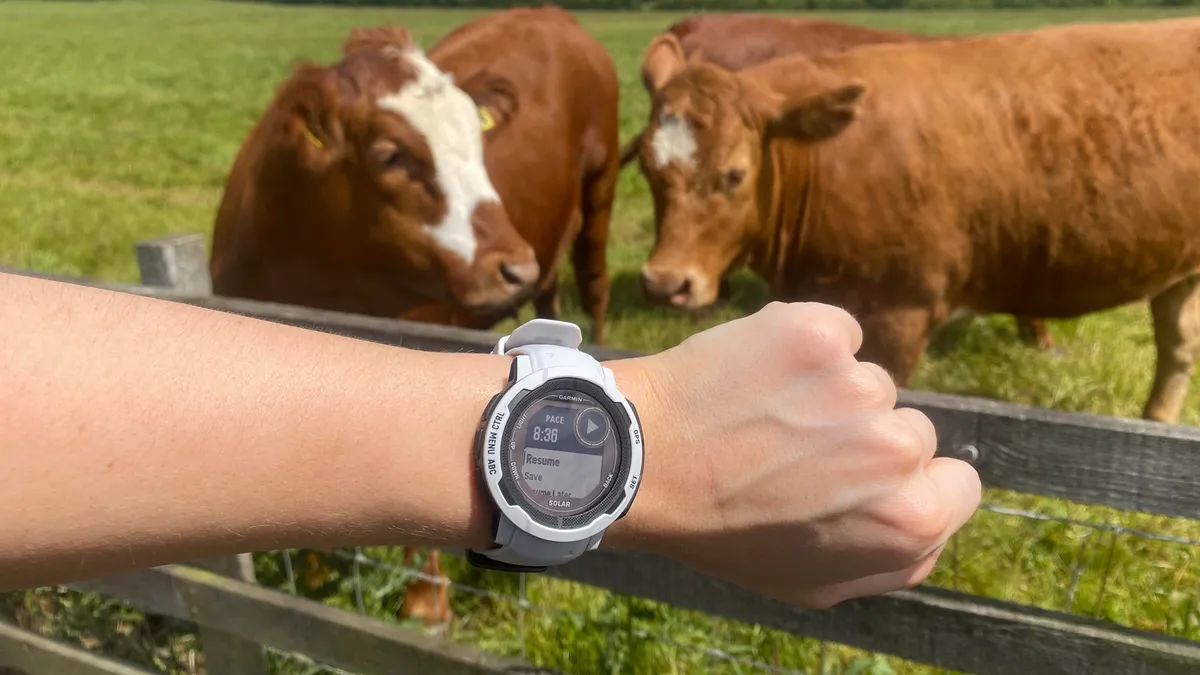
There are an awful lot of Garmin watches to pick from. But answering just a few core questions can whittle down that number massively. Let’s get to it.
Do you need maps? Only fairly expensive and high-end Garmin watches have on-watch maps. It’s a great feature that lets you download entire landmasses of map data to your watch. But plenty of people may actually end up just as happy with “breadcrumb” trail navigation, where you work out a route on your phone and send it over to the watch wirelessly.
Do you want OLED or MIP? These are Garmin’s two main screen types. MIP is the battery-saving old guard, OLED the newer kind. And only the Enduro range is yet to get an OLED entry. We like OLED gloss, but you can’t beat Garmin MIP watches for length and consistency of battery life.
Do you need 10ATM water resistance? All Garmin watch water resistance looks good on paper. 5ATM means a watch can withstand depths of 50 meters. But it doesn’t mean it can withstand the additional pressures of movement at that depth. We feel more comfortable recommending 10ATM watches to committed swimmers, while the Fenix 8 is even prepped for diving at up to 40m depth. Will a 5ATM Forerunner 970 die if you take it in the pool? Absolutely not, it’s designed for pool swimming. But don’t take one scuba diving.
Do you want athlete-geared stats? Garmin watches become more serious tools when stats like Training Load and Training Readiness enter the picture. These are available in the Forerunner 265 and up. They can be used to more accurately judge when you are at risk of exercising too much, or if you are slacking (over the period of a week, for example) without realising. It makes your watch feel more like a personal trainer, minus the expense. But many people own these high-end watches and make no good use of these stats.
How much do you care about smartwatch features? A proliferation of smartwatch features is one of Garmin’s most recent trends. This saw watches like the Forerunner 570 gain a speaker and mic, letting you take calls and talk to your phone’s assistant. If you’re not too fussed about these, it’s a good reason to consider an older model in a sale. Find the Forerunner 965 cheaper than the Forerunner 570? It’s arguably an altogether more capable watch.