

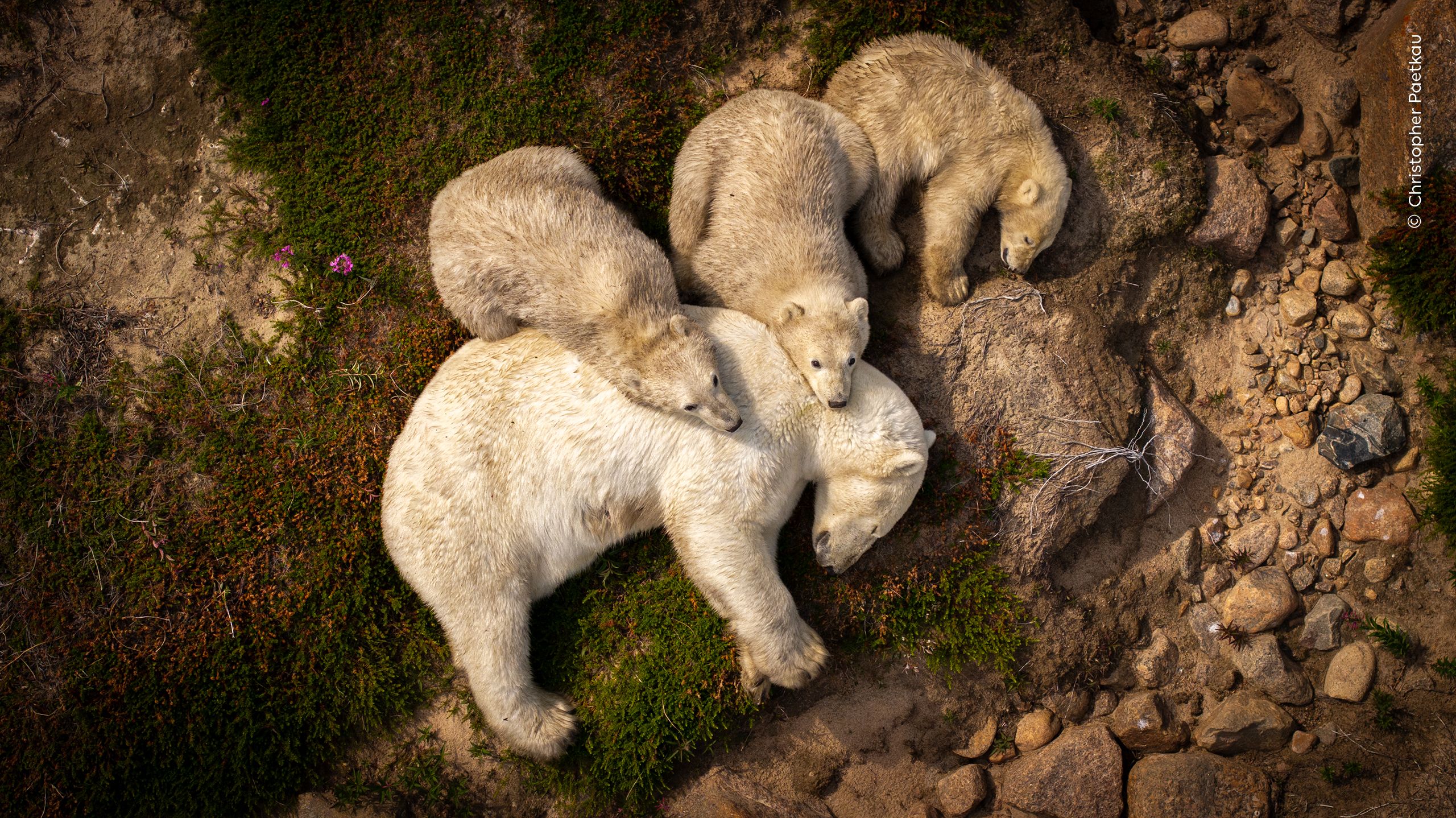
A bleak photograph shows a mother polar bear and her three cubs resting on bare ground and moss, their coats brown with mud.
The image is on the shortlist for this year’s Wildlife Photographer of the Year Nuveen People’s Choice Award — a contest in which members of the public vote for their favorite among 24 images that have been selected by the Natural History Museum, London, and a panel of photography and wildlife experts.
The touching new photograph is a reminder that global warming endangers polar bears by shrinking their sea ice habitat, forcing them to find new sources of food elsewhere. Unlike other bears, polar bears (Ursus maritimus) do not hibernate. Previously, most polar bears spent the entire year on the ice hunting their favorite prey of ringed seals (Pusa hispida) and bearded seals (Erignathus barbatus). But with sea ice declining each year, polar bears now have to seek out more land-based prey, such as reindeer.
Another image of a polar bear is also shortlisted for this year’s People’s Choice Award. It captures a cub during a hunting trip on the Norwegian archipelago of Svalbard that ended in tragedy when the baby bear and its mother approached a human settlement. The mother bear was found dead shortly after, and police officers shot the cub because it seemed aggressive.
Voting for the Nuveen People’s Choice Award is now open online until March 18 for anyone to select the winner of the people’s choice award.
The winning image and four runners-up will be announced March 25.
“Whether showcasing fascinating behaviour or platforming a powerful story, this year’s selection of images is truly exceptional, and we can’t wait to see which one will be chosen as the public’s favourite,” Douglas Gurr, the director of the Natural History Museum, said in a statement shared with Live Science.
The winning image will be displayed along with 100 images from last year’s Wildlife Photographer of the Year competition in an exhibition at the museum that’s open until July 2026. Wildlife Photographer of the Year is developed and produced by the Natural History Museum.
You can see the images that made it onto the shortlist here.