QUICK FACTS
What it is: Comet C/2025 K1 (ATLAS)
Where it is: 220 million miles away, in the constellation Pisces
When it was shared: Jan. 28, 2026
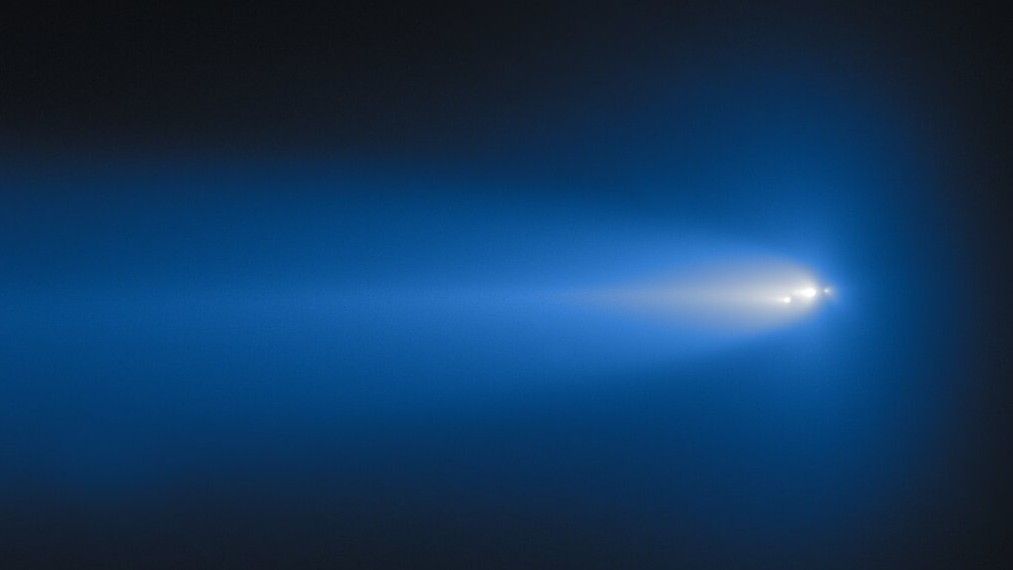
Just as the mythological Icarus melted his feathers and wax wings when he flew too close to the sun, comets often suffer the consequences of orbiting too close to our star. That was definitely the case for Comet C/2025 K1 (ATLAS), which was caught breaking apart by the Gemini North telescope on Mauna Kea, Hawaii, late last year.
As it approached its closest point to the sun on Oct. 8, 2025, at just 31 million miles (50 million kilometers), hopes were not high for the ball of ice and dust to survive; comets that endure a close approach to the sun often brighten significantly afterward, as their component ices sublimate into gas. Surprisingly, Comet K1 emerged from behind the sun intact, but it never brightened enough to be seen with the naked eye.
In early November, the comet’s nucleus began to break up. This is not unusual for comets; extreme solar heating causes the nucleus to release jets of gas and dust — called outgassing — which combines with gravitational forces from the sun to weaken the comet’s structure. Most comets either survive or never emerge from behind the sun, but Comet K1 did — and in just the right place for telescopes across the world to image its spectacular breakup.
A zoomable version of Gemini North”s image clearly shows three fragments.
Another high-stakes encounter with the sun may soon follow the dramatic disintegration of Comet K1. Comet C/2026 A1 (MAPS), a “Kreutz sungrazer comet” discovered Jan. 13, is now hurtling toward the sun and will make a perilously close pass on April 4, when it gets within 465,000 miles (748,000 kilometers) of the sun’s surface.
If it survives that dangerous encounter, some astronomers predict the comet could reach magnitude -4, about the same brightness as Venus. That would be a spectacular sight, but like Comet K1, Comet A1 will have to face searing heat and intense gravity and could either blaze brilliantly or succumb to the sun’s fury.
For more sublime space images, check out our Space Photo of the Week archives.