


A fireball meteor spectacularly exploded in the skies over Europe before raining fiery fragments onto buildings in a German town — punching a hole through the roof of a house and into the bedroom below, according to reports.
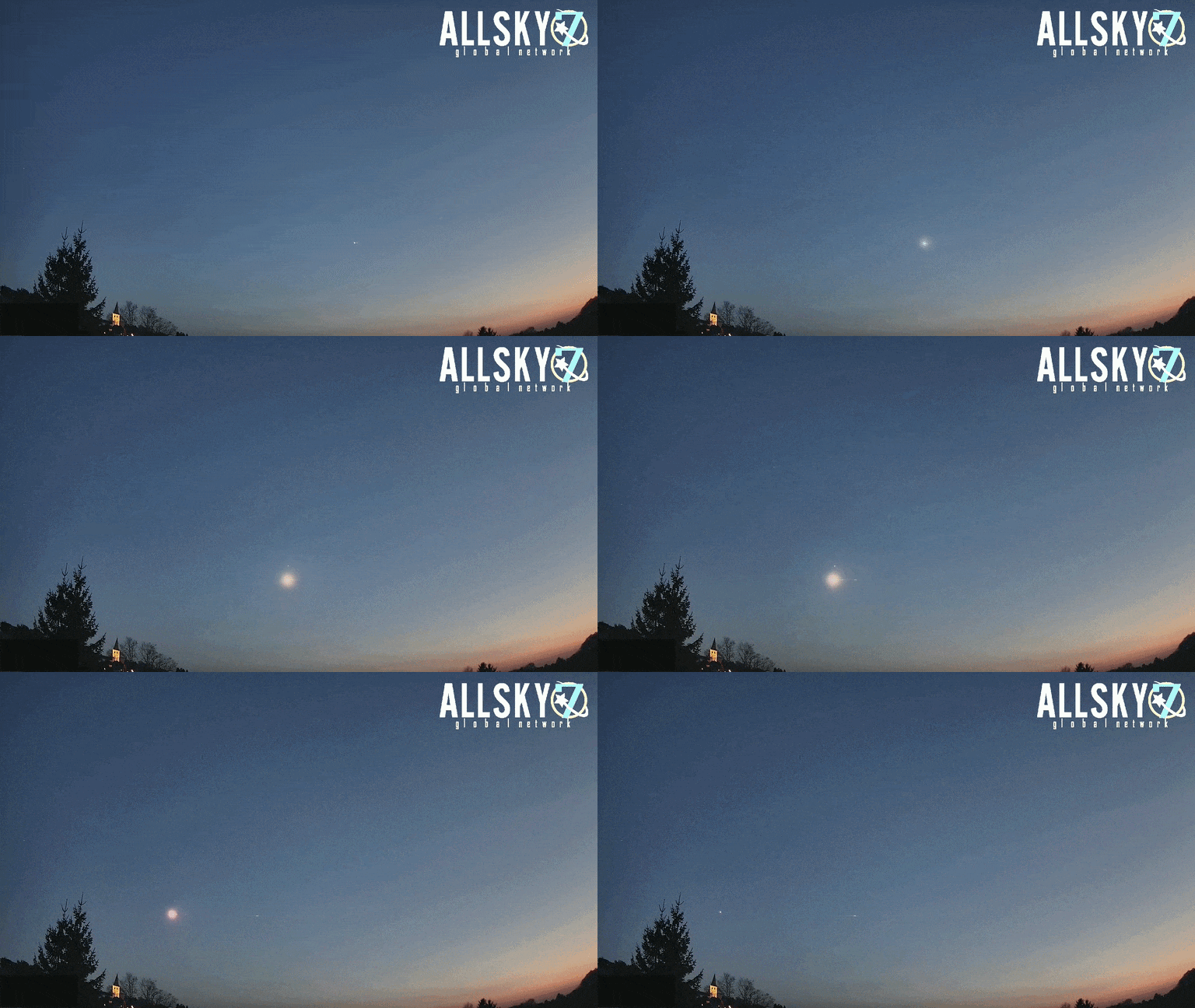
On Sunday (March 8), at around 6:55 p.m. local time, a meteor streaked through the atmosphere over the German state of Rhineland-Palatinate before it suddenly exploded, creating a bright flash that lasted for around six seconds, according to the European Space Agency (ESA). The light show likely meant that the space rock, caught on camera by Europe’s AllSky7 fireball network, was “several meters” in diameter..
More than 3,000 people — including eyewitnesses in France, Switzerland, Belgium, Luxembourg and The Netherlands — reported the explosion to the International Meteor Organization. Several people also reported hearing the atmospheric explosion from the ground.
Article continues below
ESA representatives wrote that “at least one house in the German town of Koblenz-Güls is reported to have been struck by small pieces of the resulting meteorites.”
Local reports have since confirmed that multiple buildings in the area were hit by fragments. Some of these meteorites have since been collected, Live Science’s sister site Space.com reported. Nobody is believed to have sustained any physical injuries from the falling space rocks.
It is unclear how many buildings were hit by the extraterrestrial debris or what the total extent of the damage is. However, German news site Bild shared several photos from the town, which is home to around 110,000 people, including an image of a hole around the size of a soccer ball in one roof. The local fire department told Bild that the rock that punched this hole ended up in a bedroom, which was unoccupied at the time.
Another photo showed nine golf ball-size rocks in a brown paper bag. However, it is unclear if these were all of the fragments that were collected, and they are yet to be confirmed as true meteorites.
Fireball meteors occur when falling space rocks are superheated due to high levels of friction from the surrounding air, according to the American Meteor Society. This often causes the object to break apart, which creates a secondary bright flash (as seen in the latest video).
Most of the resulting fragments burn up before they hit the ground or are so small that they are never found. But occasionally, a few larger pieces can remain intact before impacting our planet’s surface, especially when the fireball breaks apart close to the ground.

The space rock that exploded over Germany was not known to scientists before it entered Earth’s atmosphere. But this is “not unusual,” given that only 11 meteors have ever been detected prior to hitting our planet, according to ESA.
Other close calls
It is extremely rare for meteorites to land in populated areas, let alone impact property or people. But it has happened before.
In June last year, a space rock that punched a hole through the roof of a home in Georgia and was later discovered to be older than Earth. Similar incidents have also seen meteorites crash into the bedrooms of homes in New Jersey in 2023 and British Columbia in 2021. And in 2022, a house in California burned down after being hit by a suspected fireball fragment — although it remains unclear if this was the true cause of the fire.
A tiny space rock also landed on and scorched a driveway in southwest England in 2021 and was collected for analysis. A similar encounter was filmed on a doorbell camera at a Canadian house in January 2025, which also captured the first-ever sound of a meteorite impact.
And in 2023, a French woman is believed to have been directly hit by a pebble-size meteorite while drinking coffee on her front porch, without causing any real injury. This is thought to be only the second confirmed case of a human-meteorite impact, after an Alabama woman was hit and injured by a hefty rock that crashed through her roof as she slept in 1954, according to Smithsonian Magazine.