On April 1, four astronauts blasted off on what will be a 10-day voyage around the moon and back. Their mission, the first to send humans to the moon since 1972, will test key systems for two lunar landings in 2028, which will, in turn, lay the foundation for a permanent base on the moon’s surface.
The Artemis II crew — which consists of commander Reid Wiseman, pilot Victor Glover, and mission specialists Christina Koch and Jeremy Hansen — are slingshotting around Earth before initiating a translunar injection burn to send them on a roughly 245,000-mile (394,000 kilometers) flight to lunar orbit.
Sunrise over moonshot

At 322 feet (98 meters) in height, the Artemis II rocket stack is taller than the Statue of Liberty and provides over 8.8 million pounds (4 million kilograms) of thrust to a capsule the size of a camper van.
Taking a seat

Artemis II’s launch has been hotly anticipated, with NASA originally targeting a moon landing by 2024 back in 2019.
Still, given the numerous delays and setbacks suffered by Artemis II and its predecessor mission, setting up this early was an act of faith by many onlookers.
Onto the tarmac

To avoid health issues in space, it’s standard protocol for astronauts to quarantine before a launch.
The Artemis II astronauts quarantined with their families and, just before exiting, played a card game — one of many prelaunch rituals intended to “use up” bad luck before heading out to the launchpad.
Locked and loaded

The astronauts experienced up to four times Earth’s gravity during their ascent to orbit, accelerating to speeds of up to 10,000 mph (16,000 km/h).
Those speeds pale in comparison to those at reentry, in which the Artemis II astronauts will fall at slightly over 25,000 mph (40,000 km/h), becoming the fastest humans in history.
Liftoff

To reach orbit, the SLS rocket burns through more than 730,000 gallons (28,000 liters) of liquid hydrogen and liquid oxygen in its core stage alone.
The core stage’s four RS-25 engines consume propellant at a rate of 1,500 gallons (5,700 liters) per second during their eight minutes of operation. That’s more than enough to drain an Olympic-size swimming pool in that time.
Live from Cape Canaveral

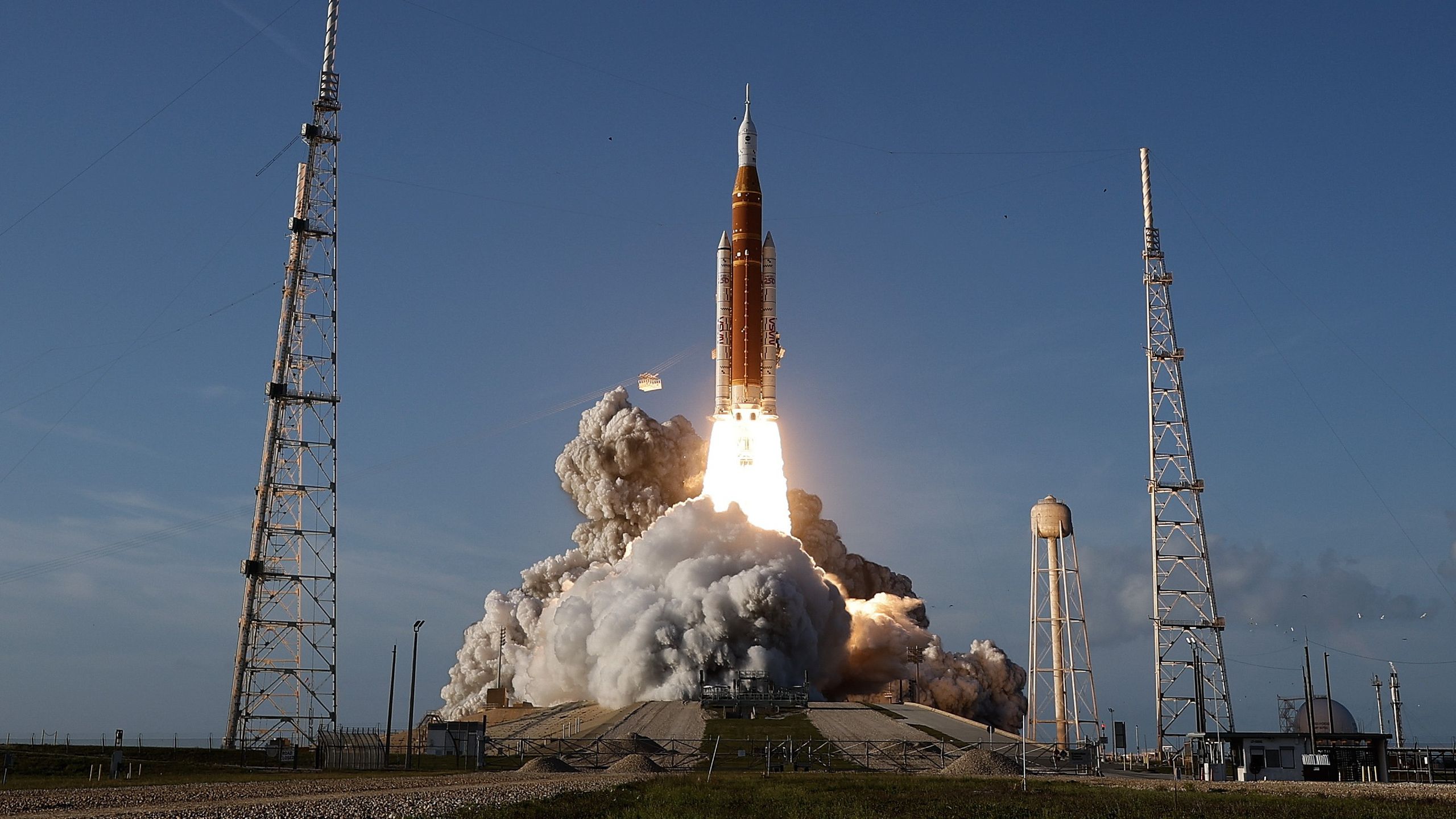
This image of the liftoff was taken by Roger Guillemette, Live Science’s Artemis II launch correspondent, for our live Artemis II coverage.
Guillemette has witnessed close to 100 piloted spaceflight launches, from the July 1975 Saturn IB launch of the Apollo-Soyuz Test Project to the final launch of the Shuttle Atlantis on STS-135 in July 2011.
A screaming across the sky

The SLS rocket produced a thunderous noise measuring 176 decibels during liftoff — loud enough to cause serious eardrum damage and to be heard up to 30 miles (50 km) away.
As the world watched

Up to 400,000 people watched the rocket take off from along Florida’s Space Coast, with tens of millions simultaneously watching online, according to early viewing estimates.
Rocketing skyward

It took around seven seconds for the SLS rocket to clear the launch tower after its two solid-fuel boosters ignited for liftoff. The rocket broke the sound barrier just under a minute into the flight.
Onward to the moon

Upon entering space, the Orion capsule swung around Earth, performing a gravitational slingshot maneuver to pick up speed.
This will be followed by a translunar injection burn that puts the crew on their final trajectory toward the moon.