


Scientists have discovered a vast whale graveyard stretching for hundreds of miles in the Indian Ocean, with some fossil bones dating back over 5 million years.
The deep-sea “megasite,” which the researchers have named the Diamantina Zone necropolis, is the most extensive accumulation of whale carcasses and fossils ever found, the researchers reported in a new study published Wednesday (June 10) in the journal Nature.
“It covers over 1,200 kilometers [750 miles], which just defies belief,” Nick Pyenson, a curator of fossil marine mammals at the Smithsonian National Museum of Natural History in Washington, D.C., who wasn’t involved in the study, told Live Science. “‘Megasite’ is a totally appropriate term. I think they’ve uncovered something really special.”
“The density is crazy”
Xiaotong Peng, a deep-sea researcher at the Chinese Academy of Sciences’ Institute of Deep-sea Science and Engineering, and his colleagues used an underwater vehicle called the Fendouzhe submersible to survey the seafloor in the Diamantina Zone, an area of ridges and fractures in the southeastern Indian Ocean.
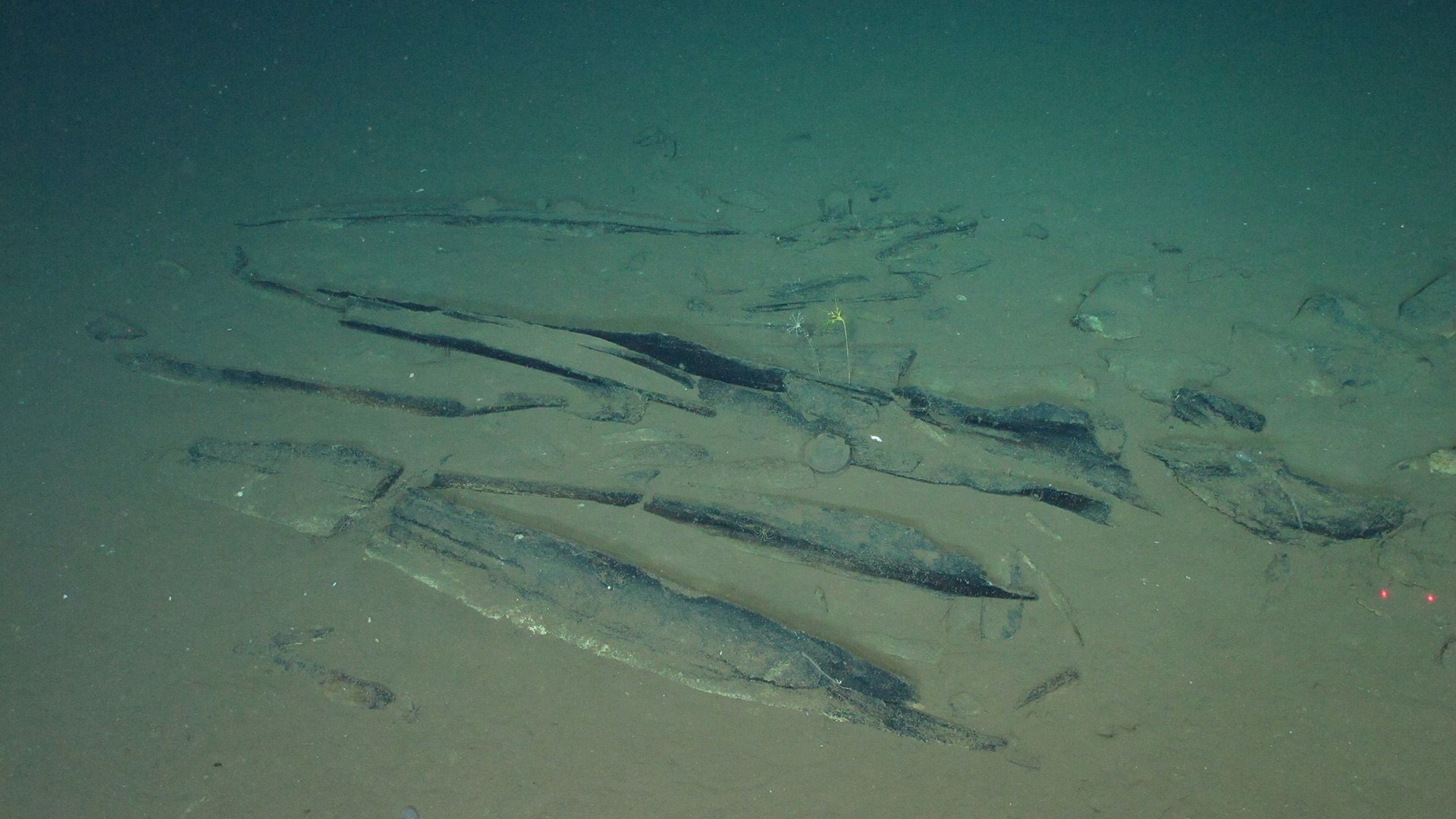
After initially spotting one fossil, the team conducted 32 dives covering a survey area of about 0.25 square miles (0.64 square kilometers). In total, they identified 476 whale fossils and five carcasses of whales that had died more recently, known as whale falls, at depths of between 13,800 and 23,000 feet (4,200 to 7,000 meters).
A 16.4-foot-long (5 meter) Antarctic minke whale on the seafloor. This whale fall was host to 26 invertebrate species.
(Image credit: Global TREnD, IDSSE)
Extrapolating from these figures, the authors said there could be seven to eight whale carcasses and about 750 fossils per square kilometer in the area.
The largest carcass is a 16.4-foot-long (5 m) skeleton from an Antarctic minke whale (Balaenoptera bonaerensis), the researchers said, but most of the remains are from beaked whales — marine mammals we know little about because they live in the open ocean and spend a lot of time diving.
Get the world’s most fascinating discoveries delivered straight to your inbox.
The five active whale falls are covered in bacteria that live without light or oxygen and break down the oils in the whales’ bones, producing hydrogen sulfide. This source of chemical energy enables the carcasses to host diverse communities of jellyfish, brittle stars, bone-eating Osedax worms and bivalve mollusks, which together reach densities of up to 2,840 individuals per square meter, the authors discovered.
Many of the members of the whale-fall communities may also be newly discovered species, the authors wrote, because although most could be matched to the genus or family level using DNA data from samples, only one could be confidently assigned to a species: a clam known as Abyssogena southwardae.
“The density is crazy, as is the fact that they’re probably all new to science,” said Stephen Godfrey, curator of paleontology at the Calvert Marine Museum in Maryland who wasn’t involved in the study. “It’s like each one of these whale falls is a new little restaurant that opens up in a 1,200-kilometer-long [745 miles] strip mall,” he told Live Science.

The distribution and abundance of whale fossils and whale falls in the Diamantina Zone. The orange circles mark dive locations where whale fossils or whale falls were observed.
These are the deepest whale-fall communities ever found, with the one at about 22,000 feet (6,700 m) being about 8,200 feet (2,500 m) deeper than any other known one, according to the study authors.
A fossil deposit being formed
Peng and his colleagues recovered 43 fossils and dated 33 of them based on the ratios of strontium isotopes present. The fossils belonged to five beaked whale species and one species of baleen whale, a group that includes bowhead and humpback whales.
The oldest fossil found in the area belonged to an extinct beaked whale in the Pterocetus genus that dates back about 5.3 million years, to the Early Pliocene. Another fossil find represented a new species, which the authors have named Pterocetus diamantina.
All that remains of most of the specimens is the bony upper jaw, or rostrum. These fossils came mainly from two species: the Andrews’ beaked whale (Mesoplodon bowdoini) and the strap-toothed whale (Mesoplodon layardii). Both of these species still inhabit the Indian Ocean, but the fossils the team discovered could be up to 1 million years old.
“The really awesome thing is that this megasite is showing beaked whale ecology over geologic time scales, so you are getting extinct species overlapping the fossil remains of extant species,” Pyenson said.
The megasite is analogous to either the famous Lagerstätte fossil deposits, where there is high-quality preservation, including of soft tissue, or to the Burgess Shale in Canada, which has a huge abundance of animals, Godfrey said, “only here, you have one that’s still forming.”
Beaked whales are rarely seen, so it might seem strange to find the remains of so many individuals in one place. But Godfrey said these animals might preserve better because of the staying power of their rostra, which have one of the highest known bone densities and mineral contents among living vertebrates.
This means they can persist long enough at great depths without being dissolved or consumed by bone-eating worms that they then become encrusted with ferromanganese oxides, solidifying and encasing the bone in a kind of natural sarcophagus.
“This seals the specimen in, so it will last in perpetuity, or at least over 5 million years, and who knows how much longer,” Godfrey said.
Why so many dead whales?

An Antarctic minke whale fall that’s now host to many marine species, including brittle stars, bone-eating worms, tubeworms, sea anemones and amphipods.
(Image credit: Global TREnD, IDSSE)
The authors saw many squid and fish in the dives in the Diamantina Zone, which suggests the area provides an ideal deep-water foraging ground for beaked whales. This might mean more whales live and die in the area, even though when a whale dies, its decomposition can make it expand with gas and float on the surface for great distances before eventually falling to the seabed.
Peng and his colleagues also suggested that there might be an increased risk of death by beaked whales being tempted to chase prey below their maximum observed diving depth of about 10,000 feet (3,000 m), which puts them at risk of lung collapse or decompression sickness.
Another possibility is that the V-shaped topography of the Diamantina Zone may funnel sinking carcasses into a smaller area, the authors suggested.
“I think what they’re dealing with is an analogue to the terrestrial tar pits or caves that are natural traps where biological remains accumulate over time,” Pyenson said.
That’s only part of the story, though. Normally, ancient remains on the seabed would get covered by sediment from eroded rocks, so we’d never see the fossils. But the sedimentation rate close to the Diamantina Zone is incredibly low — just 0.02 to 0.22 inches (0.05 to 0.55 centimeters) per 1,000 years, the study authors noted. This means skeletal remains could be exposed for hundreds of thousands of years at the flat bottom parts of the zone and for millions of years on slopes or uplifted sections, the team said.
They think there might be other similar “necropolises” off South Africa, the Iberian Peninsula, and the remote Crozet and Kerguelen islands near Antarctica, where some fossils have already been discovered by trawling.
Peng, X., Zhou, P., Song, X., Bianucci, G., Du, M. Collareta, A., Gao, Z., Xie, T., Teng, M., Leduc, D., Mills, S., Ta, K., Li, J., Wei, T., Dasgupta, S., Liu, H., He, Y., Xu, W., Liu, S., Zhang, H. (2026). A 5.3-million-year-old deep-sea whale necropolis in the Diamantina Zone. Nature. https://doi.org/10.1038/s41586-026-10546-z
How much do you know about killer whales? Find out with our orca quiz!